
Goose Control in Aiken, SC
Resident Canada geese settle where mown turf meets open water. Coastal K-9 & Pest Solutions works trained herding dogs on Aiken ponds, golf lakes and HOA basins, moving birds off the shoreline day after day until the flock relocates — then helping you change the ground so the site stops selecting for them.
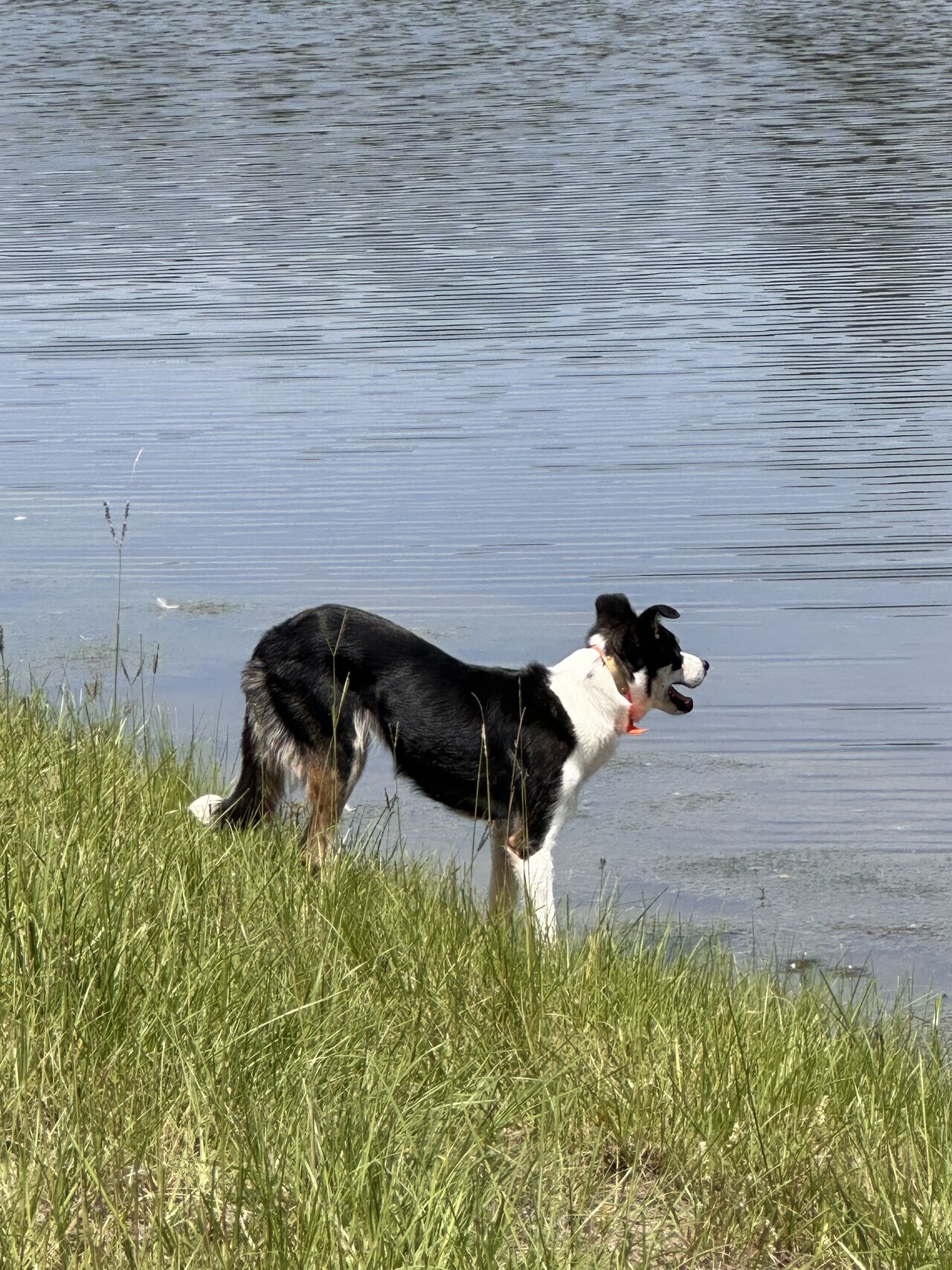
Almost every call about geese is described as a bird problem. It is not. It is a landscape problem that happens to have birds standing on it. A resident Canada goose is choosing your property against a short list of criteria, and once you know the list you can see why the pond behind one Aiken clubhouse is covered in droppings while a pond a mile away, the same size and age, has never held a goose.
The list is short grass to graze, an unobstructed view so the flock can watch for a predator, and water within a few steps to escape into. Mown turf running down to open water delivers all three — the geometry of a golf approach, a retention basin behind a subdivision, a campus quad with a stormwater pond, the lawn above a boat ramp. Geese did not invade those places. We built them, and the birds noticed.
What is a resident Canada goose actually selecting for?
Short grass. Geese graze, and they prefer turf that is fertilised, irrigated and cut. The greener the sward, the higher the protein, and the more birds an acre carries.
Sightlines. A goose on the ground manages risk by watching. Open ground with nothing to hide a coyote behind reads as safe. Break the sightline and it stops reading that way, which is why a waterline you cannot see over beats any device you can buy.
Water within a few strides. Water is the escape route. A bird that must first cross forty feet of tall vegetation to reach it will not settle there.
A resident flock is not attracted to Aiken, or to your address. It is attracted to one arrangement of turf, view and water, a design decision that can be reversed. Our parent page on Canada goose management sets out the full method, and the species profile sits in our Canada goose library entry.
Why can nobody give you an Aiken goose count?
Because nobody has published one, and we will not invent one for a bigger number.
A statewide figure does exist. The South Carolina Department of Natural Resources puts the resident Canada goose population above 50,000 birds and describes it as increasing, with the largest concentrations in the Upper Coastal Plain, the Piedmont and the Foothills. Aiken County sits on the Sandhills belt at the top of the Upper Coastal Plain, so that distribution points our way. That is an inference from a sourced statewide number, and we label it as one rather than dress it up as a local census.
The load-bearing word is resident. These birds hatch here, nest here and stay year round. A goose that leaves in March is a photograph; a goose that stays through August is a maintenance line item. The AIKEN 4 NE station records a last spring freeze near 22 March, a first fall freeze near 12 October, and 232 freeze-free days — nothing that forces a bird to leave.
Which water around Aiken actually fits the pattern?
The county has plenty of surface water and very little documented waterfowl habitat.
Langley Pond
Roughly 300 acres of former Horse Creek mill impoundment near Burnettown and Langley, 19 feet at most and only 4.9 feet on average. It carries a 2,000-metre, eight-lane buoyed rowing course that hosted pre-Games training in 1996 and still runs winter regattas, and the park side adds a beach, bathhouse, fishing pier and free boat ramp. Shallow water with lawn running into it is textbook goose geometry, and the ramp and beach are where droppings become a public problem.
Audubon’s Silver Bluff Center & Sanctuary
3,410 acres at Jackson with 2.6 miles of Savannah River frontage, about 50 acres of ponds and wetlands, and more than 200 recorded bird species including waterfowl and wading birds. It is the county’s only site with documented waterfowl, and it is a sanctuary — we do not work it and would not propose to. It matters as context: a managed property nearby competes against genuinely good habitat.
Golf course water
Woodside Plantation holds five lakes alongside two eighteen-hole courses, The Reserve by Jack Nicklaus and Hollow Creek by Fuzzy Zoeller and Clyde Johnston. Houndslake runs three nine-hole layouts from Joe Lee’s 1974 design, and Cedar Creek is an Arthur Hills course through gently rolling sand hills and pine forests. Palmetto Golf Club dates to 1892, but we cannot document its water features and will not describe them. Nor will we name which club has a goose problem.
Subdivision and HOA water
Aiken has a long list of neighbourhoods whose names announce their water: Gem Lakes, Mallard Lake, Summer Lakes, Graylyn Lakes, Johnson Lake Estates. We cannot document how many ponds sit inside each, so we will not print a count. What is clear is that a retention basin is engineered for exactly what geese select — a broad shallow bowl, a mown verge, clear approach lines — and the basins from Aiken’s 2000s build-out are mature enough to hold established flocks.
What geese ignore
Horse Creek falls fast off the fall line through eight mill villages. Moving water in a wooded corridor is not goose habitat, and neither is Black Gum Pond in Hitchcock Woods, because 2,100 acres of closed canopy is the opposite of a sightline.
The Sand River, which is not a river
People send us the Sand River as a goose question and it never is one. It is a dry sand channel, not a stream. It runs only after heavy rain, can form quicksand when it does, and serves as the outlet for Aiken’s urban stormwater — which is why it has gullied Hitchcock Woods and why the city has built storage and retrofit projects to control it. A channel dry most of the year offers no escape water and no grazing.
What does a trained herding dog actually do out there?
A border collie worked on geese presents the posture of a stalking predator: head low, shoulders down, eyes fixed, moving in an arc. Prey animals read that as a hunt about to happen. The dog does not catch a goose, is not asked to, and a handler who allows contact with a protected migratory bird has turned lawful harassment into a federal problem. The birds lift, circle and settle elsewhere.
Repetition makes it work, not drama. One visit produces a spectacular thirty seconds and no lasting result — the flock returns next morning and the owner concludes dogs do not work. What changes behaviour is being moved off the same shoreline again and again, at unpredictable hours, until the site is written off as unsafe.
The published evidence worth knowing comes from gulls rather than geese. A 2008 study in Environmental Management tested nine deterrent methods against three gull species at six landfills and found that methods carrying real consequence held their effect, while methods with nothing behind them faded as birds habituated. We will not claim geese never habituate to a dog — that is an overstatement the industry makes constantly, and this study is why we avoid it. The decay is simply far slower than for anything inanimate, and the window it buys is what you spend on habitat.
Why do the cheap deterrents stop working?
Because a goose is a long-lived, social, observant animal that watches for threats all day, and every static device eventually files itself under scenery.
| Method | What it does | Why it fades |
|---|---|---|
| Plastic coyote or owl decoy | Avoidance for a few days, sometimes weeks | It never moves, never approaches, never carries a consequence. Birds graze within a few feet of one by month’s end. |
| Reflective tape and flash deterrents | Brief startle on a bright, breezy day | No threat is attached to the stimulus, and habituation is the documented outcome for non-consequential deterrents. |
| Propane cannons and noise makers | Clears a field briefly after each report | Predictable timing teaches the flock the schedule. Near housing or a school it generates complaints faster than results. |
| Feeding bans with no enforcement | Correct policy, no effect | A sign changes nothing unless somebody actually asks people to stop. One household feeding bread can hold a flock by itself. |
| Herding dog plus habitat change | Moves the flock now and removes the reason it chose the site | The dog’s effect decays slowly and needs maintenance. The habitat change does not decay at all. |
None of these are frauds, and several have a narrow use inside a varied programme. The failure is selling one alone against an established flock.
What habitat changes hold after the dog goes home?
This is the only lever you control completely, and the one most people skip, because it changes how the property looks.
- Let a vegetated buffer grow at the waterline. An unmown band of grass and native planting between turf and water removes the grazing surface and blocks the escape route at once. Geese dislike walking through cover tall enough to hide something.
- Break the sightline with plantings. Shrub groupings, ornamental grasses and staggered small trees turn an open panorama into compartments. A goose that cannot see across the pond cannot post a lookout.
- Steepen the bank where you can. A gentle turf slope into water is a ramp built for waterfowl. A rip-rap or boulder margin does not read as an exit.
- Stop the feeding properly, not with signage. If your pond has a feeding culture, the buffer alone will not hold the line.
- Reconsider fertiliser and irrigation nearest the water. The most attractive grass on the property is usually the last twenty yards before the water.
- Accept the aesthetic trade. A manicured lawn running to a mirror of water is the most goose-attractive arrangement available. You can have that view, or a shoreline without droppings on it.
Where the buildings are the issue rather than the turf — roosting on a clubhouse roof, ledges above an entrance — that is bird exclusion, which is physical and permanent rather than behavioural.
Is it legal to run dogs at Canada geese?
Yes, and the reason is worth stating precisely, because this is where marketing copy gets loosest.
Canada geese are protected under the Migratory Bird Treaty Act, by name, at 50 CFR 10.13. That protection is real, not a technicality. What it prohibits is take — killing, capturing, possessing, or disturbing nests and eggs — not moving a bird along. The controlling language is 50 CFR 21.100: no permit is required merely to scare or herd depredating migratory birds. Harassment with a trained dog is exactly that. Now the boundaries.
- Nests and eggs are a separate regulation. Destroying, oiling or addling nests and eggs falls under 50 CFR 21.162 and requires federal registration or authorisation. A vendor offering to quietly handle a nest is offering you a liability.
- The general depredation order does not reach geese. 50 CFR 21.150 covers blackbirds, cowbirds, crows, grackles and magpies, and explicitly excludes geese, gulls, vultures, herons, egrets and doves. Anyone citing it at you over a goose has cited the wrong rule.
- The resident goose control orders are narrow. Dedicated orders exist for airports and military airfields at 21.159, agricultural facilities at 21.165 and public health at 21.168, plus the Special Canada Goose Permit at 21.120, each with its own eligibility conditions. A golf course is not an airport.
- State permits sit on top, not instead. SCDNR issues depredation permits free, valid 30 days and renewable, through its regional wildlife management and law enforcement offices, and notes that additional permits may be required for federally protected birds.
Contrast that with birds outside the Act. Rock pigeon, European starling and house sparrow are not protected at all — a legal difference with real operational consequences, which is why pigeons and European starlings are handled under an entirely different rule set from the geese on the same property.
When in the year does this matter most in Aiken?
- Late winter, before pairing. The best time to start and the least glamorous. Birds have not committed to a nest site, and moving them now is far easier than later. With the last spring freeze near 22 March, late January into February is the window to establish a programme.
- Nesting season, spring. Once a pair commits, harassment becomes less effective and more constrained: grazing birds can lawfully be moved, but the nest cannot be approached.
- The summer molt. Canada geese drop their flight feathers once a year in summer and spend several weeks flightless. A flightless bird cannot leave, so harassment then pushes birds around on foot without giving them the option to relocate. We adjust rather than pretend otherwise, and this is when droppings accumulate fastest.
- Late summer into autumn. Flight returns and birds re-evaluate the site, which makes this a strong window for intensive work. With the first fall freeze near 12 October and 232 freeze-free days, the grazing season runs long. The county averages 50.77 inches of rain on the 1991–2020 normals and a mean of 64.1°F, so the turf almost never stops.
- Winter. Resident birds stay, migratory birds may add to the numbers, and shoreline planting is easiest in the dormant season.
How does a Coastal K-9 goose programme run?
Site walk and habitat assessment first
Before a dog comes out we walk the water with you and map what the birds use: loafing areas, grazing turf, entry and exit points, and where the sightlines run. This is also the honest conversation about whether the property will accept a changed shoreline.
We agree the constraints
Play schedules on a course, regatta dates at a water venue, pool hours on a campus, walking patterns in an HOA. Harassment must happen at unpredictable times, a scheduling problem best solved before it becomes a complaint.
Intensive early visits
The opening phase is frequent and deliberately irregular, because the flock has a routine and the objective is to make it unreliable. Frequency in the first weeks decides the outcome.
The dog works, and never makes contact
Handler and dog work the shoreline and loafing areas in a stalking approach. Birds lift and leave, the dog is recalled. Nothing is caught or cornered, and no nest is approached.
We taper as use drops
Visit frequency falls as the birds stop using the site. Here a property that did the habitat work separates from one that did not: the first tapers to maintenance, the second needs the dog indefinitely, because nothing has changed about why the birds came.
Written recommendations and monitoring
Buffer widths, plantings, grading opportunities, feeding policy and where to cut turf inputs, specific to your shoreline. Bird use is logged across the season, and most sites need a return push once a year as flight returns after the molt.
What is included
- Initial site walk and a written habitat assessment of shoreline and adjacent turf
- Scheduled non-lethal harassment visits with trained herding dogs, irregular by design
- Handler-controlled work with no contact between dog and bird at any point
- A logged record of goose use, so the trend is documented
- Written habitat modification recommendations your grounds staff can act on
- Guidance on where a federal or state permit is and is not required
- Coordination with your superintendent, property manager or board
- Seasonal return visits and a maintenance schedule once the flock moves
- A clear statement of what we will not do — nests, eggs, take, or anything needing an authorisation we do not hold
What do golf courses and HOA ponds need that a back garden does not?
Scale, scheduling and a paper trail.
On a course the damage is not primarily aesthetic. Clemson Extension’s Savannah Valley District puts droppings from geese on small ponds at two to four pounds per bird per day, and notes that the birds compact soil and kill turf by overgrazing. Across a resident flock landing on greens, approaches and cart paths, that is a labour cost before it is anything else. Overgrazed turf on a bank also starts an erosion problem, and the soils here are quartz sand with rapid permeability — the Lakeland series through this belt is classified as excessively drained. Bare sand on a pond bank does not stay put.
An HOA faces a different pressure. The complaint arrives at a board meeting, the board has a fiduciary duty and no wildlife expertise, and the two loudest positions in the room are usually do something drastic and do nothing. A documented non-lethal programme with a written habitat plan answers both, and our HOA and golf course goose management programme is built around that. What we ask is honesty about the landscaping: a club that will not let a buffer grow is buying a permanent dog contract.
What about rowing venues, swim decks and walking paths?
Langley Pond is the clearest local example of the problem shape. A buoyed racing course brings crews to a launch area, and the park side has a beach, a fishing pier and a boat ramp. Each is a hard surface at the water’s edge with mown lawn behind it — a goose loafing area with a public use bolted onto it. Droppings on a ramp are a slip hazard, on a pool deck a complaint, and on a path they get tracked into cars and houses.
On water quality we will be careful, because this is a claim people overstate. Clemson Extension’s regional guidance reports that fecal bacteria counts in goose droppings run roughly 25 times those of human waste. That is a sourced statement about the material, not a statement that any particular Aiken water body has a bacterial exceedance — we found no published sampling for a specific local pond. What is fair: where people swim, launch boats or put hands in the water, waterfowl faeces concentrated on the shoreline is a legitimate consideration. Langley Pond does carry a state fish consumption advisory, which is a separate contaminant issue entirely.
Where else does this come up around Aiken?
Any property combining maintained lawn, a stormwater feature and foot traffic, which in a growing county means most institutional sites. USC Aiken exceeded 4,200 students in autumn 2025 with residence halls at capacity and more than 900 living on campus. Aiken Regional Medical Centers carries 273 licensed acute-care beds and over 1,200 employees, and a hospital entrance is not where anyone wants a slip hazard. The county school district runs 41 schools with nearly 23,000 students. Senior communities such as Cumberland Village deserve a mention, because a slip on a wet path is not theoretical at eighty. Where a goose issue sits alongside a rodent issue at the same pond edge, that is canine rodent detection.
Who regulates this work in South Carolina?
Two authorities, and neither is the one people expect. Wildlife sits with SCDNR at state level and the US Fish and Wildlife Service federally. SCDNR depredation permits are free, run 30 days, renew, and issue through the regional wildlife management and law enforcement offices, with the agency flagging that additional federal permits may be required for federally protected birds. Non-lethal harassment of the kind described here requires neither, under 50 CFR 21.100.
Pesticide work is a different regime. In South Carolina it runs through the Clemson University Department of Pesticide Regulation rather than a state agriculture department, under category 7A, with a business licence, a Designated Certified Applicator at each location, and liability cover of at least $100,000 combined single limit. That governs chemical turf repellents, not running a dog. Across the river, structural work runs through the Georgia Department of Agriculture instead.
Where we work around Aiken
Our base is 320 Wendy Lane, Windsor, SC 29856, roughly twenty minutes from downtown Aiken. We cover the City of Aiken and its subdivisions — Woodside Plantation, Houndslake, Cedar Creek, Gem Lakes, the Kalmia developments, Three Runs Plantation, Summer Lakes and Mallard Lake — plus the Winter Colony districts, the Horse District, Schofield and the Parkway District, and the 1950s Savannah River Site subdivisions at Crosland Park, Virginia Acres and Forest Heights. Beyond the city we work Graniteville, Warrenville, Gloverville, Langley, Burnettown, Bath and Clearwater through the Horse Creek Valley, plus Montmorenci, Beech Island, Jackson and New Ellenton. See every area we serve.
Goose work also runs in North Augusta, Columbia and Lexington. Where a site needs a raptor rather than a herding dog — gulls and grackles at outdoor dining — that is falconry bird abatement. If the property also has a bed bug question, our Aiken canine bed bug work covers it.
Frequently asked questions
Will the dog hurt the geese?
No. A trained herding dog presents the posture of a stalking predator and is recalled before contact is possible. Nothing is caught, injured or cornered, and no nest is approached. That is a legal requirement as much as an ethical position: Canada geese are protected under the Migratory Bird Treaty Act, and this work is lawful without a permit because the birds are moved rather than touched.
How many visits will it take?
More than one, and that is the honest answer. A single visit moves the flock for a morning. Changing an established routine takes frequent, irregular visits across weeks, because what you are teaching is that the site is unreliable rather than dangerous on one particular Tuesday. Properties that modify the shoreline taper to maintenance. Properties that change nothing keep the dog indefinitely.
Do I need a permit to have geese moved off my property?
Not for non-lethal harassment. 50 CFR 21.100 states that no permit is required merely to scare or herd depredating migratory birds, and working a dog without contact sits inside that. Permits become relevant the moment anything touches a nest, an egg or a bird — those fall under separate provisions, including 50 CFR 21.162.
Can you addle eggs or remove nests for us?
Not as part of this service. Nest and egg work for resident Canada geese requires federal registration or authorisation under its own regulation, with its own reporting conditions. We would rather say plainly that it is outside our scope than take the job and improvise. If nest management is what a site genuinely needs, the route runs through the US Fish and Wildlife Service.
Why will a plastic coyote not do this for a tenth of the cost?
Because it never does anything. Geese are long-lived, social and observant, and a stimulus with no consequence behind it becomes background within days. The deterrent research is consistent: methods carrying a real consequence hold their effect, and methods that do not decay as birds habituate. Sold alone against an established flock, decoys fail.
Are the geese on my HOA pond even resident birds?
Almost certainly, if they are there in July. Resident Canada geese hatch, nest and live here year round rather than following a flyway schedule, and they are the population SCDNR puts above 50,000 statewide and calls increasing. Migratory birds may swell winter numbers, but the flock creating a summer maintenance problem is nearly always resident.
How much habitat change is enough?
Enough to break at least two of the three things the birds select for. A vegetated buffer at the waterline removes the grazing surface and the escape route at once, which makes it the highest-value single change. Add plantings that interrupt the view across the water and the site becomes genuinely uncomfortable. What is never enough is a device on a post with unchanged turf behind it.
Does this work in summer when the birds cannot fly?
It works differently, and we say so in advance. Canada geese drop their flight feathers once a year in summer and are flightless for several weeks. Harassment then moves birds around on foot but cannot offer them the option of leaving the property, so expectations have to be set accordingly. The strongest windows are late winter before pairing and late summer once flight has returned.
Can you clean up the droppings already on the ramp?
Clean-up is a separate trade and we will say if a site needs it, but the point of the programme is that it stops being a weekly line item. Clemson Extension’s regional figures put goose droppings on small ponds at two to four pounds per bird per day. What you spend on cleaning scales directly with how many birds stand on your shoreline.
Do you handle pigeons and starlings on the same site?
Yes, and it is a different job under a different rule set. Rock pigeon, European starling and house sparrow are not protected under the Migratory Bird Treaty Act, so the constraints governing goose work do not apply. Structural birds are usually an exclusion problem rather than a harassment one — netting, ledge modification, sealing entry points. Our Aiken bird control and exclusion pages cover it.
Related services
Geese on your pond, your course or your ramp?
Tell us the water, the acreage and how many birds you are seeing. We will walk the shoreline, tell you what the site is offering them, and give you a written plan pairing dog work with the habitat changes that make it stick. Serving Aiken, Langley, Burnettown and the Horse Creek Valley mill villages, out of Windsor, South Carolina.