
Goose Control in Columbia, SC
Three rivers meet in Columbia, and the geese that cause trouble here are almost never on them. They sit on campus, hospital and neighborhood ponds, where mown lawn runs down to still water. Coastal K-9 & Pest Solutions moves resident Canada geese off those shorelines with trained herding dogs, then reshapes the edge so the flock stops choosing it.
The Broad and the Saluda meet in Columbia to form the Congaree, a river of roughly fifty-three miles that drains both watersheds before joining the Wateree to make the Santee. Very little of our goose work happens on that water. A river moves, and a current is not what a grazing bird wants underneath it. The calls come from ponds instead.
Ponds are what a capital city builds. Stormwater must be detained somewhere. A campus wants a water feature in a lawn, and an apartment community markets an amenity lake. Every one arrives with turf mown to the edge, and that detail, rather than anything peculiar about Columbia’s bird life, is why the phone rings.
Why does a state capital produce so many goose calls?
Because government, higher education and healthcare all build the same landscape, and that landscape is what a resident Canada goose is shopping for.
Consider what the bird needs. It grazes, so it wants grass short, green and fertilised. It manages risk by watching, so it wants a long clear view and nothing nearby large enough to conceal a coyote. It escapes by swimming, so it wants water within a few strides. Assemble those three and you have described a detention basin behind an office park, a quad with a pond at its centre, an amenity lake at a leasing office, and the ground beside a cart path.
None of it was designed for waterfowl. It was designed for drainage, for a view from a window, for a photograph in a brochure. Geese read the site more literally than the designer did. Richland County’s two largest employment sectors are Health Care and Social Assistance at 33,974 jobs and Public Administration at 24,376 — 15.3 and 11.0 percent of county employment. Those are the industries that build campuses with ponds on them. The underlying method is set out on our parent page, Canada goose management; the biology sits in the Canada goose library entry.
Where is the water around Columbia, and which of it matters?
Plenty of surface water, and only a fraction of it in the shape geese select. What follows is geography, not an allegation. No source names a Columbia water body with a goose problem, we name no club, and we will not invent one. Harbison State Forest is the counter-example: closed canopy over Broad River bluffs that flood several times a year is the opposite of what a goose wants.
The confluence and the Columbia Canal
The Congaree begins where the Broad and Saluda meet near the Fall Line and runs about fifty-three miles as the outlet for both. Beside it lies the Columbia Canal, cut between 1820 and 1824, redesigned in 1888 and reopened in 1891 at roughly 3.5 miles. It was breached in the catastrophic flooding of early October 2015, and as of February 2024 the repair was still in planning despite funding approved in 2021.
Lake Murray, which is not a Columbia lake
SCDNR records Lake Murray at 48,579 surface acres with 620 miles of shoreline, spread across Lexington, Newberry, Richland and Saluda counties, impounded in the late 1920s behind a dam 1.6 miles long. It sits at the edge of the metro, not inside the city. Where a flock originated matters far less than what your own bank offers it.
Sesquicentennial State Park
A 30-acre fishing lake inside 1,419 acres of Sandhills park about twelve miles from downtown, with 12 miles of trails, created after Columbia’s 1936 sesquicentennial. Maintained shoreline plus heavy foot traffic turns a wildlife question into a housekeeping one.
The riverfront and the greenway
Riverfront Park sits on the Columbia side, and the City’s parks department pictures the diversion dam at its northern end. Across the water the Three Rivers Greenway threads through Cayce Riverwalk Park and the Timmerman Trail to the West Columbia Riverwalk Park and Amphitheater. The pattern is what counts: paved path, mown verge, open water, repeated for miles.
Institutional and HOA retention ponds
This is the day-to-day work, and the category with the least published information. No inventory of Columbia’s stormwater ponds, campus water features or association basins exists in any source we could reach, so we give no count and name no pond. What we can say is structural: a detention basin is a broad shallow bowl with graded turf banks and clear approach lines, which is goose habitat arrived at by accident.
Are the birds on your pond residents or migrants?
If they are still there in July, they are residents, and that one word changes the whole problem.
Resident Canada geese hatch, pair, nest, moult and winter inside a small home range, and will not solve anything by leaving in spring. SCDNR puts South Carolina’s resident population above 50,000 birds and calls it increasing, with the greatest concentrations reported for the Foothills, the Piedmont and the Upper Coastal Plain. Richland and Lexington Counties straddle the Fall Line between those regions, so the distribution points this way — an inference from a statewide number, labelled as one rather than a local census.
Climate explains why residency sticks. The state climatologist’s station normals give Columbia Metro Airport a last spring freeze of 1 April and a first fall freeze of 13 October, 236 freeze-free days. The Columbia University of SC station, downtown, records 26 February and 26 October — 261 days. That twenty-five day gap between two stations in one city is measured, not modelled. A long warm season and open water that rarely locks up gives a bird no reason to leave.
Which Columbia properties carry the most exposure?
The ones with the most maintained lawn, the most foot traffic and the least tolerance for a slip hazard — a short, heavily institutional list.
University campuses. USC enrolled 38,504 students on its Columbia campus in fall 2024, across more than 359 downtown acres, with roughly three quarters of them living off campus against 9,243 assignable beds. Two exposures overlap: institutional lawns, and the apartment communities absorbing everyone else. Columbia is a majority-renter city — 45.5 percent owner-occupied against 53,076 households — and rental communities compete on amenities, which often means a pond.
Hospital campuses. Prisma Health Richland operates 641 beds plus 124 at its affiliated Heart Hospital, and it is a Level I Trauma Center and the sole regional referral centre for the Midlands. An entrance, an ambulance approach and a walking loop are the last places for droppings underfoot.
Fort Jackson. More than 52,000 acres inside the city limits since annexation in 1968, training roughly 43,000 service members a year. We name it as scale, not a client.
The convention district. The Columbia Metropolitan Convention Center opened in September 2004 with 142,500 square feet, next to Colonial Life Arena in the Congaree Vista. Plazas, hardscape and event lawn near the river are where droppings stop being a grounds problem and become a guest-experience one.
Associations and clubs. A board carries a fiduciary duty, a complaint at a meeting and no wildlife background. That is the situation our HOA and golf course goose management work was designed around; multi-site portfolios go through commercial pest control.
What is the dog actually doing, and why does one visit fail?
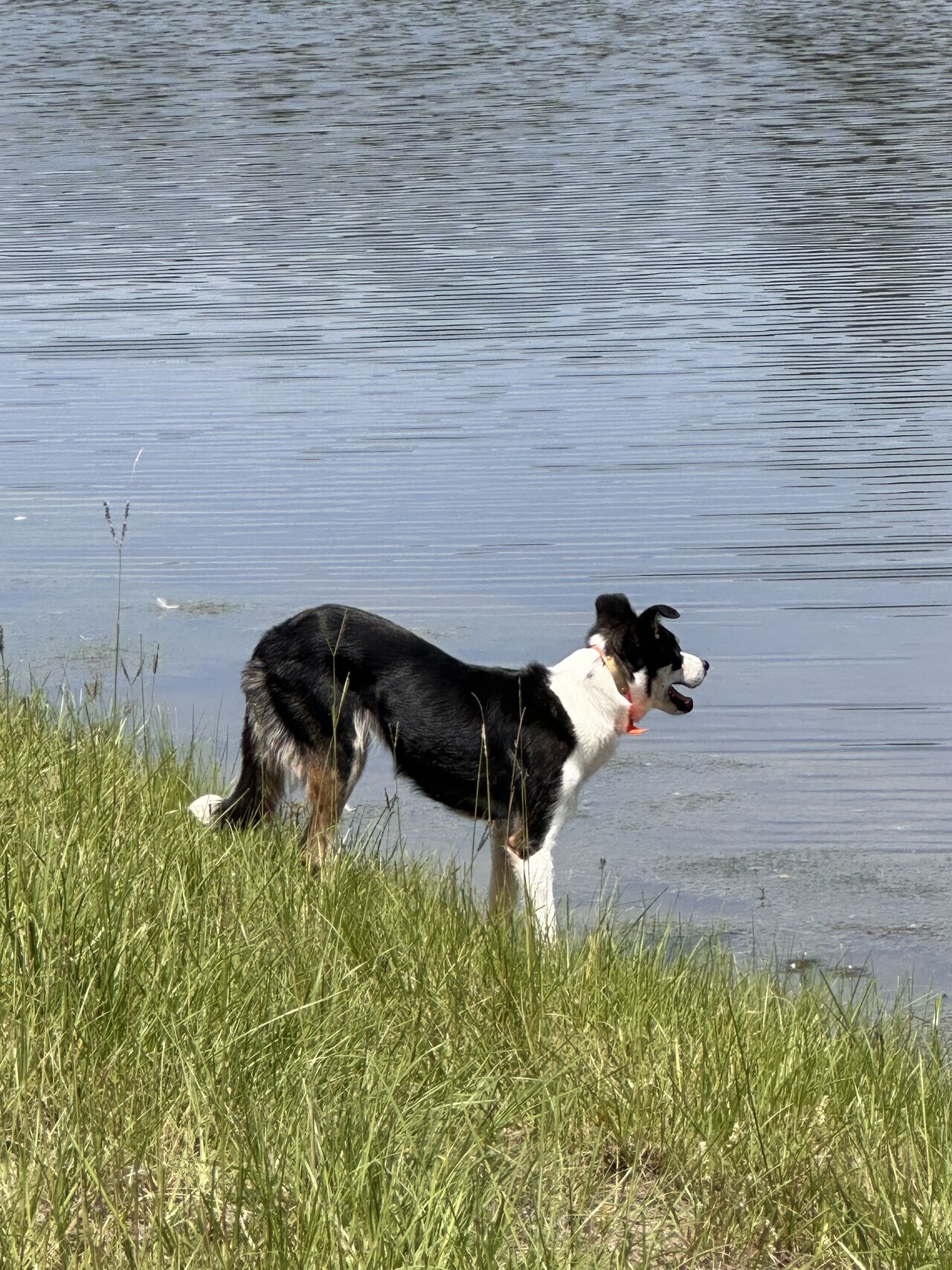
The dog communicates one message: a predator is hunting here. A border collie worked on waterfowl drops its head below the shoulder line, fixes its eyes and moves in on an arc. Geese are prey animals with long memories for danger, and they read that shape without having to learn it.
Nothing is caught. The dog is not trained to make contact and is not permitted to, and a handler who allows it has converted lawful harassment into a federal problem. Recall discipline, and judgement about where birds are pushed, matter more than anything at the water’s edge.
Geese hold a daily routine, and a single visit interrupts one instance of it. The flock returns next morning, the manager concludes dogs are theatre, and the programme dies early. Behaviour changes through repetition across days and weeks, at hours the birds cannot anticipate, until the site stops reading as reliable. Frequency in the opening fortnight most predicts the outcome.
We will not tell you geese never habituate to a dog. That claim is common in this trade and it is an overstatement. A 2008 paper in Environmental Management tested nine deterrent techniques against three gull species across six landfills, and found methods backed by real consequence held up while methods without one faded. A live predator belongs in the first category, so the fade is gradual — gradual, not absent, and the time it wins you is time to spend on the shoreline.
Which deterrents underperform when they are the whole plan?
Nearly all of them, and the reason never varies. Geese live a long time, watch one another, and re-price risk continuously, so anything that threatens without ever delivering ends up as furniture.
| What gets bought | What it delivers | Why it stops delivering |
|---|---|---|
| Coyote or owl statue at the bank | Some avoidance for days, occasionally weeks | It has never once approached a bird. Give it a month and geese feed alongside it. |
| Reflective streamers and spinners | A brief startle in sun and wind | The movement is random and consequence-free, so attention to it simply stops. |
| Bangers, sirens and sonic units | Open turf clears for a few minutes per firing | Fixed intervals teach the timetable, and near housing complaints arrive faster than results. |
| Grape-extract turf repellent | Less grazing on treated grass while residue lasts | Rain and mowing take it off, and loafing birds still foul the pavement. |
| A feeding rule with nothing behind it | Sound policy, very little movement | It withdraws a supplement and leaves acres of forage. Your lawn is the meal. |
| Dog work paired with a rebuilt edge | Relocates the flock now, removes the reason it settled | The dog effect needs renewal. The change to the ground never needs repeating. |
None of these are frauds, and rotating several slows habituation more than leaning on one. The failure is buying a single tool and expecting it to beat a settled flock.
How do you rebuild an edge so the result holds?
Habitat is the only lever an owner controls outright; everything else depends on a vendor or somebody’s compliance. Break two of the three things the bird came for and the site stops competing.
- Leave the last band before the water uncut. Grass and native planting allowed to stand there erase the grazing surface and close the walk-out together. Nothing else here returns as much, and it costs less than any product, being labour you subtract rather than add.
- Break the view into compartments. Grouped shrubs, ornamental grasses and staggered small trees replace one open panorama with several partial ones, and a flock unable to post a sentry treats the ground as risky.
- Change the grade at the margin. A gentle turf slope into water is a boat ramp for waterfowl. Facing the edge with stone deletes the easy exit.
- Pull the inputs back from the bank. The best forage on most properties is the last twenty yards of irrigated, fertilised turf before the water, and less nitrogen there means lower protein.
- Treat the buffer as design, not neglect. Height and continuity are what matter biologically; a crisp mown edge behind the planting is what stops a board calling it a missed mowing.
- Make the trade consciously. Nothing in Southeastern landscaping suits a goose better than clipped lawn meeting a flat sheet of water. That view and a clean bank are alternatives, not a package, and a property declining to pick one pays for visits forever.
Where birds are on the buildings instead of the grass — a parapet, a canopy, a ledge — the answer is hardware rather than behaviour. That is bird exclusion, covered further on our Columbia bird control page.
Should your property ban feeding, and what should you check first?
As a management principle, yes. Handouts concentrate birds exactly where people walk, and one determined household can undo everything else a board attempts. A written no-feeding rule in the covenants, backed by somebody willing to have the conversation, is worth having.
Two cautions come with it. The first is scope: bread and corn are a supplement, not the diet. Canada geese graze, and irrigated, fertilised lawn is high-protein forage available here most of the year. Ending the feeding removes a concentration point, but the food supply is the turf, and the turf is still there next morning.
The second is legal. We have not read the current City of Columbia code on feeding wildlife, so we do not tell you what it says in either direction — we would rather report that than guess. Anyone building a programme should check the current municipal code and their own HOA covenants, lease terms or campus policy. What governs a public park is frequently not what governs a private basin.
What does federal law actually permit here?
The Canada goose is a species the Migratory Bird Treaty Act covers, named at 50 CFR 10.13, and anyone who shrugs that off should worry you. The conduct barred is take — killing, capturing, possessing, or meddling with nests and eggs. Persuading a bird to stand somewhere else is none of those things. The governing text is 50 CFR 21.100, which says no permit is required "merely to scare or herd depredating migratory birds." A dog that never closes the distance works inside that provision. The edges are worth knowing exactly.
- Nests and eggs answer to a separate rule. Addling, oiling or destroying them sits under 50 CFR 21.162, with federal registration or authorisation and reporting attached. A contractor who offers to deal with a nest discreetly is transferring liability to you, not absorbing it.
- The general depredation order stops short of geese. The species named in 50 CFR 21.150 are magpies, grackles, crows, cowbirds and blackbirds. Doves, egrets, herons, vultures, gulls and geese are all excluded, so anyone citing that order at you over a goose has opened the wrong rule.
- The resident goose control orders are deliberately narrow. Section 21.120 carries the Special Canada Goose Permit; 21.168 addresses public health; 21.165 covers agricultural facilities; 21.159 applies to airports and military airfields. A campus lawn answers to none of those descriptions.
Set that against the species the Act omits. Three birds routinely found on the same site — the rock pigeon, the European starling, the house sparrow — hold no federal status whatever, and the options open on them are correspondingly wider. Our pigeon and European starling profiles set out the difference. For gulls or grackles working an outdoor terrace, the usual answer is falconry bird abatement.
How does the goose year run in the Midlands?
- Deep winter, before pairs commit. January and early February are the strongest and least popular time to begin. Nothing is defended yet, birds stay movable, and a programme started now shapes the breeding season.
- Nesting, spring. Once a pair settles, the options shrink. Birds out grazing may still be moved lawfully; the nest itself is off limits. Beginning in this window means slower going, and we say so before the job starts.
- The moult, early summer. Once each year the birds drop their flight feathers, and for several weeks afterward they cannot get airborne. A bird that cannot fly cannot leave, so harassment reshuffles the flock on foot rather than relocating it. Droppings accumulate fastest then, which is when most first calls arrive.
- Late summer into autumn. Flight returns, the flock reassesses where it wants to live, and this is the most productive push of the year. Richland County averages 47.75 to 48.11 inches of rain and a mean of 66.5°F on the 1991–2020 normals, with about 76 days a year above 90°F against 30 on the coast.
- Late autumn. With a first fall freeze near 13 October at the airport and 26 October downtown, growth carries on past the point most people expect. Dormant season is right for planting and grading, so the habitat work and the calendar line up.
What does a Coastal K-9 programme look like week by week?
The water gets walked before any dog arrives
We map how the flock uses the site: where it loafs, where it feeds, how it enters and leaves the water, what it can see from the bank, and which stretch generates complaints. This is also the candid conversation about whether the property will accept a changed edge.
Constraints are settled up front
Clinic hours, class changes, event dates in the Vista, pool schedules, peak trail use. Harassment must be unpredictable to the geese and predictable to your staff.
Early visits cluster and vary
The opening phase is deliberately frequent and irregular. The goal is not one impressive morning; it is making the flock’s routine unreliable enough that the site loses its appeal.
Handler and dog work the edge, then stop short
The dog works the loafing ground and the bank, birds lift and go, and the recall comes before anything closes. No bird is cornered, no nest is walked up on, and nothing is pushed toward traffic or a car park.
Every visit goes on the record
Counts, locations and behaviour are logged each time, so a board or facilities director has a trend line rather than competing impressions.
Visits taper and the written plan takes over
You receive buffer widths, planting options, grading opportunities, turf input changes and a feeding policy written for your bank. Most sites then need one renewed push a year, once flight returns after the moult.
What is included
- Non-lethal harassment visits using trained herding dogs, scheduled irregularly on purpose
- Work kept under handler control, with dog and bird never in contact
- Shoreline recommendations written for a grounds crew or landscape contractor
- Straight answers on which federal and state authorisations bear on your site
- The boundaries stated in advance: no nests, no eggs, no take, nothing needing an authorisation we do not hold
What happens where droppings meet a public surface?
Clemson Extension’s Savannah Valley District reports that geese on small ponds produce two to four pounds of manure per bird each day, and that the birds compact soil and kill turf through overgrazing. Across a resident flock, that is a standing labour line. On a walking loop it travels into cars on shoe soles. On a pool deck or a plaza it is a complaint the same afternoon. On a cart path or boat ramp, wet and trodden, it is a slip exposure. Overgrazed bank turf then thins, and this is Sandhills country — quartz sand, the Lakeland series classified as excessively drained. Bare sand on a slope above water does not stay where it was put.
On water quality we are careful, because this is the claim the industry inflates hardest. Clemson Extension’s regional guidance puts faecal bacteria counts in goose droppings at roughly twenty-five times the level in human waste. Read that as a property of the material and nothing more. It does not establish that any pond, lake or river reach here exceeds a bacterial standard, and no published sampling for a specific local water body surfaced in our research, so none is cited here. The defensible version is smaller: droppings concentrated on a bank that people swim from, launch from or sit beside are worth managing.
Who licenses this work in South Carolina?
Two separate authorities, and neither is the one most people name first.
Start with wildlife. Administration of the Migratory Bird Treaty Act belongs to the US Fish and Wildlife Service. At state level SCDNR issues depredation permits at no cost, good for thirty days, renewable, out of its regional wildlife-management and law-enforcement offices, with a warning that federally protected species may require more. Herding without contact calls for neither permit, under 50 CFR 21.100.
Pesticides run through a different door. In this state the licensing authority for structural, institutional and health-related work is the Clemson University Department of Pesticide Regulation, not an agriculture department. Under category 7A a firm holds a business licence, posts a Designated Certified Applicator at every location, and carries commercial general liability of $100,000 combined single limit or more, with no deductible above $1,000. That framework governs chemical turf repellents and structural work, not a dog, and a company that cannot explain the difference is not the one to hire.
Where we work in and around Columbia
Coastal K-9 & Pest Solutions operates from 320 Wendy Lane, Windsor, SC 29856; the Midlands is a straightforward run north. In the city we cover Shandon and Old Shandon, Rosewood, Heathwood, Forest Hills, Earlewood, Elmwood Park, Cottontown and Bellevue, Eau Claire, Hyatt Park, Arsenal Hill, Historic Waverly, Wales Garden, Melrose, Hollywood-Rose Hill, Sherwood Forest, Druid Hills, Kilbourne Park, Lake Katherine, Granby Hill, Olympia, The Vista, University Hill, Seminary Ridge, Grove Park, Tanglewood, Kings Grant, Historic Trenholm-Buchanan, Lincoln Park and Greenview. See every area we serve.
Outside the city limits we work the Richland County side toward Sesquicentennial and Harbison, and the Lexington County side through Cayce, West Columbia, Irmo and Lexington. Where a pond edge has a rodent issue alongside the waterfowl, that is canine rodent detection, and student housing, hotels and multifamily buildings are covered by our Columbia canine bed bug work.
Frequently asked questions
Did our geese come from Lake Murray?
Possibly, and it does not change the plan. Lake Murray covers 48,579 acres with 620 miles of shoreline across four counties, and sits at the edge of the metro rather than inside Columbia. Resident geese range locally and settle wherever the ground suits them. Chasing a flock’s origin is interesting; what your own shoreline offers is what produces a result.
How quickly should we expect to see fewer birds?
Movement usually shows inside the first fortnight, but the number that matters is how the site looks after two months. An established flock keeps a routine measured in seasons, and undoing it takes repetition at unpredictable hours until the ground stops feeling safe. Properties that also change the shoreline taper to maintenance; those that change nothing keep buying visits.
Do we need a permit before you start?
Not for non-lethal harassment. Under 50 CFR 21.100 no permit is required merely to scare or herd depredating migratory birds, and a dog that never touches a bird falls inside that. Permits become relevant the instant anything involves a nest, an egg, capture or take. If your situation calls for that route, it runs through the US Fish and Wildlife Service.
Can you work a hospital or campus pond without disrupting operations?
That is a scheduling problem and we treat it as one. Ambulance approaches, clinic hours, class changes and pool times are mapped before the first visit. Timing stays unpredictable to the geese while remaining fully known to your staff, and we agree in advance which directions birds may be pushed toward and which are off limits.
There is a nest on the island in our basin. Can you deal with it?
Not through this service. Anything done to a nest or its contents falls under 50 CFR 21.162, which carries its own registration or authorisation requirement. We would rather tell you it is outside our scope than improvise around a protected species. Harassment of grazing birds continues lawfully while a nest is active, provided the nest is left alone.
How wide does the unmown buffer need to be?
No honest answer is a single number, and we found no Columbia-specific prescription worth quoting. What governs the effect is height, density and continuity: vegetation tall enough that a goose cannot see over it, thick enough that walking through is unattractive, and unbroken enough that no gap exists. A buffer with a mown gap is a doorway, and the birds find it within a day.
Our board wants to try a laser or a drone first. What should we expect?
An initial response, then a decline, on the same logic that governs every other deterrent. Devices producing no consequence get reclassified as scenery by a long-lived, observant bird. These tools have a place inside a varied programme. Sold as the whole solution against a settled flock with unchanged turf, they disappoint.
Can you handle pigeons or starlings on the same site?
Yes, though it is a separate discipline. Neither species holds federal status, nor does the house sparrow, so none of the limits described above applies to them. Birds on structures are dealt with physically rather than behaviourally: netting, altered ledge angles, sealed openings. The dog plays no part in that work at all.
Related services
Geese on your campus pond, your basin or your riverfront lawn?
Tell us how much water you have, how much bank is mown to the edge, and how many birds use it. We will walk the bank, explain what your ground is offering them, and put a plan in writing that ties dog work to the changes that hold. Serving Columbia, Cayce, West Columbia, Irmo and Lexington from Windsor, South Carolina.