
Goose Control in Lexington, SC
Lake Murray hands Lexington 620 miles of shoreline, and a great deal of that edge is lawn cut straight to the water. Coastal K-9 & Pest Solutions puts trained herding dogs on resident Canada geese at lakefront lots, subdivision basins and club turf here, then reshapes the edge so the flock stops picking it.
Two numbers carry most of the goose problem in this town. One is 620, the miles of shoreline SCDNR records for Lake Murray across Lexington, Newberry, Richland and Saluda counties. The other is 2002, the median year a housing unit inside the town of Lexington was built.
A very large reservoir and a very young suburb yield the same product: edge, where clipped grass meets standing water. Edge is what a resident Canada goose shops for. It is indifferent to a postcode or a set of covenants, and nearly every acre of what it wants here was built on purpose.
How much lawn-to-water edge does this area really have?
More than anywhere else we work. SCDNR’s Lake Murray brochure gives 48,579 acres of surface water, 620 miles of shoreline, an average depth of 41.5 feet and a maximum near 200, across Lexington, Newberry, Richland and Saluda counties. The impoundment sits behind a dam 1.6 miles long and feeds the 205 MW Saluda hydroelectric station.
Shoreline length measures interface. Every mile is a mile where an upland owner decides what the last thirty feet before the water look like, and the customary answer is turf, mown short, running to a bulkhead or a sand edge with a dock beyond.
Most of that edge is neither town property nor public. Dominion Energy administers the reservoir under FERC Project No. 516, and the 360-foot contour marks normal maximum pool and, along much of the lake, the boundary between utility and upland owner. Of the public access sites the utility lists, two are labelled by county: the Park Site on the Lexington side at 17.9 acres, and the Dam Site on the Irmo side at 6.8. The method behind our work is on the parent page for Canada goose management, and the species account is in the Canada goose library entry.
What does a lakefront lot look like from the bird’s side?
Like a solved problem, which is exactly the difficulty. A grazing goose needs three conditions met at once. It eats grass, so it wants a sward short, green and preferably fertilized. It survives by watching, so it wants a view holding nothing large enough to hide a coyote. It escapes by swimming, so it wants water reachable in a few strides.
Now describe the standard Lake Murray lot. Lawn maintained to the top of a bulkhead, or to a shallow sandy margin. A dock or boat lift beyond it. No screening planting at the waterline, because screening blocks the view everybody paid for. Open water in front, and in the Midlands water that does not lock up in winter. All three conditions inside about thirty feet, which is why one house holds birds while a neighbor with a wooded bank and a rip-rap face never sees them on the ground. The dock compounds it, being a loafing platform with clear approaches on every side and instant escape underneath.
Why does a town built after 1990 hold so much of this habitat?
Because the drainage rules changed, and the drainage rules built the ponds. ACS tables for 2020 to 2024 put the town’s median year of construction at 2002, while Lexington County as a whole sits at 1993. Of the town’s 10,348 housing units, 80.3 percent went up in 1990 or later and only 9.5 percent predate 1980.
Subdivisions of that vintage arrive with engineered stormwater management, which here usually means a retention basin holding an amenity pond. Consider what a basin has to be: a broad shallow bowl, banks graded gently enough to mow safely, an unobstructed perimeter, a maintained turf apron. Nobody set out to build waterfowl habitat. The specification simply matches the bird’s requirements almost item for item.
The Town’s own GIS subdivision layer lists 93 named developments, and many announce their water: Barr Lake, Carriage Hills Lake, Coventry Lake, Mallard Lakes, Whiteford Lakes, Whisperlake, Lakeside at Woodcreek, Shoal Creek, Royal Creek, Bent Creek, Creekside Farms, Saluda Springs, Woodstream. No count of stormwater ponds inside the town limits was obtainable, so we print none rather than estimate one.
Which local water fits the pattern, and which does not?
What follows is geometry, not an accusation. No published source identifies a Lexington water body as having a goose problem, and we name no association or club as either a client or a complaint.
The Lake Murray shoreline
The main event and the least uniform. Coves with steep wooded banks hold almost nothing on the ground; cleared lots with turf to the bulkhead and a wide view generate the calls. Because the shoreline crosses four counties and much of it lies outside any municipal boundary, two neighbors a quarter mile apart can sit under different local rules.
Subdivision retention basins
The bulk of the day-to-day work, and a manufactured version of what the lake offers naturally: mown turf all the way round, a path, a bench, clear approach lines. Basins built in the 1990s and early 2000s are now mature enough to hold breeding, year-round flocks.
Gibson Pond Park and Old Mill Pond
Gibson Pond Park sits at 241 Gibson Road, where fishing runs under state rules, gas-powered watercraft are banned and swimming is prohibited. Old Mill Pond Trail runs from 711 East Main Street.
Twelve Mile Creek and Fourteen Mile Creek
Twelve Mile Creek is gauged: USGS station 02168810 at Lexington, hydrologic unit 03050109. Fourteen Mile Creek carries a 3,500-foot Town trail off North Lake Drive and Old Cherokee Road, and it floods. Both are poor goose ground, because moving water in a wooded corridor offers a grazing bird nothing it wants.
Golden Hills Golf and Country Club
One hundred Scotland Drive: eighteen holes, par 71, 6,426 yards. It is the single golf facility we could verify at a Lexington town address. We could not document its water features, so we describe none.
What we will not attach to this town
Timberlake Country Club is a genuine Lake Murray club, but its address is in Chapin, roughly eighteen road miles from downtown, so calling it a Lexington course would be wrong. Several neighborhood names that come up locally appear nowhere in the Town’s own 93-name layer, so we leave them out.
What is the dog doing, and why does one visit fail?
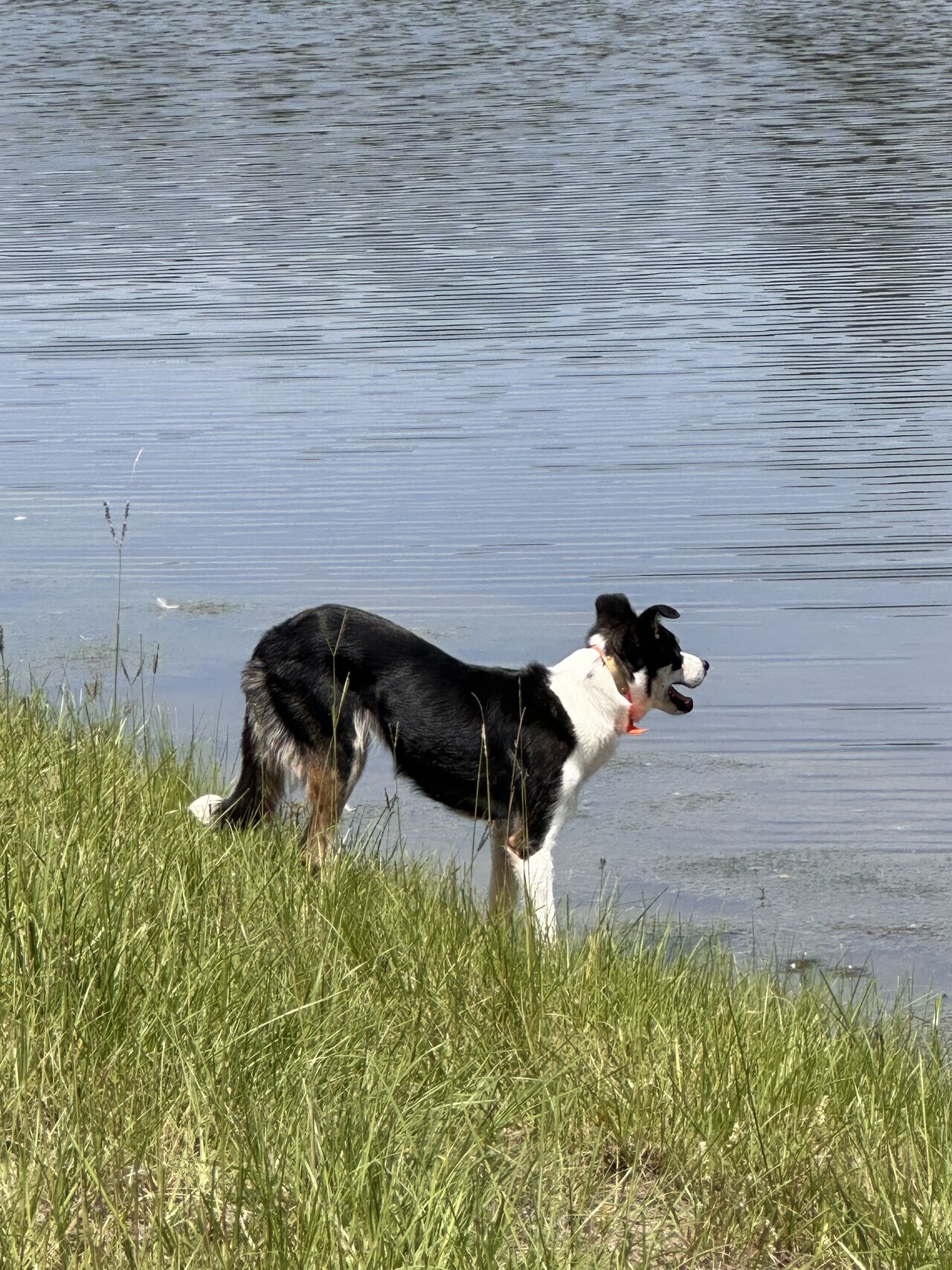
The dog delivers one signal: something is hunting here right now. Put a border collie on the bank and it flattens, fixes its gaze and comes in along an arc rather than head-on. That shape is the universal preamble to a predator’s rush, and prey species need no teaching to read it.
Contact is the line, and it is not a soft one. Closing the distance is neither trained nor tolerated, and a handler who lets it happen has converted a lawful push into a wildlife offence. The handler’s judgement about direction of travel matters more than anything the dog does, because birds have to be pushed toward open water and away from parking, occupied docks and traffic.
Timing is where expectations go wrong. Geese hold a routine measured in weeks and seasons, and a single visit interrupts one instance of it. Settled birds give way to sustained repetition instead, spread over weeks and timed so the flock can never predict it. Nor do we sell the line that a dog is immune to habituation, which the research does not support. Writing in Environmental Management in 2008, researchers ran nine deterrent methods at six landfill sites against three species of gull; the ones with genuine consequence behind them kept working, and the empty ones lost their grip. A live predator belongs in the first group, so the decline is slow rather than absent.
Which deterrents get bought first, and where do they run out?
Nearly all of them, for one reason. A goose lives a long time, watches its neighbours and re-prices risk continually, so anything that threatens without following through is eventually reclassified as furniture.
| What gets tried | What it buys | Where it runs out |
|---|---|---|
| Coyote or owl statue on the bank | Some avoidance, days to a few weeks | It has never once taken a step toward a bird. Within a month geese feed in its shadow. |
| Flash tape, flags, spinners | A startle in bright, breezy conditions | Movement without consequence stops registering, and the tape looks tired by August. |
| Bangers, sirens, sonic units | Open ground clears for minutes per firing | Fixed intervals teach the timetable. At 6am in a subdivision you also meet the Town’s noise chapter. |
| A feeding rule and nothing else | Correct policy, very little movement | It withdraws a snack and leaves acres of forage standing. The lawn is the meal. |
| Dog work plus a rebuilt waterline | Relocates the flock and deletes the reason it settled | The dog effect needs renewal. The change to the ground does not. |
None of these are frauds, and rotating methods slows habituation. The failure is buying one and expecting it to beat a settled flock.
Does the town’s bird sanctuary ordinance change what is legal here?
It is a live question and it deserves a straight answer in two layers, federal first, local on top.
The federal layer. The Canada goose is protected by name under the Migratory Bird Treaty Act at 50 CFR 10.13. What the Act prohibits is take: killing, capturing, possessing, and interfering with nests and eggs. Persuading a bird to stand somewhere else is not take. That distinction is written into 50 CFR 21.100, which withholds any permit requirement from scaring or herding depredating migratory birds. A dog that never makes contact does not touch, injure or take a bird. Anything involving a nest, an egg, capture or removal is a separate regulation, principally 50 CFR 21.162, and needs federal authorization we do not hold.
The local layer. The Town of Lexington code contains § 91.06, headed bird sanctuary, making it unlawful to "trap, hunt, shoot or attempt to shoot or molest in any manner any bird or wild fowl or to rob bird nests or wild fowl nests." The general penalty at § 91.99 runs to $500 or thirty days, each day a separate offence. That provision is broader than the federal Act in two ways: it reaches birds the Act leaves out entirely, including rock pigeon, European starling and house sparrow, and it names nests directly.
- We are not offering a legal opinion on § 91.06. How the Town reads "molest in any manner", and how it enforces the section, are questions for the Town and for your own attorney.
- We claim no exemption, and we do not say the ordinance bans this work. No carve-out for professional waterfowl management was found in the Lexington code, and if somebody tells you one exists, ask for the section number. The opposite conclusion would be a legal opinion too, drawn in our own commercial interest.
- Confirm the current code before anything starts. Anyone planning a goose programme inside the town limits should read the current text of Title IX, Chapter 91 and speak to the Town directly.
- Two codes are in play, not one. Section 91.21 adopts the Lexington County animal control ordinance by reference and provides that where a Town provision conflicts, the County ordinance controls. The most recent adopting ordinance recorded is 2024-13, passed 7 October 2024.
- Geography decides which layer applies. A retention basin inside the municipal boundary is in the town. Much of the Lake Murray shoreline is not, and answers instead to Dominion Energy under FERC Project No. 516.
If the code is uncertain, what always works?
Changing the ground. No ordinance restricts how tall you let the grass at your own waterline grow. Habitat is the one lever an owner controls outright, without depending on a vendor, a permit or anybody else’s compliance, and it is the only permanent change available.
- Stop mowing the last band before the water. Leaving that strip in grass and native planting takes away the food and seals the exit at the same time. It costs less than any product, being work you subtract rather than add.
- Plant to break the sightline. Grouped shrubs, ornamental grasses and staggered small trees convert one open panorama into partial views. A flock that cannot post a sentry treats the ground as risky.
- Change the grade at the margin. A gentle turf slope into water is a launching ramp for waterfowl. Steepening it, or facing it with stone, deletes the easy exit.
- Shrink the mown-turf-to-water interface itself. Measure how many linear feet of bank are cut to the edge, then set a reduction target.
- Pull irrigation and fertilizer back from the bank. On most sites the richest feed is the final twenty yards of irrigated ground, and cutting nitrogen there drops the protein in precisely the sward they came for.
- Treat the buffer as design. Biologically the requirement is height, density and continuity, and a gap works as a door geese find on the first day. Visually, native planting with a crisp mown edge behind it reads as landscape architecture rather than a missed cut.
Where birds are on the buildings instead, a clubhouse parapet or a ledge above an entry, the answer is hardware. That is bird exclusion, covered further on our Lexington bird control page.
What can an HOA board here actually get approved?
Less than the biology wants in year one, and more than most boards expect by year two. Somebody raises it at a meeting; the directors owe a duty of care and know nothing about waterfowl; and the room splits between people wanting something dramatic and people wanting it dropped. The quiet middle position, letting the grass grow at the pond, is the one that changes how the neighborhood looks, and boards approve budgets more readily than appearances.
Three things make approval likelier. Phase it, proposing one demonstration stretch of bank rather than the whole perimeter. Bring the log, because a documented record of bird numbers before and after answers both loud positions at once. And borrow the Town’s own language: Lexington’s land development regulations include an article stating that the Town encourages conservation subdivision design on all suitable land in and around the Town. Golf property runs on the same logic with playability as the extra constraint, and our HOA and golf course goose management work is built around those realities.
What do droppings cost on a dock, a ramp or a cart path?
Clemson Extension’s Savannah Valley District guidance puts geese on small ponds at two to four pounds of droppings per bird per day, and notes that the birds also compact soil and kill turf through overgrazing. A boat ramp or dock, wet and trodden, is a slip exposure. A cart path carries it onto shoes, and a pool deck produces a complaint the same afternoon. Overgrazed bank turf thins, which matters here: we sit in the Sandhills, on quartz sand, where the Lakeland soil series carries an excessively drained rating. Sand with a worn cover, tilted toward a pond, migrates.
Water quality is where we slow down, because no claim in this trade gets stretched further. Clemson Extension’s regional guidance reports fecal bacteria counts in goose droppings running roughly twenty-five times those in human waste. It does not establish that any pond, basin or stretch of Lake Murray shoreline exceeds a bacterial standard, and we found no published sampling data for a specific local water body, so none is cited. The defensible version is narrower and still useful: droppings concentrated where people swim, launch boats or set down children are worth managing.
How does the goose year run between the county’s two weather stations?
No climate station publishes normals for the town itself, so we use the two the State Climatology Office does publish inside Lexington County, and we label them.
- January and February, before pairs commit. The strongest time to begin and the time almost nobody calls. Nothing is being defended and birds remain movable.
- March into May, nesting. Once a pair sits, options narrow sharply. Grazing birds may still be moved lawfully; the nest is off limits and stays off limits. Little Mountain records a last spring freeze around 31 March, Pelion 4 NW around 21 March.
- Early summer, the molt. Once each year the birds drop their primaries and go several weeks without the ability to fly. A flightless bird cannot accept an invitation to leave, so harassment then redistributes the flock on foot rather than relocating it.
- Late summer into fall. Flight returns, the flock reconsiders where it wants to live, and this becomes the most productive push of the year. First fall freeze falls near 20 October at Little Mountain and 10 October at Pelion 4 NW, giving 246 and 226 freeze-free days respectively.
- Winter. Residents stay, migrants may add to the numbers, and open water on a 48,579-acre reservoir does not ice over.
For temperature and rainfall the nearest published normals are the Columbia and Midlands set: 47.75 to 48.11 inches of precipitation and a mean of 66.5 degrees Fahrenheit on the 1991 to 2020 normals. Lexington sits roughly twelve miles from downtown Columbia, so we label those figures Columbia and Midlands rather than dressing them up as Lexington’s own.
How does a Coastal K-9 programme run here?
The bank gets walked before any dog arrives
Together we chart the way the birds use the place: grazing turf, loafing ground, walk-out points, sightlines, and which stretch generates complaints. On lake frontage we also want to know where your line sits relative to the 360-foot contour, because that decides who controls the ground you propose to plant.
The local questions get settled first
Municipal boundary or not, town park or private basin, association covenants, and what the Town tells you when you ask about Chapter 91.
Constraints go into the schedule
Tee times, pool hours, school traffic, peak trail use, event dates. Harassment must be unpredictable to the geese while staying predictable to your staff.
Opening visits cluster and vary
The first phase is frequent and deliberately irregular. One dramatic morning is not the aim. Wrecking the dependability of the flock’s day is.
Numbers go on the record every visit
Counts, locations and behaviour are logged each time, so you hold a trend line rather than competing recollections.
Visits taper and the written plan takes over
The document covers buffer depth, plant choices, where grading would pay, mowing and fertiliser changes, and a feeding rule fitted to your own water. Nearly every property wants one refresher season, timed to the return of flight.
What is included
- A written habitat assessment covering the whole waterline and the ground behind it
- Scheduled dog work, non-lethal throughout, with the timing kept deliberately erratic
- Every visit run under handler control, with the dog kept clear of the birds
- A season-long record of what was counted, where, and how the birds behaved
- A measured baseline of how much of your bank is mown to the water, and a reduction target
- Shoreline recommendations written so a grounds crew or landscaper can execute them
- A written note of the local code questions to put to the Town before work begins
- The limits stated up front: no nests, no eggs, no take, nothing requiring an authorization we do not hold
Who licenses this work in South Carolina?
Wildlife runs federal and state: administration of the Migratory Bird Treaty Act rests with the US Fish and Wildlife Service, while SCDNR hands out depredation permits free of charge, good for thirty days and renewable, from its regional offices. Neither is needed for the herding work set out above, per 50 CFR 21.100. These authorities stack rather than substitute, and none of them displaces a municipal provision.
Pesticide work is a wholly different regime. In this state, structural, institutional and health-related pest control is licensed by the Clemson University Department of Pesticide Regulation rather than by a state agriculture department, under category 7A. That means a firm licence, a Designated Certified Applicator stationed at every location, and general liability cover no lower than $100,000 combined single limit. That framework governs chemical turf repellents and structural treatments, not a dog.
One distinction worth carrying. Rock pigeon, European starling and house sparrow hold no protection under the federal Act; the gap is spelled out in our pigeon and European starling profiles, and the Town’s § 91.06 language does not appear to carve those species out the way federal law does. Where gulls or grackles work an outdoor terrace, the tool is usually falconry bird abatement.
Where we work around Lexington
Coastal K-9 & Pest Solutions operates from 320 Wendy Lane, Windsor, SC 29856. Inside the town we work the subdivisions on the Town’s own list, among them Barr Lake, Bent Creek Plantation, Brookstone, Carriage Hills Lake, Carrington Place, Cherokee Village, Coventry Lake, Creekside Farms, Golden Hills, Hope Ferry Plantation, Lakeside at Woodcreek, Laurel Falls, Mallard Lakes, Nightingale Hills, Pilgrim Point, River Ridge, Royal Creek, Saluda Springs, Shoal Creek, Sterling Bridge, Twelve Mile Ridge, Whisperlake, Whiteford Lakes and Woodstream. See every area we cover.
Outside the town limits we work the Lake Murray shoreline on the Lexington County side, the Irmo and Chapin side of the lake, and the Cayce, West Columbia and Columbia end of the Midlands. Where a pond bank has a rodent problem alongside the waterfowl, that is canine rodent detection, and multifamily buildings, lakefront rentals and lodging are covered by our Lexington canine bed bug work.
Frequently asked questions
Does the bird sanctuary ordinance mean you cannot work in Lexington?
We will not answer that as a legal conclusion in either direction, because it is not ours to give. Section 91.06 makes it unlawful to trap, hunt, shoot or molest any bird or wild fowl, or to rob nests. How the Town interprets and enforces that language is a question for the Town and for your attorney. What we can say with certainty is that habitat modification is untouched by it.
Our lot is on the lake but outside the town limits. Which rules apply?
Different ones, and the difference is worth establishing before anything is scheduled. Municipal provisions apply inside the municipal boundary. Much of the Lake Murray shoreline sits outside it, under Dominion Energy’s administration of FERC Project No. 516, with the 360-foot contour as normal maximum pool and, along much of the lake, the property boundary. Federal migratory bird law applies everywhere regardless.
How many geese are there in Lexington?
Nobody has published a figure, and we will not manufacture one to make a page look authoritative. The only sourced number available is statewide: SCDNR puts the state’s resident Canada goose total past 50,000 and rising. That is a state figure, not a town or county one, and anyone quoting you a Lexington-specific count should be asked for the source.
Can you take a nest off our dock?
Not under this service. Nests and their contents are governed federally by 50 CFR 21.162, which brings registration or authorization and its own reporting duties. Saying so flatly beats improvising around a protected species. Birds out feeding can still be moved while a nest sits there, so long as nobody goes near it.
Our pond is small. Will a buffer really be enough?
On a small basin it is frequently the whole answer, because a small pond has proportionally more edge than open water, and edge is what you are changing. What governs the effect is height, density and continuity rather than width in feet: planting that stands above eye level for a goose, dense enough to discourage walking in, and carried right round without a break.
Why did the birds arrive only after our neighbourhood was finished?
Because the pond had to mature. A newly built basin has raw banks, thin turf and construction traffic. Give it a few seasons and it has established grass to the waterline, quiet, and a mowing contract keeping the sward short and green. Local stock is young, with a median build year of 2002 in the town, so many basins here reached that stage at roughly the same time.
How long before we see a difference?
Movement usually shows within the first two weeks, but the number that matters is what the bank looks like after two months. Birds that have lived somewhere for seasons only give it up after enough irregular pressure that the place stops feeling secure. Properties that also change the shoreline taper down to occasional maintenance. Properties that change nothing keep paying for the dog.
Can the dog work a public park or a town trail?
Anything on public ground is arranged with the Town rather than simply booked. Town parks open sunrise to sunset, prohibit hunting and trapping outright, and carry their own rules on dogs and use. Most of what we do is on private water, private basins and private lake frontage, where scheduling is between us and the owner.
Related services
Geese on your lake frontage, your basin or your dock?
Tell us how much bank you have, how much of it is mown to the water, and how many birds are using it. We will look at the bank with you, say what it is offering the birds, and set out in writing how dog work and shoreline change fit together. Serving Lexington, Irmo, Chapin, Cayce and West Columbia from Windsor, South Carolina.