
Rat & Mouse Control in Aiken, Augusta & the CSRA
Rodent control only holds when you seal the building. A mouse passes a quarter-inch gap and a rat passes a half-inch, so trapping and baiting reduce the population while exclusion is what keeps the next one out. Coastal K-9 & Pest Solutions traps, seals and verifies across Aiken, North Augusta, Graniteville, Augusta, Columbia and the Midlands.
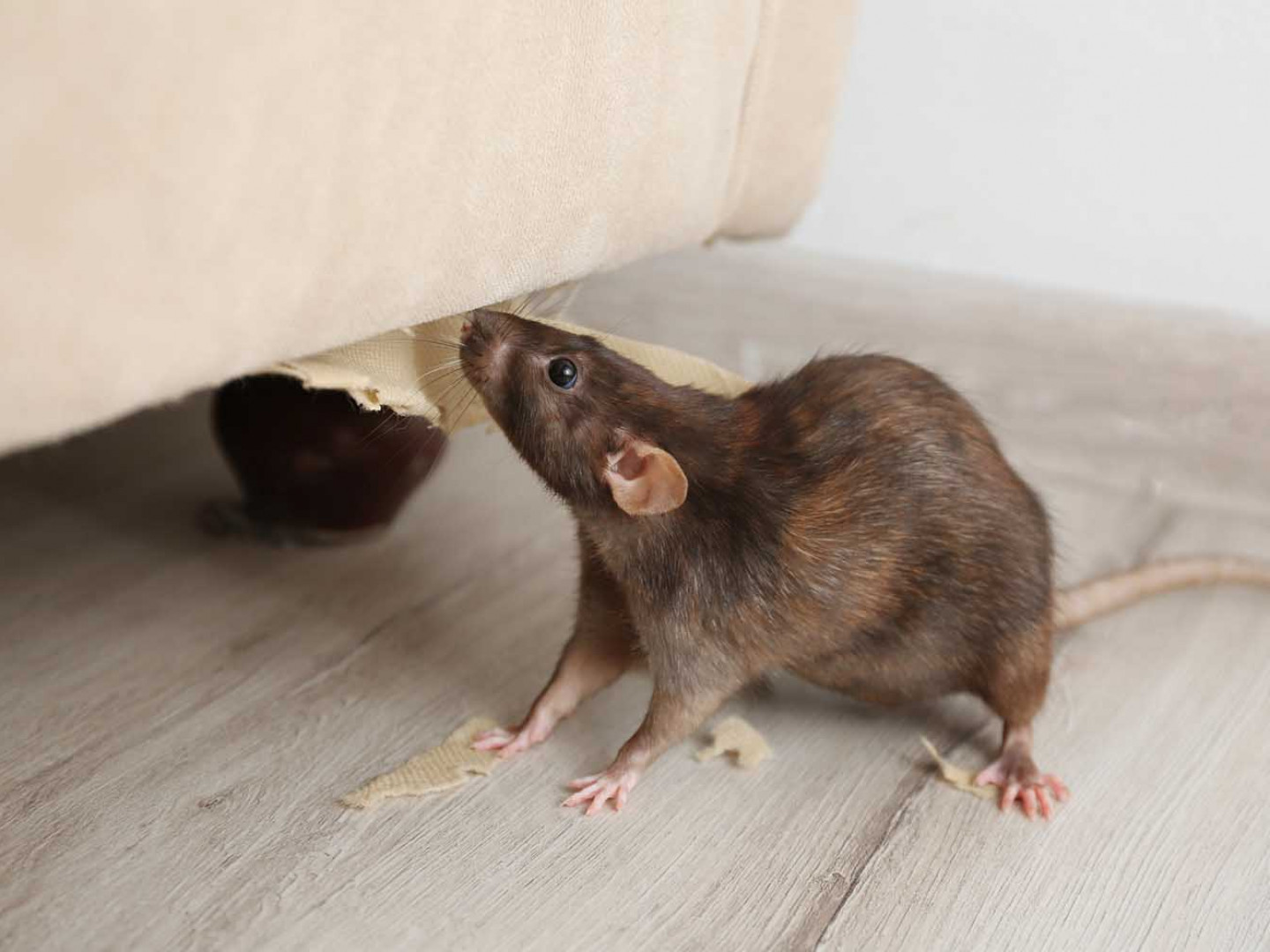
Every rodent job comes down to one question: how are they getting in? Bait and traps handle the animals already inside. They do nothing about the quarter-inch gap under the garage door corner, the failed crawl space vent screen, the dryer vent with no damper, or the gap where the refrigerant line enters the wall. Leave those and you are on a subscription — forever paying for the same population, rebuilt every season from outside.
We work the other way around. We find the entry points and the travel routes first, seal them to a specification that rodents cannot gnaw through, and use trapping and stations to clear what is already inside while that work happens. If you also want certainty about where the activity is — inside a wall, above a ceiling, in a specific section of a warehouse — that is what our certified K-9 rodent detection is for. This page is about the treatment and the repair.
What rodents do we actually have here?
Norway rat
Rattus norvegicus. Around a pound, coarse brown fur, blunt muzzle, small eyes, and ears too small to fold down over the eyes. The tail is shorter than the head and body. Droppings run up to three-quarters of an inch with blunt ends. A burrower and a ground-floor animal — crawl spaces, slab edges, dumpster pads, shed floors, sewers. Six to twelve young per litter, four to six litters a year, sexually mature at about three months. Needs a half-ounce to an ounce of free water a day. Travels an area roughly 100 to 150 feet across daily and rarely goes more than a few hundred feet from the burrow. Neophobic — it avoids new objects for days, which is exactly why pre-baiting matters. Norway rat profile.
Roof rat
Rattus rattus. Five to ten ounces, pointed muzzle, large eyes, ears long enough to pull down over the eyes, and a tail longer than the head and body. Droppings about half an inch with pointed ends. An excellent climber that nests above ground — attics, rafters, trees, ivy-covered walls — and uses overhead lines and fence tops as runways. Its documented US range covers the lower East Coast and Gulf states, which includes South Carolina. Three or more litters a year, five to eight young each, and it usually needs water daily. This is the species that drives soffit, roofline and attic work. Roof rat profile.
House mouse
Mus musculus. Half an ounce, five to seven inches including a nearly hairless tail, with a slightly pointed nose and large ears. Rice-grain droppings about a quarter-inch with pointed ends. Five to six young per litter, five to ten litters a year, sexually mature at six to ten weeks. Critically, it does not need free water — which is why mice colonize dry attics, wall voids and cabinets where a rat could not survive. Its home range is only 10 to 30 feet across, and it nibbles at many places each night rather than eating one meal. That single fact is why low-density trapping fails. House mouse profile.
What it probably isn't
Not every animal in the attic is a rat. Southern flying squirrels are nocturnal cavity-nesters and are constantly reported as “rats in the attic” because of the night noise. Eastern gray squirrels are a game animal in South Carolina with their own handling rules. Cotton rats and woodrats are native species that live in grass and woodland and rarely invade structures — cotton rats turn up under bird feeders, not in pantries. White-footed mice are the Peromyscus you are likely to see here. Identifying correctly matters, because the legal and practical handling differs.
How do rodents get in, and what actually closes it?
The numbers are not marketing. Seal every opening larger than a half inch for rats and larger than a quarter inch for mice — that is the figure in the standard wildlife-damage management handbooks and it is corroborated by UC IPM, which notes a rat will squeeze under a door with a half-inch gap.
The building code says the same thing in a different way. Section R408.2 of the International Residential Code requires under-floor ventilation openings to be covered so that the least dimension of the covering does not exceed one quarter inch, and lists what is acceptable: perforated sheet metal at least 0.070 inches, expanded sheet metal at least 0.047, cast-iron grating, extruded brick vents, hardware cloth of 0.035-inch wire or heavier, or corrosion-resistant mesh with a least dimension of an eighth of an inch. In other words, a code-compliant crawl space vent in your house is already a rodent barrier — and a rusted, torn or missing one is a code-level defect, not just a nuisance.
The rodent-proofing specifications we work to:
- Hardware cloth for rats: half-inch by half-inch mesh, 19 gauge, woven — woven specifically, because non-woven breaks easily.
- Hardware cloth for mice: quarter-inch by quarter-inch mesh, 24 gauge, woven.
- Sheet metal: 24 gauge or heavier for wall and pipe barriers; 22 gauge or heavier for kick plates and door edging.
- Masonry: concrete at least two inches if reinforced, three and three-quarter inches if not; brick three and three-quarter inches with mortared joints.
- Doors: the gap between the door bottom and the threshold must not exceed a quarter inch, with flashing or a sweep closing to within an eighth of an inch at the edges.
- Burrowing barrier: a curtain wall extending at least 36 inches below grade, or an L-footing with a one-foot horizontal outward extension, or a stone band of one-inch-plus gravel two feet wide and half a foot deep.
What rodents chew straight through — and what we will not use as a permanent seal: lead and aluminum sheeting, window screen, wood, rubber, vinyl, fiberglass, plastic and low-quality concrete or block. UC IPM's house mouse guidance is explicit that effective materials are metal or concrete, and that plastic screening, rubber, vinyl, expanding foam, wood and other gnawable materials should be avoided. Steel wool and copper mesh have a role as fillers behind a hard cap — steel wool rusts and can be worked loose, and neither is a barrier on its own. If someone sealed your house with a can of foam, it was not sealed.
Where we look, in order: crawl space vents and access doors; the garage door corner seals and threshold; utility, plumbing, HVAC line-set and electrical penetrations; dryer vents; gable and soffit vents; roof-to-wall junctions and the fascia return; plumbing chases; floor drains and sewer cleanouts; the attached-garage-to-house door; and, for roof rats, every overhanging limb, fence line and utility line that reaches the roof. Sewers are a genuine Norway rat pathway — a 2023 systematic review in Urban Ecosystems found sewers act as major reservoirs for urban rat populations, with rats moving between the underground system and the surface, and with higher presence in systems built of brick and clay, poorly maintained, and near residences and food establishments.
How our rodent service works
Inspection and mapping
Exterior perimeter, roofline, crawl space, attic, garage and interior. We record droppings by size and shape, rub marks, gnaw damage, runways, burrow openings, nesting material and food sources, and we photograph what we find. Droppings tell us the species; the travel routes tell us the entry.
Confirm the species
Norway rat, roof rat and house mouse need three different trap layouts and three different sealing priorities. Blunt-ended three-quarter-inch droppings and ground-level burrows mean Norway. Pointed half-inch droppings and overhead runways mean roof rat. Rice-grain droppings scattered widely mean mice. Getting this wrong wastes the first two weeks.
Trap at real density
The most commonly botched variable in the whole trade. Mouse traps go no more than about six feet apart — because a mouse home range is only 10 to 30 feet across and it feeds at many sites per night, so a trap eight feet away may as well be in another building. Rat stations and traps run within roughly 20 to 30 feet. Traps go tight to walls, behind objects and in dark corners; for roof rats they also go up, on beams, pipes, ledges and sills. Traps with wide trigger plates catch better.
Pre-bait where it matters
Norway rats avoid new objects for days. Traps are left baited and unset until the bait has been taken at least once — a minimum of three to five days, with feedings no more than 48 hours apart. Skipping this is why a DIY snap-trap line catches nothing for a week and then gets abandoned.
Exterior stations, used correctly
Where rodenticide is appropriate, it goes in tamper-resistant stations, secured, numbered and mapped, with placements recorded. It is not scattered, it is not used indoors as a first resort, and it is not the whole plan.
Seal the building
The actual fix. Vent screens, thresholds and sweeps, penetrations, soffit and fascia gaps, roof-to-wall junctions, and the crawl space envelope — all closed with metal, mesh or masonry to the specifications above. Where the scope is structural, our repairs and exclusion crew does the work.
Clean up and verify
Droppings, contaminated insulation and nesting material removed; damaged vapor barrier and ductwork documented. Then we come back and check — empty traps, no fresh sign, no new gnawing. If you want independent confirmation that a structure is clear, our K-9 detection teams can verify it.
Why does “just put out bait” fail?
Because bait removes individuals and does nothing to the two things that actually determine your rodent population: the food and shelter available, and the holes in the building.
Look at the reproduction numbers. Norway rats produce four to six litters a year of six to twelve young, reaching sexual maturity at three months. House mice produce five to ten litters a year and mature at six to ten weeks. A single surviving pair, or a single unrepaired gap that lets the neighbors' population walk in, rebuilds the infestation inside a season. Even the FDA Food Code frames the requirement as eliminating harborage conditions alongside control methods — the regulator itself treats bait as insufficient on its own.
There is a second reason to be careful with rodenticide, and it is one we would rather raise ourselves. Anticoagulant residues are widespread in wild raptors. A Cornell study published in Ecotoxicology in 2022 found 68 percent of 72 red-tailed hawks tested in New York carried anticoagulant rodenticide residues. A USGS study found 48 percent of 40 barred owls in Oregon and Washington positive for at least one anticoagulant, with exposure described as widespread rather than concentrated near development. Both studies are out of region — we could not find comparable Southeastern raptor monitoring data and we are not going to imply one exists. But the finding is enough to shape how we work: stations secured and mapped, product used where it is the right tool rather than as a default, and exclusion carrying the long-term result.
One thing worth knowing as a consumer: since the EPA's rodenticide risk mitigation decision, the second-generation anticoagulants — brodifacoum, bromadiolone, difenacoum and difethialone — are no longer registered for consumer products and are available only to the commercial and structural pest control markets. Consumer products must be ready-to-use bait stations with block or paste formulations, and pelleted consumer baits are no longer permitted. A licensed applicator can lawfully use products and placements you cannot buy, in tamper-resistant stations, with placement records.
What does not work
- Ultrasonic and electronic repellers. In May 2001 the Federal Trade Commission sent warning letters to more than 60 manufacturers and retailers of ultrasonic pest-control devices, stating that efficacy claims must be supported by scientific evidence, and it brought enforcement actions against six companies between 1985 and 1997 and further actions in 2002 and 2003. UC IPM's 2025 guidance states there is little evidence that sound, magnetic or vibrational devices of any kind will drive established house mice from buildings. The handbook is blunter: advertising claims for many commercial devices are unsubstantiated by scientific research.
- Expanding foam as a seal. Named explicitly by UC IPM among the gnawable materials to avoid. It stops air. It does not stop a rodent.
- Glue boards as a control method. UC IPM notes adult rodents can often detect and avoid the glue, so what you catch is mostly juveniles — you miss the breeding adults driving the population — and animals caught on glue may not die quickly and need to be euthanized. There is also real non-target risk to lizards, snakes and songbirds. We use them for monitoring in specific situations, not as the plan.
- Sanitation alone. The handbook is honest about this too: even the best sanitation will not eliminate house mice. It makes trapping and baiting work better and makes fresh sign visible. It is not a substitute for closing the building.
- The fire statistic you have seen. You will find “rodents cause 20 to 25 percent of fires of unknown origin” on a great many pest control websites. We traced it to an uncited state health-department fact sheet, and we could find no NFPA or US Fire Administration data attributing any share of structure fires to rodents. So we do not repeat it. What is true and verifiable: rodent incisors grow about five inches a year, rodents gnaw constantly including on electrical insulation, and chewed wiring is a routine finding in established infestations. That is reason enough to take an attic or crawl space infestation seriously without inventing a number.
What is the actual health risk?
The CDC lists a long set of diseases transmitted directly by rodents — including leptospirosis, salmonellosis, rat-bite fever, sylvatic typhus, tularemia, hantavirus and lymphocytic choriomeningitis — and a second list transmitted indirectly through ticks, mites and fleas. Several of those are not US-endemic and have no business on a South Carolina page. The ones plausibly relevant here are leptospirosis, salmonellosis, rat-bite fever and LCMV.
Hantavirus deserves a straight answer, because it is the one people worry about. The CDC has recorded 890 US hantavirus disease cases in total since surveillance began in 1993, and 94 percent of infections occur in states west of the Mississippi River. The main US agent is carried by the deer mouse. House mice and commensal rats — the species actually infesting homes in Aiken and Columbia — are not reservoirs for it. Hantavirus is real, and it is not a meaningful driver of rodent risk in the Midlands. Anyone telling you otherwise is selling.
The better-supported concern is allergen. The National Survey of Lead and Allergens in Housing sampled 831 homes across 75 randomly selected areas and found detectable mouse allergen in 82 percent of US homes, with roughly 22 percent showing kitchen-floor concentrations above a level associated with allergy and asthma. Risk was highest in high-rise apartments and mobile homes. If someone in the house has asthma, the droppings in the pantry are not just unpleasant.
And the contamination math is worth seeing. One Norway rat eats about an ounce of food a day — 20 to 40 pounds a year — and contaminates roughly ten times that amount with urine and droppings. Grain-storage research cited in the standard handbook found that 10 to 26 rats contaminated 70 percent of stored grain within 12 to 28 weeks. In a crawl space, what we routinely find is nested-out batt insulation, torn vapor barrier and shredded flex duct. We will document what is in your building with photographs rather than quote you a percentage we cannot source.
When do rodents move in around here?
The South Carolina State Climatology Office puts Aiken's last spring freeze around March 22 and its first fall freeze around October 12, with Columbia stations ranging from late February to late October — a freeze-free season of roughly 226 to 261 days depending on the station. That is far longer than the seasons most national rodent advice is written for, and it means outdoor food and cover persist most of the year.
It does not mean rodents breed year round outdoors, and we are not going to say that. The wildlife-damage literature is specific: Norway rat breeding peaks in spring and fall, declines during the heat of summer, and often stops in winter depending on habitat. The honest version is that mild Midlands winters extend the productive breeding window at both ends compared with colder markets.
- Late February to April. Spring breeding peak. Burrow activity along foundations, sheds and dumpster pads becomes visible as populations start to build.
- May to August. Breeding slows in the heat. Outdoor food is abundant, so rats and roof rats work the landscape — fruit and nut trees, pet food, bird feeders, dumpsters. Structural complaints drop while exterior harborage builds.
- September to November. The annual spike, and the reason we push exclusion in August and September. Fall breeding peak coincides with cooling nights and the collapse of outdoor food, right around those October freeze dates. Roof rats move into attics as the canopy thins.
- December to February. Whatever got in is now inside and obvious — attic noise, pantry droppings, gnawed wiring. A heated, harborage-rich building is a habitat where winter breeding does not stop, so an untreated interior population comes into spring larger than it started.
The practical takeaway: seal before they need to come in. August through early October is the window, and UGA Extension gives the same advice for the same reason.
Why the CSRA and Midlands are different
The soil. The Sandhills run in a belt along the Fall Line through Aiken County and Columbia, with deep, coarse, excessively drained quartz sands — the Lakeland series carries sand thicknesses beyond 80 inches with rapid to very rapid permeability. In our field experience that soil is easy for a Norway rat to excavate and does not waterlog, so burrows under slabs, stoops, sheds and dumpster pads stay usable through the year. We will flag that as professional inference rather than published research, because no one has measured rat burrowing in Sandhills soil specifically. The countermeasure, though, is spec'd: a curtain wall 36 inches below grade, an L-footing with a one-foot outward extension, or a gravel band.
The housing. New construction across the South Atlantic is now about 86 percent slab, which means crawl-space housing here is disproportionately the older stock — the Aiken Winter Colony districts built largely between 1900 and 1930 with stables and outbuildings, the Graniteville mill village whose canal dates to 1846 and whose mill was completed in 1849, Old Shandon in Columbia established in 1893, and the Olympia and Granby mill villages. Pier-and-beam framing, vented crawl spaces, a century of utility penetrations and original millwork are exactly where rodent entry concentrates. If you own one of these houses, the exclusion scope is bigger and it is worth doing once, properly.
The agriculture and industry. Aiken County reported 1,132 farms and 138,479 acres in farms in the 2022 Census of Agriculture, with more than 4,000 acres of corn for grain, 8,000 acres of cotton, and a livestock inventory including nearly 3.6 million broilers. Grain handling, feed storage and poultry houses generate serious commercial rodent pressure, and the industrial and distribution footprint around Sage Mill, Graniteville and Beech Island adds warehouse and dock-door exposure on top of it.
The vegetation and the water. Ivy-covered walls, overhanging limbs and heavy shrub lines are roof-rat highways — the standard guidance is to remove vine-covered structures and trim limbs so they do not overhang or touch the roof. We will not quote you a specific clearance distance, because no extension source publishes one. Firewood goes at least a foot off the ground. Garbage goes in rust-resistant, damage-resistant containers with tight lids. Bird feeders and pet food left out are, in practice, the two most common reasons a property has rats at all.
Commercial rodent programs and audits
If you operate a food establishment, warehouse or plant, the standard you are held to is written down and it is worth reading.
The FDA Food Code, at 6-501.111, requires premises to be maintained free of pests by routinely inspecting incoming shipments of food and supplies, routinely inspecting the premises for evidence of pests, using control methods including trapping devices if pests are found, and eliminating harborage conditions. Section 6-501.112 requires dead or trapped pests to be removed from control devices and the premises at a frequency that prevents accumulation or the attraction of more pests. Section 6-202.15 requires outer openings to be protected by filling or closing holes and gaps along floors, walls and ceilings, with tight-fitting windows and solid, self-closing doors; where an opening must stay open, it specifies 16-mesh-to-the-inch screening or a properly designed air curtain. An active infestation can meet the Food Code's definition of an imminent health hazard, which is the mechanism by which a restaurant gets closed.
In South Carolina, retail food inspections are run by the South Carolina Department of Agriculture, not DHEC — that responsibility moved on July 1, 2024 when DHEC was split into the Department of Public Health and the Department of Environmental Services. Any vendor still telling you DHEC inspects your kitchen has not updated their materials since 2024.
For plants under third-party audit, we build the deliverable your auditor expects: a documented pest program, a site map with uniquely numbered monitoring and bait device locations, service reports, trend analysis, corrective actions, and applicator licensing, product labels and safety data on file. We describe it that way deliberately — we are not going to quote you SQF or BRCGS clause numbers we have not verified against the current standards, because a wrong clause number in front of a QA manager is worse than saying nothing. See our commercial programs, our warehouse and distribution program, and our nationwide K-9 rodent detection for audit-driven work.
Who licenses this work?
In South Carolina, pesticide applicators and pest control businesses are licensed by the Clemson University Department of Pesticide Regulation. Structural and household work falls under Category 7A. Commercial firms need a business license from DPR, a Designated Certified Applicator at each location, and comprehensive general liability coverage of not less than $100,000 combined single limit with no deductible over $1,000.
In Georgia, the Georgia Department of Agriculture regulates structural pest control through the Structural Pest Control Commission under the Structural Pest Control Act. The relevant operator category is Household Pest Control, and Georgia's own rules define it in a way that is unusually precise about rodents: it “does not include the control of mammals with the exception of commensal rodents and squirrels.”
What is included in a rodent service
- Full interior, exterior, crawl space, attic and roofline inspection with photographs
- Species identification from droppings, runways, gnaw marks and nesting sign
- Entry-point map showing every gap that needs to close and why
- Trapping at correct density — and elevated placements where roof rats are involved
- Pre-baiting where the population is neophobic
- Tamper-resistant, secured and numbered exterior stations where rodenticide is appropriate
- Exclusion to hardware-cloth, sheet-metal and masonry specification — not foam
- Sanitation and habitat findings: feeders, pet food, dumpsters, wood piles, vegetation contact
- Droppings, nesting material and contaminated insulation removal
- Follow-up verification, with K-9 detection available where you need independent confirmation
Where we work
We are based in Windsor, South Carolina, and run rodent service across Aiken, North Augusta, Graniteville, Vaucluse, Warrenville, Beech Island, Edgefield, Columbia, Lexington, West Columbia, Cayce and Irmo, plus Augusta, Evans and Martinez on the Georgia side — from Winter Colony houses and Horse District barns in Aiken to Hammond's Ferry and Riverside Village in North Augusta, the Graniteville and Vaucluse mill villages, Shandon, Rosewood, Earlewood and the Olympia and Granby mill villages in Columbia, the Riverwalk corridor through Cayce and West Columbia, and Lake Murray shoreline properties in Lexington and Irmo. See all areas we serve.
Frequently asked questions
How do I know whether it's rats or mice?
The droppings settle it. Mouse droppings are about a quarter inch, rice-grain shaped with pointed ends, and scattered widely. Rat droppings are much larger — Norway rat droppings run up to three-quarters of an inch with blunt ends, roof rat droppings about half an inch with pointed ends. Location helps too: mice range only 10 to 30 feet from the nest and turn up everywhere; Norway rats stay low; roof rats stay high. Send us a photo with something for scale.
Can you get rid of them without poison?
Often, yes — and in occupied homes with children, pets or asthma concerns we prefer to. Trapping at correct density combined with full exclusion resolves a great many residential jobs with no rodenticide at all. Where we do use product it goes in secured, tamper-resistant, numbered exterior stations. Tell us your preference at the inspection and we will build the program around it.
Why do I still hear them after treatment?
Two normal reasons and one bad one. Normal: a rodenticide-based program takes several days to work, and remaining animals move more as the population thins. Also normal: what you are hearing may be a flying squirrel or a gray squirrel rather than a rodent at all — the noise is very similar and the handling is different. The bad reason is an unsealed entry point still admitting new animals, which is exactly why we lead with exclusion instead of ending with it.
Will sealing the crawl space make it worse if something is trapped inside?
That is a real risk and it is why sequence matters. We clear the interior population first, or seal with a one-way arrangement where the situation calls for it, and we verify before final closure. Sealing a building with an active interior population is how you end up with an odor problem, and it is a mistake we design around rather than discover.
Is expanding foam good enough to close a gap?
No. UC IPM lists expanding foam among the gnawable materials to avoid. Rodent incisors grow about five inches a year and foam offers no resistance at all. Foam is a fine air seal behind a proper barrier — hardware cloth, sheet metal or mortar — but on its own it is a cosmetic repair that fails within a season.
Do ultrasonic plug-ins work?
No. The FTC warned more than 60 manufacturers and retailers about unsupported ultrasonic pest-device claims in 2001 and brought multiple enforcement actions before and after. UC IPM's current guidance states there is little evidence that sound, magnetic or vibrational devices of any kind will drive established house mice from a building. Save the money and spend it on a door sweep.
How many traps do I actually need?
Far more than most people use. Mouse traps should be no more than about six feet apart along active runs, because a mouse's entire home range is only 10 to 30 feet and it feeds at many sites each night. Rat traps and stations run within roughly 20 to 30 feet. A single trap under the sink is not a rodent program — it is a sample.
What about my bird feeder?
It is very often the answer. Bird feeders and outdoor pet food are documented rodent attractants, and cotton rats in particular are noted feeding beneath feeders. Keep firewood at least a foot off the ground, use rust- and damage-resistant garbage containers with tight lids, store pet food in sealed rodent-proof containers, and either take feeders down during an active infestation or move them well away from the structure.
Do you clean up droppings and contaminated insulation?
Yes. Droppings, urine-soaked and nested-out insulation, nesting material and damaged vapor barrier all get removed and documented, and we photograph the condition of ductwork and the crawl space envelope. That matters both for the health side — 82 percent of US homes carry detectable mouse allergen — and because leftover odor and pheromone continue attracting rodents to the same voids.
How is this different from your K-9 rodent detection?
This page is the treatment and repair: trap, seal, remove, verify. K-9 detection answers a different question — exactly where live activity is inside a structure when the evidence is ambiguous, or independent confirmation that a facility is clear after remediation. Homeowners usually need this page. Facilities with an audit finding, a trend report that does not match reality, or a recurring problem no one can locate usually need both.
Related services
Hearing something in the attic or finding droppings in the pantry?
Tell us what you have seen and where. We will identify the species, map every way they are getting in, clear what is inside, and seal the building so the next one stays out. Serving Aiken, North Augusta, Graniteville, Augusta, Columbia and the Midlands from Windsor, South Carolina.