
Cockroach Control in Aiken, Augusta & the CSRA
Cockroach control starts with identifying the species, because German cockroaches are carried indoors and breed inside, while palmetto bugs and smokybrowns come in from mulch, tree holes, gutters and sewers. Coastal K-9 & Pest Solutions treats both correctly across Aiken, North Augusta, Graniteville, Augusta, Columbia and the Midlands — with gel bait, monitoring and source work, not fogging.
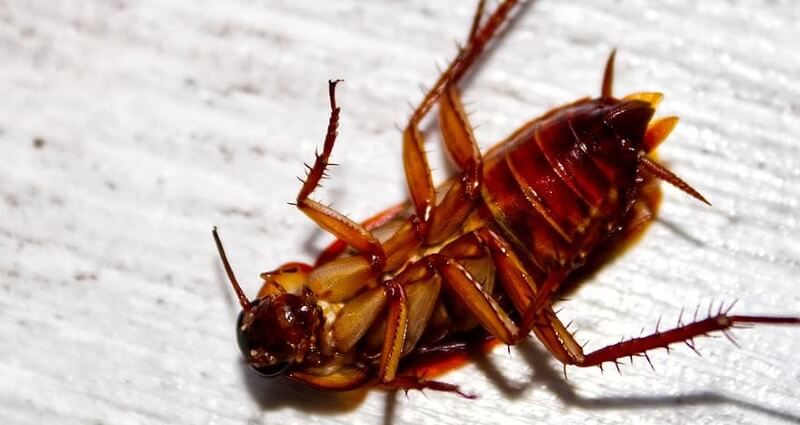
Two people call us about cockroaches on the same day. One found a single large reddish-brown insect on the bathroom floor at two in the morning. The other found small tan insects with two dark stripes streaming out from behind the dishwasher when the kitchen light came on. Those are not the same problem, they do not have the same cause, and treating them the same way guarantees that one of the two customers will be calling back.
The first is almost always an American or smokybrown cockroach — a peridomestic species that lives outdoors in mulch, tree holes, gutters, crawl spaces and sewer lines and came inside through a gap. The University of Florida notes that outdoor cockroaches do not survive well indoors and that people frequently overreact to finding one. The second is a German cockroach, which the University of Georgia classifies as an obligate indoor pest, never to rarely found outdoors. It did not walk in from the yard. It arrived in a box, a bag, an appliance or a piece of used furniture, and it is now breeding in your kitchen. Our first job on every cockroach call is to tell you which one you have.
Which cockroach do you actually have?
Species identification is not academic on this page — it is the whole job. Get it wrong and you will bill an indoor gel-bait program for an outdoor landscape problem, or spray a perimeter for an insect that never goes outside.
German cockroach
Blattella germanica. Half an inch to five-eighths, pale tan, with two parallel dark stripes on the shield behind the head — present on nymphs and adults alike. Has wings but does not fly. The female carries her egg case for about two weeks until just before it hatches, which is why 30 to 40 eggs survive most sprays: they are travelling on her. Three to four generations a year, up to six. It harbors in cracks as narrow as a sixteenth of an inch, lives in kitchens first and bathrooms second, and survives only about twelve days without water. German cockroach profile.
American cockroach — the “palmetto bug”
Periplaneta americana. An inch and a half to two inches, reddish-brown with a pale yellow halo band behind the head. Lives in sewers, storm drains, crawl spaces, basements, mulch and steam tunnels; UF notes it is more common in commercial buildings than in residences. Mark-recapture work in sewers found more than 90 percent of recaptured adults moving 2 to 20 metres, with one male covering 192 metres between manholes — and the authors specifically noted reinvasion from nearby sewers after treatment. LSU reports they pass through openings as small as 3 mm. American cockroach profile.
Smokybrown cockroach
Periplaneta fuliginosa. One to one and a half inches, uniformly shiny dark mahogany to black with no pale halo — that absence is the field identification. Both sexes fly and both are drawn to light. An Annual Review of Entomology paper calls it an increasingly important peridomestic pest throughout much of the southeastern United States. UGA places it in tree holes, attics, crawl spaces and sheds, notes it wants temperatures above 68°F and high humidity, and says it is most common in older neighborhoods with established trees. That is a literal description of Aiken's Winter Colony blocks and Columbia's Shandon and Rosewood.
Oriental cockroach
Blatta orientalis. An inch to an inch and a quarter, shiny dark brown to jet black, unmarked, and neither sex flies. Wants damp and cool: water meter boxes, sewer lines, crawl spaces, damp basements and structural voids. Clemson notes they rarely go above basement level. Egg to adult can take 200 to 800 days. Less common here than American and smokybrown, but a regular find in meter boxes and drain lines.
Brown-banded cockroach
Supella longipalpa. Same size as a German and constantly mistaken for one, but with two pale bands running across the wings and no stripes on the pronotum. The operational difference matters: it lives away from kitchens and above floor level — bedrooms, closets, high shelves, inside furniture, behind picture frames, inside electronics — and glues its egg cases to the substrate. UC IPM warns that brown-banded cockroaches are especially difficult to control using baits, so the program has to be built differently.
Wood roaches
Parcoblatta species. Light brown, males fully winged and capable of flight, females short-winged and flightless. They live in leaf litter, under loose bark and in wood piles, and they come inside on firewood or after being drawn to a porch light — then die within a few days from dehydration because they cannot survive indoors. Penn State states plainly that pesticides are unnecessary. If you have wandering wood roaches in April, you need firewood habits and a door sweep, not a treatment plan, and we will tell you so.
Why does the species change the entire treatment?
Because it changes where the population lives. Everything else follows from that.
| German cockroach (indoor) | American / smokybrown / Oriental (peridomestic) | |
|---|---|---|
| Where it came from | Carried in on grocery bags, cartons, cardboard, appliances, used furniture | Came from outside — sewers, storm drains, mulch, tree holes, gutters, wood piles, crawl spaces, attics |
| Breeds indoors? | Yes. UGA calls it an obligate indoor pest, never to rarely found outdoors | No. UF notes outdoor cockroaches do not survive well indoors |
| Core of the work | Indoor gel bait, IGR, sanitation, harborage reduction, sticky-trap monitoring | Exterior harborage, mulch and gutter work, tree holes, granular and gel bait outdoors, drains and cleanouts, exclusion, lighting |
| What fails | Perimeter spraying, foggers, over-the-counter aerosols | Indoor-only treatment — treating the roach on the floor instead of the source it came from |
| Commercial version | An inbound-goods, harborage and sanitation problem | A drain, grease-trap and sewer-connection problem |
The University of Kentucky's guidance on German cockroaches is worth quoting because it contradicts what most people expect: avoid spraying walls, floors, baseboards and countertops, since cockroaches spend very little time in those areas. The insect is in a void, under a shelf lip, inside a motor housing, behind a hinge. That is where the material has to go — and gel bait is how it gets there.
Do bug bombs work on cockroaches?
No, and this is one of the best-documented findings in structural entomology, so we will show you the study rather than just assert it.
Researchers at North Carolina State University published a trial in BMC Public Health covering 30 homes across five apartment complexes. Twenty homes received one of four different total-release fogger products; ten received gel bait. The foggers produced no significant population reduction. Both gel baits produced significant declines at two and four weeks. Sentinel cockroaches from the buildings themselves showed maximum mortality under 38 percent, and under 11 percent for some products. Meanwhile insecticide residue on horizontal kitchen surfaces reached up to 603 times baseline immediately after discharge, and more than a third of surfaces were still elevated a month later.
Lead author Zachary DeVries summarized it in the university's release: “Bug bombs are not killing cockroaches; they're putting pesticides in places where the cockroaches aren't.” Coby Schal added that this matters most in lower-income housing, where foggers get used precisely because professional service feels out of reach.
The companion paper in the Journal of Economic Entomology explains why. Across nine German cockroach populations from five apartment complexes, the cypermethrin resistance ratio was 202-fold compared to a susceptible strain, and 96 percent of collected cockroaches carried at least one copy of the kdr target-site mutation, with 77 percent homozygous. The pyrethroid aerosol under your sink is, for a modern German cockroach population, functionally water. Worse, University of Kentucky notes the ingredients in foggers tend to be repellent, scattering insects deeper into wall voids — so you have spread the infestation and contaminated your counters at the same time.
Why do baits sometimes stop working?
Usually not because the insecticide failed. Because the cockroaches stopped eating the sugar.
Glucose aversion in German cockroaches was first documented in a field population in 1993, and the mechanism was worked out in a 2013 paper in Science: in glucose-averse roaches, glucose activates bitter-taste receptor neurons instead of sugar receptors. As Coby Schal described it, the roach closes its mouth and runs away from glucose. The trait is genetically heritable and spreads through populations.
It gets worse for baiting. A 2023 study in the Journal of Economic Entomology showed that glucose aversion also breaks the secondary kill that makes gel bait so effective — the horizontal transfer where nymphs feed on the droppings of adults that ate bait. Disaccharides in the bait break down to glucose, that glucose shows up in the feces at deterrent concentrations, and the chain stops. Maltose-containing baits showed the most pronounced failure.
The practical consequence is straightforward, and it is why a monitoring-driven program beats a fixed one: if a bait stops performing, the answer is to rotate the bait matrix, not to reach for a sprayer. A Purdue field trial published in Scientific Reports tested exactly that question across multi-unit buildings over six months and found that rotation held populations level but did not reduce them, a spray mixture let populations increase at both sites, and a single active ingredient only worked where starting resistance was already low. The paper also documented cross-resistance — cockroaches surviving one product gained resistance to chemical classes they were never exposed to, rising several-fold in a single generation. Michael Scharf's conclusion in the university release was that chemicals alone make control almost impossible, and that traps, sanitation and vacuuming have to be part of it.
What actually works
Identify and monitor before treating
UC IPM calls sticky traps the best way to detect and monitor cockroach populations, checked daily for several days until it is clear where the greatest numbers are being caught. We place monitors at floor-wall junctions and suspected harborage and let the trap counts tell us where the bait goes — and, later, when to stop. A two-to-four-week run of zero catch is a real endpoint, not a guess.
Gel bait, placed properly and in quantity
UGA's figure for a standard home is 12 to 15 placements. University of Kentucky is specific about technique: many smaller placements beat a few large ones, and they need to sit flush against corners and cabinet edges, because those are the paths cockroaches actually travel. Bait takes seven days or longer to show results — that is normal and expected, not a failure.
Insect growth regulators
Juvenile hormone analogues and chitin synthesis inhibitors do not kill adults quickly; they stop nymphs from developing and make females reproductively incompetent. Novaluron causes death during the molt and suppresses fertile egg-case formation. Spray-formulation IGRs typically need four to six months to show population-level reduction, which is exactly why we set that expectation up front instead of at the third callback.
HEPA vacuuming
Genuinely underused. One published study removed an average of about 300 cockroaches per apartment across nine multi-family units using a flushing agent and a vacuum; another reported 72 to 80 percent reductions in trap catch from vacuuming alone or combined with insecticide. It removes food debris, dead cockroaches, egg cases, shed skins and dust — which measurably improves how well the bait works afterward, because you have removed the competing food. UC IPM specifies a HEPA or triple-filter vacuum, since aerosolized skin fragments and droppings are allergens.
Sanitation and moisture as control tactics
Not a lecture — a lever. A German cockroach survives about twelve days with food but no water, so a dripping supply line under a sink is a life-support system. UC IPM notes that even tiny amounts of crumbs or liquid caught in cracks are a food source. A published review found gel-bait programs that included sanitation reduced both cockroach counts and allergen levels more than an insecticide-only approach, and that apartments rated poorly on sanitation were nearly three times more likely to have an active German cockroach infestation.
Exterior source work for the peridomestic species
This is the half of the job most companies skip in the Southeast. Leaves and pine needles pulled back from the foundation, tree limbs trimmed off the structure, mulch depth kept down, gutters cleaned, wood piles relocated, tree holes and meter boxes addressed, granular bait through the landscape and gel at porch corners, window ledges and vent grates. University of Tennessee reports that an integrated exterior approach lasted twice as long as the alternative — 60 days versus 30.
Exclusion
American cockroaches pass through 3 mm openings; German cockroaches harbor in cracks a sixteenth of an inch wide. Door sweeps, weather stripping, sealed utility penetrations, screened crawl space vents, repaired thresholds. Where the work is structural, our repairs and exclusion crew handles it rather than leaving you a list.
Does mulch really matter in the CSRA?
More than almost anything else on a Southern property, and there is real research behind the recommendation.
A 1996 study in Environmental Entomology measured harborage preferences directly: juniper branches were the most preferred material for all American cockroach stages, and while smokybrowns also favored juniper, significant numbers were found under pine straw and rocks. Small and medium nymphs of both species preferred pine straw over juniper. Selection was driven by the size of the spaces between the material and by how much moisture it held — not by chemistry.
A 2013 study in the Journal of Economic Entomology looked at mulch choice for the Asian cockroach and found adult males preferring oak leaf litter and pine straw, and every nymphal stage strongly preferring rubber mulch, which held nearly 71 percent relative humidity against 33 percent in oak leaf litter. The authors recommended cypress mulch to reduce populations, and advised against oak leaf litter and rubber mulch.
Pine straw is the default landscape mulch across Aiken, North Augusta, Graniteville and the Midlands. It is inexpensive, it looks right under our pines, and it is documented cockroach harborage held tight against the foundation of the house. We are not going to tell you to rip out your landscaping. We will tell you to pull it back off the foundation line, keep the depth down, and consider cypress in the beds closest to the structure — and we will show you the difference at the follow-up.
Why do apartments and rentals keep getting reinfested?
Because the building is one habitat and the lease is not.
A national renter survey published in July 2026 by researchers at UF/IFAS, the University of Kentucky and LSU, funded by a $1.4 million HUD grant, reached 926 renters across 44 states. More than 70 percent saw cockroaches monthly and nearly 30 percent saw them daily. Seventy-nine percent were treating with consumer products themselves — the sprays and foggers the research above shows do not work. More than 75 percent said they would pay for professional complex-wide treatment. Lead author Johnalyn Gordon put the structural problem plainly: building connectivity through shared plumbing and inaccessible wall voids between apartments makes elimination very difficult.
The National Survey of Lead and Allergens in Housing found the same shape in the allergen data: 37.3 percent of high-rise apartment kitchen floors exceeded the asthma-morbidity threshold for cockroach allergen, against 0.8 percent of detached single-family homes.
What this means for a property manager in Columbia, Aiken or North Augusta is that unit-by-unit treatment on a complaint basis is a treadmill. Treating the affected unit and its neighbors on all sides, monitoring across the block, and handling shared chases and plumbing penetrations is what actually moves the number. That is how we scope multifamily work, and it is why we would rather quote a building than a door. See our multifamily and property management program.
Are cockroaches actually a health risk?
Yes — but the strong evidence is allergy and asthma, not the disease claims you usually see, and we would rather give you the accurate version.
The allergen evidence is strong. The National Cooperative Inner-City Asthma Study, published in the New England Journal of Medicine in 1997, found that 37 percent of the children studied were allergic to cockroaches, and that children who were both sensitized and living with high allergen exposure had 3.4 times the hospitalization rate and 78 percent more unscheduled asthma-related medical visits than the other groups, along with more wheezing, more lost sleep for caregivers and more school absences. The nuance matters: it took both allergy and exposure together. The EPA states directly that proteins in cockroach feces and saliva can cause allergic reactions and trigger asthma, and that cockroaches are commonly found in the southern regions of the United States. National survey data found detectable German cockroach allergen in 63 percent of US homes, and 11.5 percent of Southern kitchen floors above the asthma-morbidity threshold — nearly triple the Northeast rate. American cockroaches produce their own set of allergens; this is not a German-only issue.
The pathogen evidence is real but narrower than advertised. Cockroaches are documented mechanical carriers — a 2020 review in Environmental Health Insights lists E. coli O157:H7, Salmonella, Shigella, Staphylococcus aureus and Bacillus cereus, along with several protozoa and helminths, picked up on the cuticle or ingested and later excreted. That is exactly why an insect that spends its night in a floor drain and its morning on a prep table is a food-safety problem. But the same review states that the role of cockroaches in human infections is poorly understood and has been debated for years, and that the strongest epidemiological signal was not supported by experimental data. Cockroaches have never been definitively established as the direct cause of a human disease outbreak, and we are not going to tell you they have.
Cockroaches in restaurants, kitchens and food service
If you run a food establishment in South Carolina, one detail is worth getting right, because a lot of published advice is now out of date.
South Carolina restaurant and retail food inspections are conducted by the South Carolina Department of Agriculture, not by DHEC. DHEC was split on July 1, 2024 into the Department of Public Health and the Department of Environmental Services, and retail food safety went to SCDA — roughly 24,000 establishments statewide, inspected annually or quarterly on a risk basis, scored on a 100-point scale with Grade A above 87, Grade B from 78 to 87 and Grade C below 78. The governing regulation is SC Regulation 61-25, Retail Food Establishments, which follows the FDA Food Code structure and its Priority, Priority Foundation and Core violation classes.
In Georgia, food service is governed by Rule 511-6-1 under the Georgia Department of Public Health. The pest language is worth reading because it describes a program rather than a spray: the presence of insects, rodents and other pests must be controlled by routinely inspecting incoming shipments, routinely inspecting the premises, using traps or other control methods, and eliminating harborage conditions. Dead or trapped pests must be removed at a frequency that prevents their accumulation. Outer openings must be protected by filling or closing holes and gaps along floors, walls and ceilings, and by tight-fitting windows and solid, self-closing doors.
Those three phrases — routinely inspecting, eliminating harborage conditions, and removal at a frequency that prevents accumulation — are the whole inspection standard, and they map exactly onto a documented service program. For food plants operating under GFSI-benchmarked schemes, we build the documentation package your auditor expects: service records, a device map with numbered monitoring points, trend analysis, corrective actions, and current labels and licensing on file. See our restaurant and food service program and our food processing and manufacturing program.
When is cockroach season in the Midlands and the CSRA?
Two different answers, because two different biologies.
German cockroaches do not have a season. They live entirely inside climate-controlled buildings, do not overwinter outdoors, and run three to four generations a year, up to six under good conditions. A German infestation does not go away in the winter and does not get better on its own.
Peridomestic species track the weather. Smokybrowns want temperatures above 68°F and high humidity, which in the Midlands means roughly late March through October. Aiken County averages 50.77 inches of rain a year and Richland County 48.11, on 1991–2020 normals from the South Carolina State Climatology Office; Columbia averages 76 days a year above 90°F. That combination builds outdoor populations for most of the year rather than resetting them each winter. Research on American cockroaches in sewers found trap catch correlating positively with daily mean temperature, and outdoor smokybrown trapping showed catch dropping significantly right after rain.
What pushes them inside is conditions turning against them outdoors: drought driving them to look for moisture, heavy rain flooding mulch beds, tree holes and sewers, or cooling weather. In our own field experience across the CSRA, that means the heaviest peridomestic call volume runs from late summer into fall — and we will flag that as our observation rather than dress it up as published data, because we could not find a study that establishes a specific fall migration season for the Southeast.
Why do older Aiken and Columbia neighborhoods get hit harder?
Because the smokybrown cockroach's own habitat description is a description of those neighborhoods. UGA places it in tree knot holes in mature hardwood areas and says it is most common in older neighborhoods with established trees.
The Aiken Winter Colony historic districts hold homes built mostly between 1900 and 1930, on tree-lined streets and unpaved roads, with outbuildings, stables and expansive lawns, alongside Whitney Polo Field and Hitchcock Woods. Graniteville's National Historic Landmark district preserves original Carpenter Gothic mill workers' houses built under William Gregg between 1845 and 1849 — 175-year-old raised wood-frame construction with crawl spaces and wood-to-ground contact. Old Shandon in Columbia dates to 1893. These are properties with heavy canopy, gutters that fill with leaves and pine needles, mature hardwoods with knot holes, deep bed lines and vented crawl spaces, in a climate that delivers 50 inches of rain a year.
The other local factor worth naming is the sewer system. The City of Columbia entered a federal Clean Water Act consent decree in September 2013, agreeing to assess and rehabilitate its sanitary sewer collection system over twelve years at an estimated $750 million to address sanitary sewer overflows. An aging collection system under active repair is precisely the American cockroach habitat documented in the sewer ecology literature, and manhole, cleanout and lateral work displaces the populations living in it. If you are on the Columbia system and roaches show up after street work, that is not a coincidence.
What is included in a cockroach service
- Species identification from specimens — not from a photo on a website
- Sticky-trap monitoring placed at harborage and floor-wall junctions, read on a schedule
- Gel bait program with sufficient placement density, and matrix rotation when acceptance drops
- Insect growth regulator where the population profile calls for it
- HEPA vacuuming of harborage, debris, egg cases and shed skins
- Exterior source work: mulch line, gutters, tree holes, wood piles, meter boxes, drains and cleanouts
- Crawl space, attic and garage inspection
- Moisture findings — leaks, condensation, standing water — documented with photos
- Exclusion scope for the gaps and thresholds letting peridomestic species in
- Food-service documentation package: service records, device map, trend analysis, corrective actions
Where we work
Coastal K-9 & Pest Solutions operates from Windsor, South Carolina, and runs cockroach service across Aiken, North Augusta, Graniteville, Vaucluse, Warrenville, Beech Island, Edgefield, Columbia, Lexington, West Columbia, Cayce and Irmo, plus Augusta, Evans and Martinez in Georgia. That includes downtown Aiken and the Winter Colony districts, Hammond's Ferry and Riverside Village in North Augusta, the Graniteville and Vaucluse mill villages, Shandon, Old Shandon, Rosewood, Earlewood and the Olympia and Granby mill villages in Columbia, the Riverwalk corridor in Cayce and West Columbia, and the Lake Murray communities through Lexington and Irmo. See all areas we serve.
Frequently asked questions
Does one cockroach mean an infestation?
It depends entirely on the species. A single large reddish-brown American or smokybrown cockroach indoors usually means one insect came in from mulch, a tree hole, a gutter or a drain line — UF notes people often overreact to finding one. A single small tan cockroach with two dark stripes behind the head is different: German cockroaches breed indoors, and where there is one visible in daylight there are typically many hidden. Catch it if you can and let us identify it.
Will bug bombs help while I wait for service?
No, and they will make our job harder. A controlled 30-home study found total-release foggers produced no significant population reduction, while depositing insecticide on kitchen surfaces at up to 603 times baseline — still elevated a month later on a third of surfaces. Fogger ingredients also tend to be repellent, which scatters cockroaches deeper into wall voids and into neighboring units. Please don't. Vacuum, fix any leaks, and wait for us.
How long does it take to get rid of German cockroaches?
Gel bait does not give immediate results — UC IPM says seven days or longer before you see change, and that is the correct product working normally. A typical residential program runs several service visits over 30 to 60 days with monitoring throughout, and we consider the job finished when traps stay empty for a continuous two to four weeks. Heavily infested or heavily cluttered units, and units in buildings with shared voids, take longer.
Why did the bait stop working?
Most likely the population is rejecting the sugar in the bait matrix rather than the insecticide. Glucose aversion in German cockroaches is a documented, heritable trait — glucose activates their bitter receptors instead of their sugar receptors — and it also breaks the secondary kill that spreads bait through a population. The fix is rotating to a different bait matrix, not switching to a spray.
Do I have to empty my kitchen cabinets?
For a German cockroach program, some access is necessary — we need to reach the corners, hinges, shelf lips and voids where they actually harbor, and vacuuming those areas materially improves how well the bait performs. We will tell you exactly which areas we need opened and we work around what you cannot move. For peridomestic roaches coming in from outside, most of the work happens outdoors and no kitchen prep is needed.
Are the treatments safe around children and pets?
Gel bait placement is targeted into cracks, voids and the undersides of surfaces — not sprayed across floors and counters. That is both the more effective placement and the lower-exposure one, and it is a direct contrast with foggers, which put residue exactly where people live. Tell us about pets, aquariums and anyone with asthma, and we will plan the program around it. Cockroach allergen itself is an asthma trigger, so getting the population down is part of the health answer.
Should I switch my mulch?
Consider it for the beds closest to the house. Published harborage studies found pine straw preferred by small and medium American and smokybrown nymphs, and rubber mulch strongly preferred by Asian cockroach nymphs because it held nearly 71 percent humidity. Cypress performed better. You do not need to redo your landscaping — pull it back off the foundation line, keep the depth down, and change material only in the band right against the structure.
My neighbor has roaches. Will I get them?
In a detached home, not by walking — but yes if you accept a piece of used furniture, a box of moving supplies, or a shared appliance. In an apartment or duplex, quite likely: shared plumbing chases and wall voids connect units, which is why the national renter survey identified building connectivity as the reason unit-by-unit treatment fails. If you manage the property, treat the block, not the complaint.
Do you handle restaurants and food plants?
Yes. South Carolina retail food inspections moved to the South Carolina Department of Agriculture on July 1, 2024, and both SC Regulation 61-25 and Georgia's Rule 511-6-1 require routine inspection, elimination of harborage conditions, and removal of trapped pests at a frequency preventing accumulation. We build the service and the documentation to match — records, numbered device map, trend analysis and corrective actions.
What is a palmetto bug?
A regional name, not a species. Depending on who is using it, it means an American cockroach, a smokybrown cockroach or a Florida woods roach. As UGA's Dan Suiter put it, it is just a nice way to say cockroach. The reason we push past the term is that the three insects live in different places and need different work.
Related services
Seeing roaches where food is prepared?
Tell us what you found and where you found it. We will identify the species, show you where the population actually lives, and build the program around that — monitoring, bait and source work, with documentation your inspector or auditor will accept. Serving Aiken, North Augusta, Graniteville, Augusta, Columbia and the Midlands from Windsor, South Carolina.