
K-9 Rodent Detection in Aiken, SC
A certified detection dog locates live rodent activity inside wall voids, ceilings, feed rooms and pallet stacks that a trap line never reaches. Coastal K-9 & Pest Solutions works canine rodent inspections throughout Aiken — horse barns and tack rooms, 1950s slab subdivisions, Winter Colony carriage houses, downtown kitchens and warehouse floors.
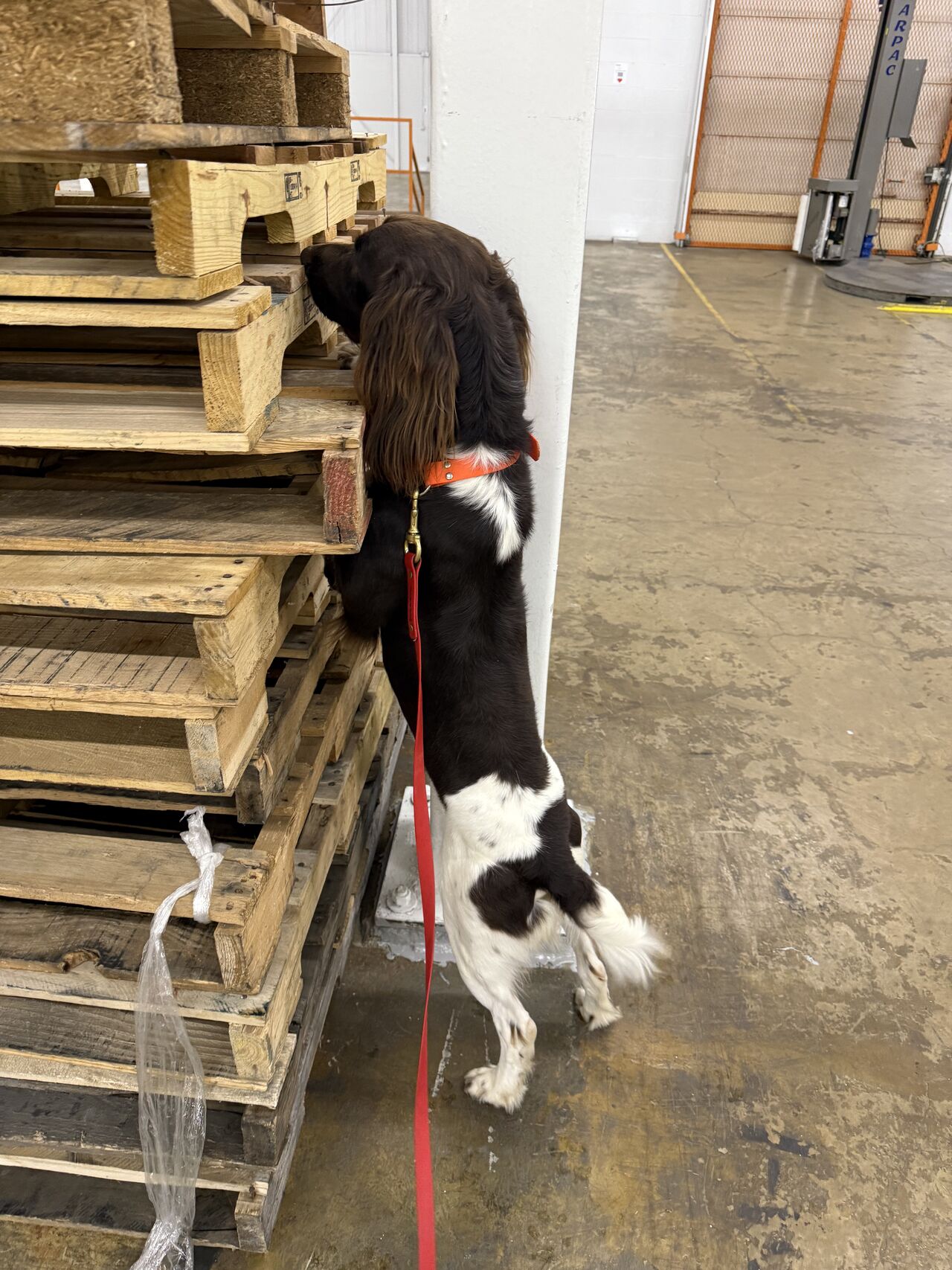
Most rodent calls here start the same way. Somebody hears scratching above a bedroom ceiling, or finds droppings on the grain bin lid, then spends six weeks shifting traps on a hunch. The hunch is the expensive part: a barn, a warehouse or a 1953 ranch house offers dozens of plausible voids, and a trap in the wrong one catches nothing.
A trained nose collapses that search, because scent from living animals differs from the residue they leave behind. Trapping and repair live on our rat and mouse control page; the canine service sits under K-9 rodent detection.
What does a detection dog tell you that a trap line cannot?
It tells you where. That is the whole product, and it is worth more than it sounds.
Traps and stations are sampling devices; a rodent that never crosses the twenty spots somebody chose is invisible to the program. A dog does not sample. It reads odor leaving voids, wall cavities, ceiling plenums and stacked product, at walking pace, across a whole building. It works in occupied space, so a tenant does not move out and a kitchen does not close. It works in cluttered and sealed space, without cutting an inspection hole first.
Now the limits. A dog tells you where activity is, not how many animals are producing it. One indication is not one rat. Odor pools, drifts on air currents and collects at the low point of a chase, so an indication marks a concentration rather than an animal at an address. Nor does a dog call species from odor; that comes from droppings and runway height.
Published field validation for canine scent detection is deepest on bed bugs and on conservation work. Structural rodent detection has much less behind it, so we quote no accuracy percentage — we could not find a study we would stand behind. Our reasoning sits on the canine scent detection accuracy page. Kimberly Camera founded this company after twenty-eight years in scent detection and a background in FEMA Urban Search & Rescue.
Why does Aiken’s building stock give rodents so many options?
Because the town was built twice, seventy years apart, and both layers are still standing.
The Savannah River Site is a 310-square-mile federal complex roughly twelve miles south of town, employing around 13,500 people. Its construction drew 35,000 workers, and when DuPont staff arrived in 1953 Aiken went from about seven thousand residents to more than forty thousand. Between 1951 and 1954 came Crosland Park, 426 slab-on-grade starter houses; Virginia Acres, 213 units on fifty-five acres; Forest Heights, 123 originally-rental houses; Silver Bluff Estates, 85; Vanwood, 53; and 244 units at Governor Aiken Park.
The weak point in that stock is not the walls. It is everything passing through them — water, sewer, gas, electrical service, later cable and HVAC line sets, each a hole cut through a sill plate or slab edge by somebody not thinking about rodents. Crosland Park is the clearest case on record: its water mains were transferred used from a Georgia housing development, are now more than seventy years old, and the city allocated four million dollars in March 2026 to replace them. Open trench along a foundation is where a burrow begins.
The older layer behaves differently. Aiken Winter Colony Historic District I holds around thirty-five properties built between roughly 1882 and 1948, most residences between 1900 and 1930, on Highland Park Drive, Lancaster Street, Dupree Road, Magnolia Street, Grace Avenue and Sumter Street. The listing describes unpaved roads, large mansions with outbuildings and expansive lawns, and stables. Rodent work there is never one building: it is a house, a carriage house, a stable and a feed room. Downtown adds a third pattern, with retail on the 1834 plat and apartments over shops on the Laurens Street spine.
What does Sandhills sand do to a burrow?
Aiken sits in the Sandhills, the uppermost coastal plain belt running along the Fall Line and covering roughly twelve percent of South Carolina. The soils are deep quartz sands — the Lakeland series is classified as thermic, coated Typic Quartzipsamments, excessively drained, rapid to very rapid permeability, sand thickness beyond eighty inches, over clay hardpans below. Rain does not stand on it. You can watch that inside Hitchcock Woods, where the Sand River only runs after heavy rain.
For a rat that means easy digging and dry lodging. We flag this as professional inference rather than published finding, since nobody has measured Norway rat burrowing in Sandhills soil: in our experience these burrows stay open year round, because the sand neither waterlogs nor collapses.
The construction split follows. New building across the South Atlantic division runs about 86 percent slab, which describes what is going up rather than what is standing — locally, crawl-space houses skew old. On a slab house, rodents burrow at the slab edge, under a stoop or garage apron, or into loose trench backfill, then enter at the sill plate. On pier-and-beam, the crawl space is a roofed burrow with your floor system as its ceiling.
Where burrowing must be stopped structurally the specification is published: a curtain wall at least thirty-six inches below grade, an L-footing with a foot of outward extension, or a gravel band two feet wide. Our repairs and exclusion crew builds to those numbers.
Norway rat, roof rat or house mouse — does it change anything?
It changes everything. Three species, three vertical habits, three trap layouts, three sealing priorities. Getting it wrong costs the first two weeks.
Norway rat
The ground-floor animal. Blunt muzzle, small ears, tail shorter than head and body, droppings up to three-quarters of an inch with blunt ends. It burrows, so locally it appears along slab edges and stoops, under sheds and dumpster pads, beneath feed rooms and grain bins. It needs free water daily, and it is neophobic, which is why pre-baiting is not optional. Norway rat profile.
Roof rat
Pointed muzzle, big eyes, ears long enough to fold over the eye, tail longer than head and body, droppings about half an inch with pointed ends. It climbs, nests above ground and uses limbs, fence tops and utility lines as roadways; its documented US range covers the lower East Coast and Gulf states. This is the species that puts you in the attic and the hay loft. Roof rat profile.
House mouse
Half an ounce, rice-grain droppings around a quarter inch with pointed ends, scattered rather than piled. The decisive fact is that it needs no free water, which is how mice colonize dry attics, cabinet runs and the inside of a tack trunk where a rat would die. Its home range is only ten to thirty feet across, which is why two traps under the sink achieve nothing. House mouse profile.
What it very often is not
Attic noise is not proof of a rodent. Southern flying squirrels are nocturnal cavity nesters and get reported as rats constantly. Eastern gray squirrels are a game species in South Carolina with their own handling rules. Cotton rats and woodrats are native and turn up under bird feeders.
Read the evidence, not the animal — you will almost never see the rodent. Dropping size and end profile settle species, then height does the rest: floor-line sign points at Norway, sign on ductwork points at roof rat, small amounts everywhere point at mice. See our pest library.
Why are horse properties the hardest rodent work in this county?
Because a feed room is a rodent’s ideal building and there is no version of it that is not.
The 2022 Census of Agriculture counted 1,132 farms and 138,479 acres in farms in Aiken County, with 14,447 acres in forage and 4,057 in corn for grain, alongside 5,610 horses and ponies. Add the equestrian core inside the city — the Horse District with its hitching posts and training grounds, the Winter Colony stables, Hitchcock Woods at 2,100 acres abutting residential streets, the Aiken Training Track, Whitney Field and Three Runs Plantation — and you have a rare density of buildings whose purpose is storing grain beside animals.
Consider what a dog is doing there. Bagged sweet feed on a pallet, a cracked-corn bin, hay stacked ten bales high, a tack room full of blankets and trunks, and a loft floor over all of it. Visual inspection means moving several tons of material. A canine screen reads the stack from the aisle.
Seasonal load compounds it. Across the three consecutive March weekends of the Aiken Triple Crown — the Trials at the Historic Aiken Training Track, which draw over ten thousand spectators, then the Spring Steeplechase, then Pacers & Polo at Whitney Field — temporary stabling, extra feed and bulk shavings arrive and then leave.
Why is rodenticide the wrong first move around a barn?
Two reasons, and the first is the animals you like.
Secondary poisoning is documented and it is not rare. A Cornell study published in Ecotoxicology in 2022 found anticoagulant rodenticide residues in 68 percent of 72 red-tailed hawks tested in New York. A USGS study found at least one anticoagulant in 48 percent of 40 barred owls sampled in Oregon and Washington. Both are out of region; we looked for Southeastern raptor monitoring and did not find it. What the findings justify is caution: a poisoned rodent stays alive and increasingly slow for days, and a slow rodent is easy prey for a barn cat, a farm dog, a hawk or an owl.
The second reason is that you lose the body. A poisoned rat does not die in the aisle where you can sweep it up. It dies in a wall void, under a loft floor, in a duct chase or six bales into a hay stack. You get odor for a fortnight and no confirmation of anything. Bait destroys the evidence detection work depends on.
Rodenticide is not never appropriate. In licensed hands it belongs in secured, tamper-resistant, numbered and mapped exterior stations, not scattered indoors. Since the EPA rodenticide risk mitigation decision, the second-generation anticoagulants brodifacoum, bromadiolone, difenacoum and difethialone are no longer registered for consumer products, and pelleted consumer bait is not permitted.
How small an opening are we actually talking about?
The rule of thumb is coins. A house mouse gets through an opening about the size of a dime; a rat needs one about the size of a quarter. The specification behind that is fractions: seal everything larger than a quarter inch for mice, larger than half an inch for rats. UC IPM notes a rat will squeeze under a door with a half-inch gap.
The building code says it a third way. Section R408.2 of the International Residential Code requires under-floor ventilation openings covered so the least dimension of the covering does not exceed one quarter inch, listing perforated sheet metal at least 0.070 inches, expanded sheet metal at least 0.047, cast-iron grating, extruded brick vents, and hardware cloth of 0.035-inch wire or heavier. A vent that meets code is already a rodent barrier; a rusted one is a code defect.
- Hardware cloth, rats: half-inch mesh, 19 gauge, woven — woven specifically, because non-woven fails at the joints.
- Hardware cloth, mice: quarter-inch mesh, 24 gauge, woven.
- Sheet metal: nothing lighter than 24 gauge on wall and pipe barriers, and nothing lighter than 22 on a kick plate or door edge.
- Doors: gap under the door no more than a quarter inch, with a sweep closing to within an eighth of an inch at the edges — barn and overhead doors included.
- Masonry: concrete at least two inches if reinforced, three and three-quarter inches if not; brick at three and three-quarter inches with mortared joints.
- Copper mesh and steel wool: fillers packed behind a hard cap, never the barrier itself. Steel wool rusts and works loose within a season.
- Sill plate and band joist: the most productive line on an older Aiken house, because every plumbing, electrical, gas and line-set penetration crosses it.
- Expanding foam: an air seal, not a rodent seal. It stops drafts. It stops nothing with teeth.
What does not work, and why does it keep selling?
- Ultrasonic and electronic repellers. In May 2001 the Federal Trade Commission sent warning letters to more than sixty manufacturers and retailers of ultrasonic pest devices, having already brought enforcement actions against six companies between 1985 and 1997. Current UC IPM guidance is equally plain: little evidence exists that any sound, magnetic or vibrational device will push an established mouse population out of a building.
- Peppermint oil and other botanical repellents. We went looking for an extension or regulatory source supporting peppermint oil as a structural rodent repellent and could not find one, so we do not sell it. We are not claiming it has been disproven, because that is a different statement — but no source we would cite recommends it.
- Glue boards left down unattended. Adult rodents can frequently sense the glue and step around it, per UC IPM, so the board fills with juveniles while the breeding adults carry on. Non-target lizards, snakes and songbirds get caught too. We use them for monitoring in narrow circumstances, never on a barn floor.
- One round of bait, then nothing. Norway rats run four to six litters a year of six to twelve young and mature around three months; house mice run five to ten litters and mature at six to ten weeks. A single surviving pair, or one unrepaired gap, rebuilds the infestation within a season.
- Sanitation on its own. The standard handbook is candid that even excellent sanitation will not eliminate house mice. It makes trapping work better and fresh sign visible. It is not a substitute for closing the envelope.
- The fire statistic you have probably read. A widely repeated percentage attributing fires of unknown origin to rodents circulates across this industry. We traced it to an uncited state fact sheet and found nothing from the NFPA or the US Fire Administration supporting it, so we will not put a number on it. The verifiable version is enough: incisors grow around five inches a year, gnawing is continuous, and chewed wiring is a routine finding in an established attic infestation.
When does rodent pressure peak around Aiken?
The normals set the frame. The Aiken 4 NE station records a last spring freeze around March 22, a first fall freeze around October 12, and 232 freeze-free days, on 50.77 inches of average annual precipitation. Outdoor food and cover therefore persist most of the year. It does not follow that rodents breed continuously outdoors: the literature is specific that Norway rat breeding peaks in spring and again in fall, slows in summer heat, and often halts in winter.
Late February through April
Spring breeding peak, arriving as the Triple Crown weekends put extra feed and temporary stabling onto horse properties. Burrow openings along foundations become visible again.
May through August
Breeding slows in the heat and outdoor food is abundant, so activity moves outward — fruit and nut trees, spilled feed, pet bowls, feeders, dumpsters. Interior complaints drop, which fools people into thinking it resolved itself.
September through November
The annual spike. Fall breeding coincides with cooling nights and the collapse of outdoor food right around that October 12 freeze date, and roof rats move into attics and lofts as the canopy thins.
December through February
Whatever got in is now obvious — ceiling noise, pantry droppings, gnawed wire, shredded insulation. A heated building with harborage is a habitat where winter does not interrupt breeding.
Seal before they need to come in. August through early October is the window in this climate, and it is when a screen earns most, because you want the map before the weather decides for you.
How does a canine rodent inspection actually run?
Scope agreed before we arrive
Which buildings, which levels, whether the barn aisle can be clear of horses, whether a warehouse needs us between shifts, and who receives the report.
Exterior first, on foot
Perimeter, grade line, slab edge, stoops, utility trenches, dumpster pad, feed bins and every line reaching a roof. Burrows, runways and gnaw damage are photographed before the dog works.
The dog works the structure
Handler and dog cover perimeter walls, floor-wall junctions, equipment bases, racking and mechanical spaces in a consistent pattern. We do not work a dog past fatigue, in heat it should not be working in, or through a space another team has just scented.
Every indication gets confirmed
Targeted human inspection at that spot — droppings, urine staining, rub marks, gnawing, nesting material, sometimes a borescope through an existing gap rather than a new hole. In a low-level problem there is often very little to see, which is why the dog was worth bringing.
Species called from evidence
Dropping size and end profile, runway height, gnaw pattern, grease marks. That determines trap layout, sealing priority and whether we work the ground plane or the roofline.
Map, then clear, seal and verify
An annotated photo set shows every opening that must close and the specification it closes to. Trapping clears the interior and exclusion closes the envelope, sequenced so nothing is sealed inside a wall. Then the dog re-screens.
What is included in an Aiken canine rodent inspection
- Certified handler and detection dog working to a consistent pattern
- Exterior perimeter, grade line, roofline and utility survey with photographs
- Interior screening of wall voids, ceilings, chases, equipment bases and stacked product
- Barns, feed rooms, tack rooms, hay lofts and grain storage inside the property scope
- Human confirmation of every canine indication before anything is recommended
- Species identification from droppings, runways, rub marks and gnaw evidence
- Entry-point map keyed to hardware-cloth, sheet-metal and masonry specifications
- Sanitation and harborage findings — spilled feed, pet bowls, feeders, dumpster condition
- Written, dated, photographed findings suitable for an owner, insurer or auditor
- Post-remediation re-screening, whether we did the remediation or somebody else did
Which Aiken operations need this documented rather than just done?
Warehousing and manufacturing. The Sage Mill industrial park, the Bridgestone plant in Graniteville and the Kimberly-Clark operation at Beech Island anchor a real distribution footprint, and racked product is where visual inspection quietly stops working. See our warehouse and distribution program.
Food service. If you run a kitchen on Laurens Street or in The Alley, know who inspects you: retail food inspections in South Carolina moved from DHEC to the South Carolina Department of Agriculture on July 1, 2024. SCDA covers roughly 24,000 establishments, scoring on a 100-point scale where an A is above 87. FDA Food Code 6-202.15 sets the requirement for outer openings, down to 16-mesh-to-the-inch screening. See our restaurant and food service program.
Multifamily and rentals. Renters occupy 31.9 percent of Aiken’s 13,275 occupied households, much of it in the 1950s subdivisions and downtown conversions. Unit-by-unit response in a connected building is a permanent line item, because a shared wall cavity is a corridor. See our multifamily program.
Campuses and institutions. USC Aiken’s residence halls ran at full capacity in fall 2025 with more than nine hundred residential students. Aiken Technical College runs a 104-acre Graniteville campus with over 3,400 credit students, the county district operates 41 schools for 22,916 students, and Aiken Regional Medical Centers carries 273 licensed beds. See our schools and student housing program.
For multi-site and audit-driven programs we run the same methodology nationally through nationwide K-9 rodent detection: documented program, site map with uniquely numbered device locations, service reports, trend analysis and corrective actions. We do not quote SQF or BRCGS clause numbers, because a wrong clause number in front of a QA manager is worse than silence.
Who is licensed to do rodent work here?
In South Carolina, applicators and pest control businesses are licensed by the Clemson University Department of Pesticide Regulation — the land-grant university rather than a state agriculture department, which catches most people out. Structural work falls under Category 7A. A firm needs a DPR business license, a Designated Certified Applicator at each location, and general liability coverage of at least $100,000.
In Georgia, which matters if your properties run over to the Augusta side, structural pest control is regulated by the Georgia Department of Agriculture through the Structural Pest Control Commission under O.C.G.A. section 43-45. The operator category is Household Pest Control, and its rule text is precise: it excludes the control of mammals with the exception of commensal rodents and squirrels.
Where around Aiken do we work?
Coastal K-9 & Pest Solutions · 320 Wendy Lane, Windsor, SC 29856 · 803-226-3155 · Kim@ck9ps.com. Windsor puts us about twenty minutes from the middle of Aiken, which is why same-week scheduling is normal.
Inside the city we cover downtown and the Laurens Street corridor, the Winter Colony districts, the Horse District, Schofield and the Parkway District, Crosland Park, Virginia Acres, Forest Heights, Vanwood, Silver Bluff Estates, Governor Aiken Park, Houndslake, Woodside Plantation, Cedar Creek, Gem Lakes, the Kalmia developments and Three Runs Plantation. Beyond the city limits: Montmorenci, Beech Island, Jackson, New Ellenton, Windsor, and the Horse Creek Valley mill villages at Graniteville, Vaucluse, Warrenville, Langley, Burnettown, Bath and Clearwater. See every area we serve.
Properties here often need more than one service: K-9 bed bug detection in Aiken for barn apartments and lodging, bird control in Aiken for warehouse roosting, and goose control in Aiken for pond and turf pressure.
Frequently asked questions
Can a dog tell me how many rats are in my building?
No, and anyone claiming otherwise is overselling. A detection dog reports the location of live activity, not a population count. Odor drifts and pools, so an indication marks a concentration rather than a number of animals. Estimates come afterwards, from trap catch over time and fresh sign at known runways.
Will the dog indicate on old droppings or a rodent that died in a wall?
A properly trained team works on odor from live activity rather than historical residue, which is the whole reason a canine screen answers a different question than a visual one. No team is infallible, and heavy old contamination complicates a space, so we confirm every indication by hand.
Do I need to empty the feed room or unstack the warehouse first?
Please do not. Clutter is the reason to hire a dog, not an obstacle to it. Breaking down racking beforehand scatters odor, disturbs runways and destroys the sign we use to confirm an indication. Switching off strong fans nearby does help.
Is this safe around horses, barn cats and farm dogs?
Yes, and that is the practical argument for leading with detection on a horse property. Nothing is applied during an inspection. Our dogs work on lead with a handler, and we schedule around turnout, feeding and farrier visits so the aisle is calm.
How is this different from your rat and mouse control service?
Different questions, different deliverables. This page is detection: where the live activity is, in what part of which structure. Rat and mouse control is treatment and repair — trapping at correct density, exclusion built to specification, cleanup and verification. A recurring problem nobody can locate usually needs both.
My house is on a slab. Can rodents still get under it?
Not under the slab itself, but that is not where the problem is. They burrow at the slab edge, under the front stoop, along a garage apron or into loose utility-trench backfill, then enter at the sill plate, a plumbing penetration or the garage door corner seal.
What about squirrels or flying squirrels in the attic?
Very common, and worth identifying before anyone sets anything. Southern flying squirrels are nocturnal cavity nesters and get reported as rats constantly, because the night noise sounds identical through a ceiling. Eastern gray squirrels are a game species here with their own handling rules.
Can you screen an occupied restaurant or a stocked warehouse without shutting down?
Usually yes, and that is much of the point. A canine screen involves no product application and no evacuation, so a kitchen can be worked between services and a warehouse between shifts. We agree beforehand how a finding in a production area gets communicated.
Will I get something in writing I can hand to an auditor?
Always — the document is the actual product. Dated findings location by location, photographed, with an entry-point map keyed to the sealing specification each opening needs. Multi-site operators get the same format through our nationwide rodent detection program.
Why hire a detection team that is not selling me the treatment?
Because incentives show up in reports. When the company inspecting is the company quoting, every finding is also a sale, and that report carries less weight when an owner, a tenant or an auditor disagree. The argument is on our independent canine detection page.
Related services
Find out where they are before you spend another dollar guessing
Tell us the building, what you have seen and where. We will work the structure with a certified team, confirm every indication by hand, map the openings that have to close, and put it in writing. Serving Aiken and the Horse Creek Valley from Windsor, South Carolina.