
K-9 Rodent Detection in North Augusta, SC
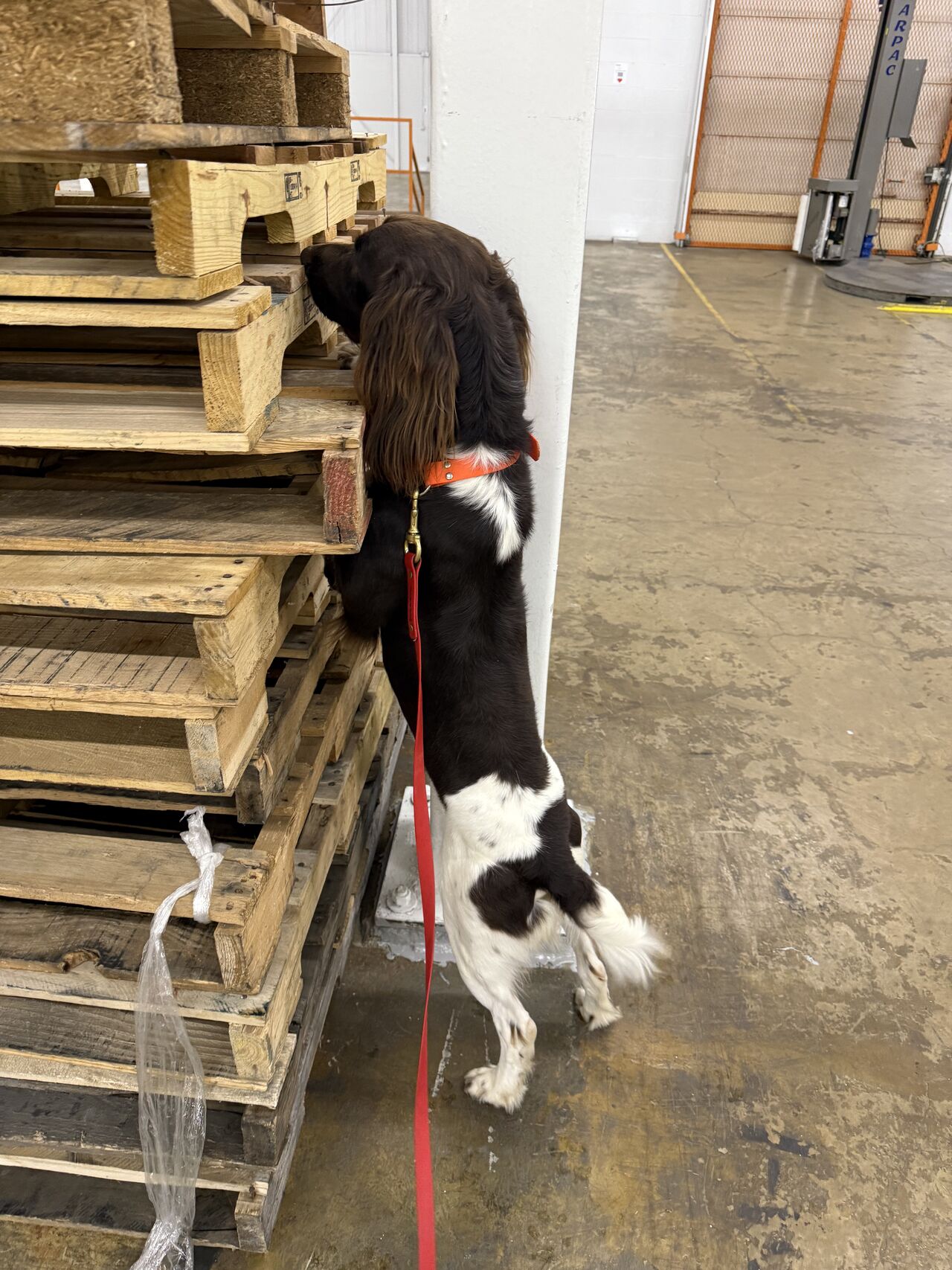
A certified detection dog from Coastal K-9 & Pest Solutions covers a North Augusta property and pinpoints where live rodent activity actually is — under seventy-year-old floor systems, behind cabinet runs, above apartment ceilings, inside riverfront storerooms. You get mapped, photographed locations instead of another month of guessing.
North Augusta grew up twice. A land company bought about 5,600 acres in 1890, the city incorporated on 11 April 1906, and the Savannah River Plant build-out then quadrupled the population. That second wave is still standing and still occupied, which is why so many rodent calls here sound identical: a noise overhead after dark, droppings behind the range, weeks of moving snap traps from one guess to the next.
Guessing is the expensive part. A trap set in the wrong void records nothing, which reads, wrongly, as good news. Trapping and repair belong to rat and mouse control; detection sits under K-9 rodent detection.
Why does a Savannah River Plant-era house leak rodents?
Because it has had seventy years of trades cutting holes in it, and nobody was thinking about mice on any of those days.
Of 12,694 housing units, the 1950s account for 2,213 — 17.4 percent, the largest decade on the record. The 2000s sit almost level at 17.1 percent. Everything predating 1950 totals 672 units, just 5.3 percent, while post-2000 building is 32.2 percent. The median structure dates to 1986 and 69 percent of units are single-family detached. The shape is a barbell, with a thin trough in between.
Our inspections concentrate in the older half, and the reason is not the walls. Walls rarely fail. What fails is everything passing through them. Count the penetrations on a 1953 house: original supply and drain, original electrical service, a gas line, then a refrigerant line set, a dryer vent, cable, an irrigation feed. Each was cut through a rim joist or sill plate by somebody solving a different problem and closed, if at all, with whatever was on the truck.
One figure we will not give you, because nobody has it: what share of local houses sit on crawl space rather than slab. No published source reports that split for this city or county. The single citable number is national — NAHB puts the South Atlantic division at 85.7 percent slab — and it describes 2024 new construction only. We look at your foundation and tell you what it is.
What can a detection dog tell you, and what will it never tell you?
It tells you where. Smaller than the claim this industry usually makes, and more useful than it sounds.
Traps and stations are sampling devices. They report only on animals crossing the fifteen or twenty points a human chose, so a rodent that never crosses one is invisible to the programme. A dog is not sampling. Handler and dog cover perimeter walls, floor junctions, cabinet kicks, chases and stacked product at walking pace, reading odor that leaves cavities the eye cannot enter — in occupied space, without cutting an exploratory hole.
Now the boundaries. An indication marks a concentration of odor, not an animal at an address, and never a census. Odor pools and settles at the low point of a chase, so two indications do not mean two rats. Nor does a dog name the species.
A further limit, published rather than buried. Peer-reviewed field validation for canine scent detection is deepest in bed bug work and conservation detection; structural rodent detection has far less behind it. So we attach no accuracy percentage here, having found no study we would defend in front of a sceptical client. The company was founded by Kimberly Camera, who brings twenty-eight years in scent detection plus a FEMA Urban Search & Rescue background, and the argument is laid out on our canine scent detection accuracy page.
Which North Augusta subdivisions do we end up in, and what does the era mean?
The city’s planning GIS carries roughly three hundred recorded plats. Names we work in and around include Hammond Hills, Crystal Lake, Pinehurst, Knollwood, Walnut Grove, Wando Woodlands, Butlers Mill, Martintowne, Foxglove, Windtree, Bergen Place, Sudlow Hills, Hampton Terrace, The Summit, The Rapids, Rivernorth, Hammonds Ferry and Leyland Place, plus the bird-named villages of Lakes and Streams — Swan Lake Village, Robin Lake and Bluebird Lake Village.
Two caveats. That layer covers the city and surrounding areas, so some plats sit in unincorporated Aiken County. And it carries book and page, not recording dates, so we will not attach a build decade to a name we cannot date. Hammond’s Ferry is a documented 2000s development by LeylandAlliance; the Hampton Terrace name descends from a 1903 hotel that burned in 1916. Otherwise we date the house by looking at it.
The mid-century cohort
Original sill plates carrying seven decades of re-cut service penetrations. Under-floor vents are often original louvres, rusted past the quarter-inch limit the code sets, and kitchens remodelled twice leave abandoned pipe stubs behind toe kicks.
The 1960s through 1990s middle
Roughly 37 percent of the stock. The vulnerable line moves upward: gable and soffit vents, roof-to-wall junctions where an addition meets the original box, attic air handlers whose condensate lines open into the ceiling plane.
The post-2000 third
Nearly a third of the city is twenty-first-century and the envelopes are tighter. That is not immunity. Recurring failures are garage door corner seals, weep holes with no rodent guards, and trench backfill that never consolidated.
How is the Georgia Avenue and Butler Avenue district a different problem?
Because it is old in a way almost nothing else here is, and because there is very little of it.
The district joined the National Register on 5 April 1984 under reference 84002017, covering roughly thirty acres along Georgia Avenue, Butler Avenue, Observatory Avenue and Martintown Road, on a hill overlooking Augusta, Georgia. The nomination counts sixteen properties — thirteen contributing buildings, one cemetery, three non-contributing structures — with a period of significance from about 1859 to about 1930 and most erected between 1903 and 1907. Named examples include Star of Edgefield, an 1859 red brick house with a two-tier veranda on iron posts, and Palmetto Lodge of 1903, Tudor Revival with half-timbering in the ends of a multi-gable roof.
Only 5.3 percent of the city’s housing predates 1950, so this is a small number of buildings doing something the rest of the stock does not. A multi-gable roof is a set of valleys and junctions, each a route for a climbing animal, and outbuildings turn a single address into a four-building job.
What we will not do is describe the Georgia Avenue commercial block. That nomination is a residential document; it lists commercial among present uses but gives no build dates or construction type for the storefronts, and no other source we found does either. Anyone stating confidently what those buildings are made of is guessing.
Which rodent is it, and how do you read what it leaves?
You will almost never see the animal, so identification is forensic. Three commensal species occur here, they occupy different vertical planes, and calling the wrong one costs you a fortnight.
| Evidence | Norway rat | Roof rat | House mouse |
|---|---|---|---|
| Droppings | Up to three-quarters of an inch, blunt ends | About half an inch, tapered to points | Around a quarter inch, rice-grain, scattered |
| Body | Blunt muzzle, small ears, tail shorter than the body | Pointed muzzle, big eyes, ear folds over the eye, long tail | Half an ounce, large ears for its size |
| Where sign is | Floor line, slab edge, burrow mouths, under stoops | Ductwork, top plates, attic insulation, rafters | Everywhere in small amounts — drawers, toe kicks |
| Water | Needs free water daily | Needs free water | Needs none, which is how it survives a dry attic |
| Range | Wide-ranging, neophobic; pre-baiting is not optional | Arboreal; travels limbs, fence tops, cabling | Home range ten to thirty feet across |
| What it changes | Ground plane sealing, burrow work | Roofline sealing, soffit and vent work | Trap density — many traps close together |
Details sit in the Norway rat profile, the roof rat profile and the house mouse profile. Rule out impostors first: attic noise proves an animal, not a rodent. Southern flying squirrels are nocturnal cavity nesters reported as rats constantly, and eastern gray squirrels are a game species with their own handling rules. More in the pest library.
What does Fall Line sand do to a burrow?
Augusta is the fall line city of the Savannah River, which puts North Augusta on that boundary and inside the Sandhills belt — the uppermost coastal plain, covering about twelve percent of South Carolina.
The soils are deep quartz sands. USDA-NRCS classifies the Lakeland series as thermic, coated Typic Quartzipsamments. Translated: excessively drained, permeability from rapid to very rapid, upwards of eighty inches of sand, clay hardpans somewhere beneath that. Rainwater does not linger; the county averages 50.77 inches a year and most goes straight down.
For a burrowing rat that is close to ideal ground. Treat the next line as professional observation rather than published finding, because nobody has measured Norway rat burrowing in Sandhills soil: these burrows stay serviceable all year, so an open hole beside a stoop in February is usually current.
Where digging must be stopped structurally, the specification is settled. Three details each stop a digging rat at a foundation: a curtain wall carried thirty-six inches or more below grade, an L-footing returning about twelve inches outward, or coarse gravel laid in a band two feet wide. Our exclusion and repair crew builds to those dimensions.
How big does a gap have to be before it matters?
Smaller than almost anyone expects. Coins make the useful mental picture. A dime-sized hole admits a house mouse; a quarter-sized one admits a rat. As a specification, close anything wider than a quarter inch where mice are in play, half an inch for rats. UC IPM notes that a rat will get under a door with a half-inch gap beneath it.
The code arrives at the same place from another direction. Under IRC section R408.2, the covering on a crawl space vent must hold its least dimension to a quarter inch or under. The code then names what satisfies that: perforated sheet metal from 0.070 inches, expanded metal from 0.047, cast-iron grating, and hardware cloth woven from wire of 0.035 inches upward. A vent still meeting that standard is already a barrier; a rusted one is a code defect and a doorway at once.
- Hardware cloth against rats: half-inch mesh, 19 gauge, woven rather than welded — welded joints are where cheap mesh gives way.
- Hardware cloth against mice: quarter-inch mesh, 24 gauge, woven.
- Sheet metal: 24 gauge or heavier on wall and pipe barriers, 22 gauge where it takes abuse.
- Doors: a quarter-inch threshold gap at most, with a sweep closing to an eighth of an inch at both corners, which is where sweeps fail.
- Copper mesh: packing behind a hard cap, never the barrier itself. It does not rust the way steel wool does.
- Sill plate and band joist: the highest-yield line on any older house here.
- Expanding foam: an air seal. It stops draughts and stops nothing with incisors.
Why is rodenticide the wrong opening move?
Two reasons. The first involves animals you never meant to poison. Secondary poisoning is documented rather than theoretical. Cornell researchers reporting in Ecotoxicology in 2022 recovered anticoagulant residue from 68 percent of the 72 New York red-tailed hawks they examined. USGS work on 40 barred owls in the Pacific Northwest returned at least one anticoagulant in 48 percent of the birds. Both are out of region, and we looked for Southeastern raptor monitoring without finding any, so we offer them as evidence of a mechanism rather than a local prevalence figure. A poisoned rodent does not die quickly. It becomes slow and exposed for days, and a slow rodent is the easiest meal available to a hawk, an owl or your own dog.
The second reason is that bait destroys your evidence. A poisoned rat dies in a wall cavity or deep in stored product, and you get a fortnight of odor and confirmation of nothing. None of that makes rodenticide illegitimate. Handled by a licensed applicator it goes outside, in locked tamper-resistant housings that carry numbers and appear on a drawing, and it goes out after the envelope is understood.
What is being sold to you that does not work?
Naming these is the fastest way to stop somebody wasting a season.
Ultrasonic and electronic repellers
Six companies faced Federal Trade Commission enforcement between 1985 and 1997, and in May 2001 the Commission followed with warning letters to over sixty makers and sellers of ultrasonic pest devices. UC IPM is blunt on the point: almost no evidence supports sound, magnetic or vibrational gadgets clearing a settled mouse population.
Peppermint oil and botanicals
Nothing from an extension service or a regulator backs peppermint oil as a structural rodent repellent, and we did look, so it is not something we sell or advise. That is not the same as calling it disproven. It means no source we would cite endorses it.
Glue boards left down and forgotten
Adults frequently sense a glue board and walk around it, per UC IPM, leaving a tray of juveniles while the animals doing the breeding go untouched. Non-target lizards, snakes and small birds get caught too.
One round of bait, then nothing
A Norway rat delivers four to six litters annually, six to twelve young apiece, and is breeding by month three. Mice manage five to ten litters and breed at six to ten weeks. One surviving pair rebuilds the whole population inside a season.
Sanitation on its own
Necessary and insufficient. Even first-rate housekeeping will not remove a house mouse population, and the trade’s standard handbook says so plainly. Cleaning does not close a building.
The fire percentage you have read
A widely circulated figure attributing a share of fires of unknown origin to rodents runs through this industry. The trail ends at a state fact sheet that cites nobody, and neither the NFPA nor the US Fire Administration carries anything resembling it, so the number stays off this page. Incisors grow roughly five inches a year and gnawing is compulsory; that is enough.
How does the rodent year run in the CSRA?
The published normals frame it. AIKEN 4 NE, the nearest official station, records a last spring freeze around 22 March, a first fall freeze around 12 October and 232 freeze-free days, on a county mean of 64.1°F. Outdoor food and cover therefore persist most of the calendar. It does not follow that breeding runs unbroken outdoors. Published work puts two Norway rat peaks on the calendar, one in spring and one in autumn, with a lull through the heat and a frequent winter halt.
Late February into April
The spring peak, opening around that 22 March freeze date. Burrow entrances along foundations reappear before the grass thickens, which makes these the best weeks of the year for an exterior survey.
May through August
Heat suppresses breeding while outdoor food is everywhere, so the pressure shifts outdoors: fallen fruit, spilled seed, pet bowls, dumpster pads, patio dining. Interior complaints fall away and people conclude it resolved itself. It went outside.
September through November
The annual spike. Autumn breeding meets cooling nights and the collapse of outdoor food around the 12 October freeze date, and climbing rodents move into attics as the canopy thins.
December through February
Whatever got in is now unmistakable: ceiling noise, pantry droppings, shredded insulation, gnawed wire. A heated building with harborage is a year-round habitat.
August into early October is therefore the window here for a screen followed by sealing.
Do vacancy rates and the greeneway corridor actually matter?
Both do, and both deserve stating carefully rather than dramatically.
Start with vacancy, which nobody thinks about. Of 12,694 housing units, 1,679 are vacant — 13.2 percent, against a rental vacancy rate of 12.6 percent. An empty unit is unheated, unmonitored and unswept, with nobody to notice droppings, and in a duplex or townhouse row the wall cavity it shares with an occupied unit is a corridor rather than a barrier.
Then the linear corridors. The North Augusta Greeneway runs over seven miles of paved trail along an abandoned railroad alignment, named for Mayor Thomas W. Greene, who served from 1985 to 1997. It reaches from Pisgah Road to Riverside Boulevard near the River Golf Club, with a 1.5-mile extension through the Crystal Lake area to the riverfront. A continuous vegetated edge with reliable cover is a travel lane for wildlife. Label that as what it is, a habitat argument: no agency publishes rodent counts for this city, and we are not inventing any.
The code does give one hard, citable sanitation rule. Section 5-16 requires that manure, urine, soiled straw and other animal refuse not accumulate more than 24 hours, held in leakproof and flyproof receptacles with tight-fitting covers, cleaned daily. Chapter 5 Article IV, adopted 17 May 2010, separately bars feeding wild animals and waterfowl in city parks and on other publicly owned land, counting each day a separate offence, though it reaches public land only. Where the pressure is birds or waterfowl, see bird control in North Augusta and goose control in North Augusta.
Which North Augusta businesses need this documented rather than merely done?
Here is a claim we will not make. We could not verify a single warehouse, distribution centre or manufacturing plant physically inside North Augusta. Regional names get attached to this city constantly and should not be: Kimberly-Clark operates at Beech Island, Bridgestone’s plant is at Graniteville, Textron is in Augusta, Georgia. The commercial rodent story here is food service, lodging, retail, offices and apartments.
Restaurants, bars and event food service. Riverside Village is a roughly 30-to-35-acre, approximately $200 million mixed-use development at the 13th Street Bridge; it broke ground as Project Jackson in May 2017 and holds restaurants, a brewery, an amphitheatre, apartments and offices. City-owned SRP Park opened beside it on 12 April 2018, seats 4,782 and holds up to 10,000 for larger events — concession space that runs hard in short bursts, then sits idle. Know who inspects you. Since 1 July 2024 the agency scoring South Carolina retail food establishments has been the Department of Agriculture rather than DHEC, working a hundred-point sheet on which anything above 87 earns an A.
Lodging. The Crowne Plaza North Augusta at 1060 Center Street opened in January 2019 inside Riverside Village: five storeys, 180 guest rooms and suites, 11,000 square feet of meeting space and a 5,400-square-foot ballroom. That shape puts kitchens, banquet storage, loading and refuse handling on one back-of-house spine, which is the geometry a canine screen covers fastest. See our hotel and hospitality programme.
Apartments, offices and retail. Multifamily of all sizes totals roughly 2,475 units, about 19.5 percent of the stock, and in a connected building a rodent problem in one stack is a building problem misfiled as a tenant problem — the basis of our multifamily programme. The plat record also carries Interchange Business Park, Martintown Professional Office Park and Merovan Business Center, where shared plenums and refuse enclosures mean a finding in one suite is rarely confined to it. Multi-site operators get the same methodology through nationwide K-9 rodent detection, and we quote no SQF or BRCGS clause numbers, because citing the wrong clause to a quality manager is worse than citing none.
How does a canine rodent inspection actually run?
Scope settled before the van leaves
Which buildings and levels, whether a crawl space is safe to enter, whether a kitchen needs us between services, and who receives the report.
Exterior survey on foot, first
Perimeter and grade line, slab edge, stoops, garage door corners, utility trenches, refuse enclosure, weep holes, vents, and every line or limb reaching the roof. Burrows and gnaw damage are photographed first.
The dog works the structure
Handler and dog cover walls, floor junctions, cabinet kicks, chases, mechanical spaces and stored product in a consistent pattern. A tired dog is a useless dog, so we stop short of that, decline conditions too hot for safe work, and will not follow another handler through a freshly scented building.
Every indication confirmed by hand
Targeted inspection at the point indicated — droppings, urine staining, rub marks, gnawing, nesting material, and where needed a borescope through an existing gap rather than a fresh hole. Early or light activity leaves almost nothing visible, and that scarcity of sign is exactly the case a dog was brought for.
Species called from the evidence
Dropping size and end profile, height of the sign, runway grease marks, gnaw pattern. That fixes trap layout and the order sealing happens in.
Map, clear, seal, re-screen
You receive marked-up photographs: each opening that has to be shut, alongside the material and dimension that shuts it. Interior trapping comes down first and envelope sealing follows, in that order, so no live animal is shut into a cavity. The dog then re-screens.
What does a North Augusta canine rodent inspection include?
- Certified handler and detection dog, working to a repeatable pattern
- Exterior perimeter, grade line, roofline, vent and utility survey, photographed
- Interior screening of wall voids, ceiling planes, chases and cabinet runs
- Crawl space and under-floor assessment where conditions allow entry
- Hand confirmation of every indication before a recommendation is written
- Species identification from droppings, runway height and gnaw evidence
- Entry-point map keyed to mesh, gauge, door-sweep and masonry specifications
- Harborage and sanitation findings against the 24-hour city refuse standard
- Dated, photographed findings for an owner, tenant, insurer or auditor
- Post-remediation re-screening, whether the repairs were ours or not
Who is licensed to do this work on each bank of the river?
The Savannah River is a licensing boundary as well as a state line, and North Augusta sits on the South Carolina side of it.
South Carolina vests licensing in the Department of Pesticide Regulation at Clemson University. A land-grant institution holding that authority, instead of a state agriculture department, surprises nearly everybody who asks. Structural work sits in Category 7A, and a firm must hold a DPR business licence, name a Designated Certified Applicator at each location, and carry general liability of $100,000 combined single limit or better.
In Georgia, which matters the moment a portfolio crosses the bridge into Augusta, the regulator is the Georgia Department of Agriculture, acting through its Structural Pest Division alongside the Structural Pest Control Commission, whose authority comes from O.C.G.A. section 43-45. Household Pest Control is the operative category, and its rule text is unusually exact about scope: mammals fall outside it, apart from commensal rodents and squirrels.
Where do we work in and around North Augusta?
Coastal K-9 & Pest Solutions · 320 Wendy Lane, Windsor, SC 29856 · 803-226-3155 · Kim@ck9ps.com. We are an Aiken County company working an Aiken County city, which is why same-week scheduling is normal rather than exceptional.
Inside the city we cover the Georgia Avenue and Butler Avenue corridor, Martintown Road, the Five Notch and Knox Avenue side of town, Riverside Village and Hammond’s Ferry, the Crystal Lake area and the greeneway corridor, and the residential belt through Hammond Hills, Pinehurst, Knollwood, Walnut Grove, Butlers Mill, Wando Woodlands, The Summit and The Rapids. Beyond the limits we work Belvedere, Clearwater, Bath, Beech Island, Jackson, Graniteville, Warrenville, Vaucluse and on into Aiken. See every area we serve. Properties here often need more than one line of work, and K-9 bed bug detection in North Augusta covers lodging, apartments and turnover units.
Frequently asked questions
Can the dog work a crawl space, or does somebody have to go under the house?
Both, in that order. A dog can often read a crawl space from the access hatch and the vent line, because odor leaves it continuously. Where the space is dry and safe, handler and dog work it directly. Where it is not, a technician goes under with a light and a camera and works the points indicated.
My house is from the 1950s. Is that a real problem or a sales line?
A real pattern. The 1950s is the largest construction decade here at 17.4 percent of housing units, and the issue is age rather than build quality. Seventy years of plumbing, electrical, gas and HVAC work means seventy years of holes cut through the sill line. A house can be sound and still be open in nine places.
Do I need to empty cabinets or move stored product before you arrive?
Please do not. Clutter is the reason to bring a dog, not an obstacle to it. Pulling a pantry apart scatters odor, disturbs runways and destroys the fresh sign we use to confirm an indication by hand. One thing does help: switch off strong fans nearby.
Will an indication tell me whether it is rats or mice?
Not by itself. The dog reports location and live activity; it does not name species from odor, and anyone claiming otherwise is overstating the method. Species gets called at the confirmation step, from dropping size, the height sign appears at, and gnaw pattern.
Is anything applied during the inspection? We have a cat and a dog.
Nothing is applied. A detection visit is a handler, a dog on lead and a camera, which is the practical argument for leading with detection rather than product. We ask that resident animals be shut in another room, mainly to keep both dogs relaxed and the scent picture clean.
My apartment manager blames the neighbouring unit. Is that plausible?
Frequently yes, and it is testable rather than a matter of opinion. Shared wall cavities, ceiling plenums and plumbing chases connect units, so activity often originates two doors away. With rental vacancy at 12.6 percent citywide, an empty adjoining unit is a strong candidate.
Should I put bait down while I wait for the appointment?
We would rather you did not, and the reason benefits you. Bait sends animals into voids to die, which produces odor with no confirmation and degrades the fresh sign we use to verify what the dog finds. Snap traps in a safe location are fine.
Do you carry out the repairs, or only the finding?
Both, and deliberately separate. Detection produces the map. Rat and mouse control handles trapping, and our repair crew builds exclusion to the mesh and gauge specifications above. Some clients want one contractor; others want the inspection independent of whoever quotes the work.
Why will you not publish an accuracy percentage for this service?
Because we found no structural rodent detection study we would be prepared to defend. Canine detection has solid field validation in bed bug work; rodent detection inside buildings has much less. Borrowing a number from a different application would be dishonest. The reasoning is on our independent detection page.
Related services
Stop paying for guesswork and get the locations on paper
Describe the building, the noises and the places sign has turned up. A certified team screens the structure, verifies each indication by hand, maps the openings that have to be shut, and leaves you a dated photographic record. Serving North Augusta and Aiken County from Windsor, South Carolina.