
Bird Control in North Augusta, SC
North Augusta sits on the bluff above the Savannah River, and its bird trouble gathers where the ledges are oldest and the food is easiest. Coastal K-9 & Pest Solutions names the species before quoting anything, works inside what federal law and the city code allow, then rebuilds the structure so the roost cannot re-form.
For its size North Augusta holds a wide range of buildings: a National Register district of turn-of-the-century houses on the hill above Augusta, a large cohort of 1950s brick from the Savannah River Plant years, business parks off the highway, and a riverfront quarter finished in the last decade. Birds read all of it the same way. Level surface, unclosed cavity, reliable meal nearby.
Two things govern a bird job here, and neither is the product catalogue: which bird it is, because federal law splits the species into two groups with different rules, and the fabric of the building, which is what generates the problem. Our bird control and exclusion service is built on both.
Which birds may you lawfully move, and which will stop the job?
Get this wrong and routine maintenance becomes a federal offence. The Migratory Bird Treaty Act protects the species named at 50 CFR 10.13, a list last revised at 88 FR 49310, effective 30 August 2023, running to 1,106 birds. Protection covers the active nest and the eggs, not only the adult. The three birds doing the most damage to buildings here are absent from that list, which is why identification comes first.
Rock pigeon
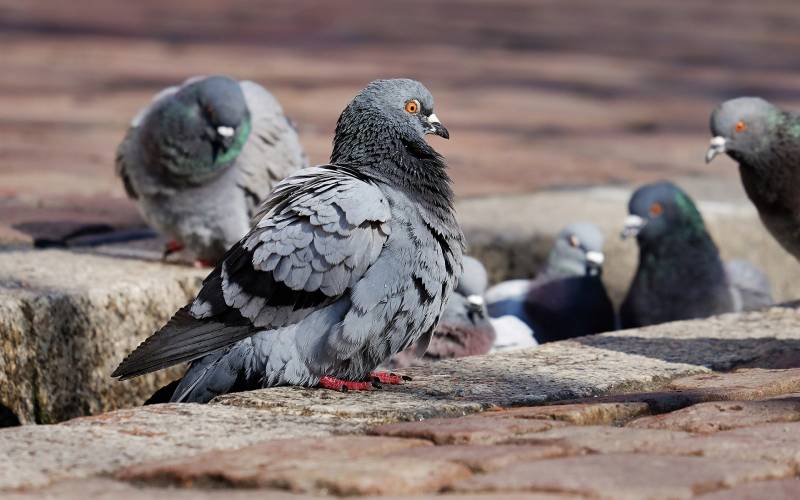
The parapet and cornice specialist, and the bird in the photograph above. Its family is covered by the treaties, but the feral pigeon is carved out as introduced. Background in our pigeon profile.
European starling
A hole-nester, which is why starlings end up behind fascia, inside gable louvres and under lifted flashing rather than out on the ledge. Closing cavities is the answer. See the European starling profile.
House sparrow
Small enough to live inside a lit channel letter or a soffit vent that lost its screen. Sparrows fall outside the treaties because their family was never brought under them — a different route from the pigeon, same result. See the house sparrow profile.
The protected majority
Chimney swifts, purple martins, swallows, crows, grackles, blackbirds, herons, egrets, gulls and Canada geese are on the list — several of them birds people assume nobody protects.
Three federal provisions decide most of what happens next.
- 50 CFR 21.100. The rule states that “no permit is required merely to scare or herd depredating migratory birds.” Anyone selling you permission to frighten birds has the regulation inverted.
- 50 CFR 21.14. A bird shut inside a building may be taken out by anybody, with no permit, where its presence blocks normal use of the space or raises a health or safety concern. Handling must be humane, adhesive traps are forbidden, and the opening must be closed afterwards. Exclusion is written into the federal exemption itself.
- 50 CFR 21.150. A standing depredation order for blackbirds, cowbirds, crows, grackles and magpies where serious damage is occurring, non-lethal measures first each year. Gulls, vultures, geese, herons and egrets fall outside it.
Depredation permits from SCDNR cost nothing, run for thirty days and can be renewed; the agency also warns that a federally protected bird may need more authority than that.
What does North Augusta’s own code of ordinances say about this?
Most cities around here say nothing specific about birds. North Augusta does. Chapter 5 of its Code of Ordinances, Animals and Fowl, is the most useful local document an owner with a roost can read.
- Section 5-12 names pigeons outright. It is unlawful to keep “any chickens, turkeys, ducks, guineas, geese, pheasants, pigeons or other domestic fowl that will, because of noise, odors or flies, or otherwise, tend to impair health or disturb the peace, quiet and comfort of nearby residents or occupants of places of business.” Noise, odors and flies: a fair summary of a mature roost.
- Section 5-16 puts a clock on the mess. Manure, urine, soiled straw and other animal refuse may not accumulate beyond 24 hours, and receptacles must be “leakproof and flyproof” with tight-fitting covers, cleaned daily.
- Section 5-18 makes inspection a standing duty. The animal control officer must examine premises “at frequent intervals” to confirm they have not become a nuisance through noise, noxious odors, flies, filth or otherwise.
- Article IV bans feeding on public ground. Sections 5-50 to 5-53, adopted by Ordinance No. 2010-08 on 17 May 2010, prohibit knowingly feeding or baiting wild animals and waterfowl in city parks and on publicly owned land.
- Every day counts separately. Section 5-53 provides that “a separate offense shall be deemed committed on each day or part of each during which a violation occurs or continues.” Section 5-23 makes a violation a misdemeanor carrying up to $500, up to 30 days, or both.
- The licensed-operator carve-out. Section 5-51(b) exempts city, state and federal agents, and “nuisance wildlife control officers lawfully engaged in a wildlife or waterfowl management program.”
Two qualifications, because overstating an ordinance helps nobody. The feeding prohibition reaches only parks and publicly owned land; it does not stop a neighbour scattering bread on their own driveway. And section 5-12 is written about keeping fowl, so a feral flock is an imperfect fit for its wording. A roost tolerated for two seasons has produced exactly the conditions the chapter describes.
Why does hardware outlast harassment?
Deterrence asks a bird to believe something. Exclusion asks it nothing. Gel lines, spinning reflectors and speakers cycling distress calls depend on an implied consequence, and a flock that has tested it a dozen times stops responding.
Take a wide masonry coping. Running repellent gel along it takes minutes, and within a season the product has skinned over, caught grit and become a tacky surface pigeons stand on happily. Converting that coping to a 45-degree slope in aluminium, stainless or polycarbonate deletes the plane altogether. One is a consumable; the other is a change to the building.
| Method | What it changes | How long it holds |
|---|---|---|
| 45-degree ledge conversion | Removes the level surface, leaving nothing to defend | Life of the fabrication |
| Closing soffits, gables and exhausts | Ends starling and sparrow nesting at source, which perch deterrents never touch | Permanent with hardware, not foam |
| Tensioned netting | Encloses canopies, courtyards, open bays and plant decks | Years, with tension checks |
| Post-and-wire | Makes a narrow ledge or rail unstable to land on; nearly invisible | Years, if retensioned |
| Stainless spike | Blocks landing on sills, pipe runs and sign tops; fails when debris bridges the rows | Long, if cleaned |
| Optical and acoustic scares | Brief displacement; habituation is documented | Days to weeks |
| Falconry patrol | Interrupts a settled flock’s routine of returning to the property | Holds while flown |
None of it works if the food stays. Sanitation decides whether the hardware has to fight or merely finish.
What changes when the building sits in the Georgia Avenue and Butler Avenue district?
The Georgia Avenue-Butler Avenue Historic District went on the National Register on 5 April 1984, reference 84002017. It covers roughly 30 acres along Georgia Avenue, Butler Avenue, Observatory Avenue and Martintown Road, on the hill overlooking Augusta, Georgia, and holds 16 properties, 13 of them contributing buildings. Its period of significance runs from about 1859 to about 1930, most of it built between 1903 and 1907.
Three named buildings show what the nomination means by character. Star of Edgefield, 1859, is red brick with a two-tier veranda on decorative iron posts, brackets and rails. Palmetto Lodge, 1903, is Tudor Revival with half-timbering in the ends of its multi-gable roof. The Queen Anne house at 1141 Georgia Avenue, 1905, is asymmetrically massed in varied textures. Read as a bird would, that is a catalogue of opportunity: bracketed cornices, open framing above verandas, repeated gable ends, deep eaves, ironwork perches.
A bank of spikes bolted through face brick on a contributing building is wrong twice over, for the fabric and for the look. Post-and-wire on mortar-joint anchors, a low slope behind a cornice line, and stainless components that will not stain the wall below are what belongs here — work that overlaps with our repairs and exclusion work, since the gap that let the birds in is usually a failed component.
An honest limit. The nomination is a residential document; it barely describes Georgia Avenue’s commercial buildings, and their dates and construction could not be verified, so we survey the elevation rather than describe a block we cannot source. Rosemary Hall, Lookaway Hall and the Charles Hammond House are separately listed and carry the same constraint.
Where else in the city do birds find a building they like?
Pre-1950 housing is only about 5.3 percent of the stock, roughly 672 of 12,694 units on the 2023 five-year American Community Survey. The historic core is small; everything else is post-war, and the distribution is barbell-shaped.
The 1950s cohort
The largest single construction decade in the city at 2,213 units, 17.4 percent of all housing — the Savannah River Plant build-out in brick and frame. Vented soffits, gable louvres, open eave returns and uncapped chimneys are the inventory a starling wants.
The 2000s cohort
A near tie at 2,165 units and 17.1 percent, with a third of the city built since 2000. Newer work is tighter, but ridge venting, dryer terminations and unscreened gable vents still fail, and vinyl soffit panels pop out of the channel in wind. Walnut Grove, The Summit and Wando Woodlands are in this group.
Townhouse and multifamily
About 9.3 percent of units are attached single-family and roughly a fifth of the stock is multifamily. Shared rooflines are the complication: a starling entering one soffit is in a run serving several addresses, so treating one door number moves the birds along rather than out. Portfolio work goes through our multifamily program.
Median year of construction citywide is 1986, and 13.2 percent of units were vacant against a 12.6 percent rental vacancy rate. A vacant unit is an unmonitored one, and that is how a soffit colony reaches its second season unnoticed.
What is different about the ballpark, the riverfront and the greeneway?
SRP Park opened on 12 April 2018, is owned by the City of North Augusta and hosts the Augusta GreenJackets. It seats 4,782 and holds up to 10,000 for larger events. It anchors Riverside Village, which broke ground as Project Jackson in May 2017 on roughly 30 to 35 acres beside the Savannah River and now holds restaurants, a brewery, an amphitheatre, apartments and offices.
We will not claim a documented bird problem at any of those addresses, because no such report exists. What can be said is structural. A covered grandstand is a shelter with ledges at every height and no walls: purlins, truss chords, sign backing and speaker mounts all read as nesting shelves, with public seating underneath. Concession waste runs on a schedule, and birds learn schedules faster than buildings. Next door, the Crowne Plaza at 1060 Center Street opened in January 2019 with 180 rooms, where entrance canopies and terrace rails are the surfaces guests notice.
The greeneway matters differently. It is over seven miles of paved trail on a former railroad corridor, named for Mayor Thomas W. Greene, who served from 1985 to 1997, and extended 1.5 miles through the Crystal Lake area to the river. A continuous wooded corridor linking river, parks and the residential interior suits nearly every bird in the city, starlings and sparrows included. If your building backs onto it, the short flight from cover to your soffit is the problem, and work at your address alone will not hold.
Waterfowl sit under a different body of federal control orders altogether, and the city code defines waterfowl to include ducks, geese, swans, heron and egrets. Geese go to our North Augusta goose control service.
What do accumulated droppings actually do?
You will see it claimed that birds carry more than sixty diseases transmissible to people. No agency source for that number has ever turned up, so it appears in nothing we write. What is documented is narrower.
- Histoplasmosis. Histoplasma is an environmental fungus found mainly across central and eastern states, growing in bird and bat droppings mixed into soil; the CDC does not describe birds as carriers. The exposure that matters is disturbing a large accumulation in an enclosed, poorly ventilated space. That is controlled remediation, not a broom job.
- Cryptococcus neoformans. Found worldwide in soil, in bird droppings and in decaying wood, it causes illness almost entirely in people whose immune systems are already weakened.
- Uric acid corrosion. Droppings are acidic and attack materials: painted and galvanised metal, roof membranes, HVAC casings, stone and mortar joints. On a 1903 building that is a conservation loss, not a maintenance item.
- Blocked gutters and scuppers. Nest material and droppings dam them, water backs up and finds the structure. The county normal for 1991 to 2020 is 50.77 inches of rain a year, all of it looking for a way down.
- Ectoparasites after the nest goes. Mites and the other arthropods living in the material stay put once the birds have gone. Pull a nest from a soffit and stop there and they spread inward looking for a replacement host.
What will we not sell you?
- Plastic owls, hawk kites and holographic tape. They displace birds for a fortnight and then become scenery — the best-demonstrated habituation effect in the trade.
- A nest knocked down before anyone identified the bird. The species is the difference between housekeeping and a federal violation.
- An effectiveness percentage for falconry. No study produces one for any commercial setting, and the best available research points the other way.
- Federal approval that does not exist. There is no FAA approval scheme for falconry or any other wildlife deterrent method, so a vendor claiming it is describing a certification nobody issues.
- Netting laid over surfaces nobody cleaned. It seals the contamination underneath and looks finished — the commonest way a bird job passes inspection and fails on substance.
Where does falconry belong in a North Augusta program?
A falconry program puts a trained raptor over the property on a scheduled patrol until the flock stops treating the place as safe. It alters the risk profile; it does not remove a population.
The best comparative evidence comes from two controlled landfill study programmes in the UK. In the first, falcons and hawks were flown at gulls and corvids, and neither raptor group cleared every scavenging bird from the site. The second tested nine techniques in forty trials at six landfills over two years and reached the same conclusion: the birds could not be eliminated. Any percentage quoted above those findings was invented by whoever quoted it.
For a building with one defined roost on one elevation, falconry is usually the wrong first purchase, because exclusion costs less and lasts. It earns its place on a large, entrenched site where the physical work will take weeks. Permitting and evidence sit on our falconry bird abatement page.
When in the year should this work be done?
The calendar is a legal constraint before a convenience. The closest official normals are the AIKEN 4 NE figures: 22 March for the last spring freeze, 12 October for the first fall freeze, 232 days between them, and a county mean of 64.1 degrees F. A long mild season means a long breeding season, and a narrow unrestricted window.
- Late autumn into winter. October to February is the install window: protected nests are inactive, and netting, ledge conversion and soffit closure proceed with no timing question over them.
- Late February and March. The last uncomplicated weeks. The Masters is played at Augusta National Golf Club, in Georgia rather than South Carolina, and the 2026 tournament runs 9 to 12 April; lifts and scaffold on a guest-facing elevation should be gone before that week.
- Spring. Identification season, and where the easiest mistake in the field gets made. If a nest appears, photograph and identify the bird before touching it.
- Summer. Constrained on any structure holding a protected species. Sanitation, deterrent maintenance and survey work continue; plan the autumn install rather than attempt it.
We do not publish South Carolina nesting-window dates. No state document fixing them could be verified, and we will not put dates carrying legal weight in front of a client on a guess. On the visit we check the current position with whichever wildlife office holds jurisdiction.
How does the job run from first call to re-inspection?
Identify the bird and record the evidence
Before pricing, before hardware. Which species, how many, the roost site as opposed to the feeding and nesting sites, and whether a nest is currently in use. That fixes the legal envelope, and the envelope fixes the scope.
Survey the whole envelope
Roof plane, parapet and coping, cornice, sign band, soffit line, gable and ridge venting, exhaust terminations and canopy frames. Fix one ledge and leave the gable open and you have moved the problem twenty feet.
Put the legal position in writing
Does any part of this require a federal permit, does a depredation order reach it, is an SCDNR permit appropriate, and what does the season allow. Citations included.
Clean and remediate first
Droppings and nest material out, respiratory protection where the deposit is heavy and the space enclosed, voids treated for the mites. Hardware laid over contamination is how a job fails quietly.
Install the physical work
Netting, post-and-wire, spike, ledge conversion, vent and soffit closure, and repair of whatever defect admitted the birds. Fixings are chosen against the substrate: historic mortar, standing-seam metal and EPDM each want a different approach.
Remove the reason they came, then document it
Unlidded bins, dock and patio waste, standing water, roof ponding — the recommendation most often declined and most often regretted. Then photographs, a written scope with citations, and a scheduled re-inspection.
What is included in the scope?
- Species identification and active-nest assessment before anything is priced
- Written statement of the federal, state and municipal position, with citations
- Removal of droppings and nest material, and treatment of the ectoparasites left behind
- Tensioned netting to canopies, courtyards, open bays and plant decks
- 45-degree ledge conversion, post-and-wire and spike work on copings, sills, cornices and signage
- Closure of soffit, gable, ridge and exhaust openings with hardware, never expanding foam
- Removal of birds trapped inside a building under the federal rule, entry closed the same visit
- Before-and-after photographs and a scheduled re-inspection
Which commercial properties here call us?
Interchange Business Park, Martintown Professional Office Park, Merovan Business Center, North Augusta Plaza and the Shoppes at North Augusta are the platted commercial addresses in the city’s own GIS, and they share a profile: parapeted flat roofs, rooftop plant, pylon signage and dock canopies. Food service is the other constant, and since 1 July 2024 retail food inspection in South Carolina has run through the Department of Agriculture rather than DHEC, under SC Regulation 61-25 with Grade A above 87. Birds on a service canopy or dock are a finding waiting to be written; that work sits with our restaurant and food service program and, for lodging, our hotel and hospitality program. Covered walkways and drop-off canopies recur across the area’s eight public schools. There is no college campus here and no purpose-built student housing, so nobody should sell you a campus program. Multi-building scoping runs through our commercial programs.
Who licenses this work on each bank of the river?
North Augusta and Augusta are one metropolitan area split by a state line, and the licensing does not cross it. In South Carolina, structural pest work is regulated by the Clemson University Department of Pesticide Regulation — a land-grant university rather than a state agriculture department. It is category 7A, covering industrial, institutional, structural and health-related pest control. The requirements are a DPR business licence, a Designated Certified Applicator on staff at every location, and at least $100,000 of combined single limit general liability cover.
Across the bridge the same work falls to the Georgia Department of Agriculture’s Structural Pest Division and Structural Pest Control Commission under the Structural Pest Control Act at O.C.G.A. section 43-45. Georgia is unusually direct about birds: its Household Pest Control category covers “the use of any pesticide or device to control pests, including birds, that commonly enter structures, nest on or in structures, or invade structures.”
The federal layer sits above both and is untouched by pesticide licensing: any species carried on the 50 CFR 10.13 list falls under the Migratory Bird Treaty Act, nest and eggs included. Falconry adds a third layer, a state falconry permit plus a federal Special Purpose Abatement permit. If a proposal cannot say which layer each line item sits under, that is worth knowing.
Which parts of North Augusta do we cover?
We work from 320 Wendy Lane in Windsor, South Carolina, and cover the whole city. Calls come from the Georgia Avenue corridor and the historic district on the hill, Hammond’s Ferry and Riverside Village on the river, and Hampton Terrace, Hammond Hills, Carolina Heights and Edgefield Heights through the older residential belt. Newer work runs through Walnut Grove, The Summit, Wando Woodlands, Rivernorth, Bergen Place and Knollwood, out to The River Club, Overlook at the Rapids, Crystal Lake and the Lakes and Streams villages.
Beyond the city we cover Aiken County, Columbia, Lexington and, across the river, Augusta, Georgia; the full list sits on our service areas page. If what you have is scratching above a ceiling rather than birds on a roof, that may not be birds at all, and our North Augusta K-9 rodent detection service settles it. If the problem is in guest rooms instead, that is our North Augusta K-9 bed bug detection page.
Frequently asked questions
Does North Augusta have an ordinance that actually mentions pigeons?
Yes. Section 5-12 of the Code of Ordinances names pigeons directly, alongside chickens, turkeys, ducks, guineas, geese and pheasants, and makes it unlawful to keep them where noise, odors or flies tend to impair health or disturb nearby residents or businesses. Section 5-16 adds a 24-hour limit on animal refuse.
Will the city feeding ban stop somebody feeding birds near my property?
Only on public ground. Article IV of Chapter 5, adopted in May 2010, prohibits feeding or baiting wild animals and waterfowl in city parks and on other publicly owned land, with each day counted as a separate offence. It does not reach private property, so a neighbour feeding on their own lot falls outside it.
Can I pull down a nest on my own house?
It depends entirely on which bird built it. A feral pigeon, starling or house sparrow nest has no federal protection at all. A nest belonging to any of the 1,106 species listed at 50 CFR 10.13 is protected, and so are the eggs in it. Photograph the nest and the adult and let us confirm before anything moves.
My building is in the historic district. Will the hardware be visible from the street?
It does not have to be. On contributing buildings we favour post-and-wire, which reads as almost nothing from the pavement, and slope conversions tucked behind a cornice line. Fixings go into mortar joints rather than face brick or dressed stone, and the components are stainless so nothing stains the wall below.
How dangerous are droppings in an old attic here?
The genuine risk is disturbing a large, long-standing deposit inside an enclosed, badly ventilated space. Histoplasma grows in bird and bat droppings that mix into soil and is found mainly across central and eastern states, so the work needs respiratory protection and controlled removal. We do not repeat the sixty-diseases claim; no agency source exists.
Will flying a hawk clear my roof permanently?
No, and anyone promising it is selling something the research does not support. Falconry breaks the habit of using a site and holds while the patrol is flown. Both of the controlled landfill programmes behind the best evidence we have reported that the birds could not be eliminated. For one building with a known roost, exclusion lasts longer.
We operate on both sides of the river. Is one licence enough?
No. South Carolina structural pest work is licensed by the Clemson University Department of Pesticide Regulation under category 7A, while Georgia work runs through the Georgia Department of Agriculture’s Structural Pest Division and Structural Pest Control Commission. Federal bird law applies identically on both banks, so the species question does not change at the bridge.
There are geese on the pond behind our building. Same job?
Different job. Canada geese are federally protected, and their management runs under control orders covering airports, agricultural facilities, public health situations, and nests and eggs. The approach is habitat modification, authorised nest and egg work and dispersal rather than ledge hardware, and the city also bans feeding waterfowl on public land.
Related services
Birds on a ledge you keep having to wash?
Send us the address, a photograph of the birds if you have one, and a note on what has been tried. We will identify the species, tell you what federal law and the city code allow for it, and price the work that ends it — and if the real fix is a bin lid, we will say so. Bird exclusion across North Augusta, from Windsor, South Carolina.