Bird Control in Aiken, SC
Bird work in Aiken begins with identification, because the species decides the law. Rock pigeons, European starlings and house sparrows carry no federal protection. Almost every other bird on an Aiken roofline does, and so do its nest and eggs. Coastal K-9 & Pest Solutions builds exclusion first and treats deterrence as the supporting act.
Almost every bird call we take in Aiken arrives in the same shape. Something is roosting where it should not be, the droppings are past tolerance, and the caller wants it handled this week. The first question is not what to install. It is what bird that is. Federal law draws a hard line between three introduced species and everything else, and on the wrong side of it a nest clearance becomes an offence.
The second point: nothing you spray, hang or flash at a bird produces a permanent result. Birds are very good at working out which threats are real. What lasts is denying the perch, sealing the cavity and removing the food. That is the argument behind our bird control and exclusion service, applied here to a town with parapeted commercial blocks downtown, an unusual density of open barns, and a lot of industrial roof west and south of it.
Which birds in Aiken may lawfully be touched, and which may not?
This is the point most bird control marketing skips. The Migratory Bird Treaty Act protects the species listed at 50 CFR 10.13, a list revised at 88 FR 49310, effective 30 August 2023, running to 1,106 species. Protection reaches the nest and the eggs, not only the adult, so once a protected species has an active nest on your parapet your options narrow sharply until that nest is finished. Three of the birds causing the most trouble on Aiken buildings are not on the list at all.
Rock pigeon
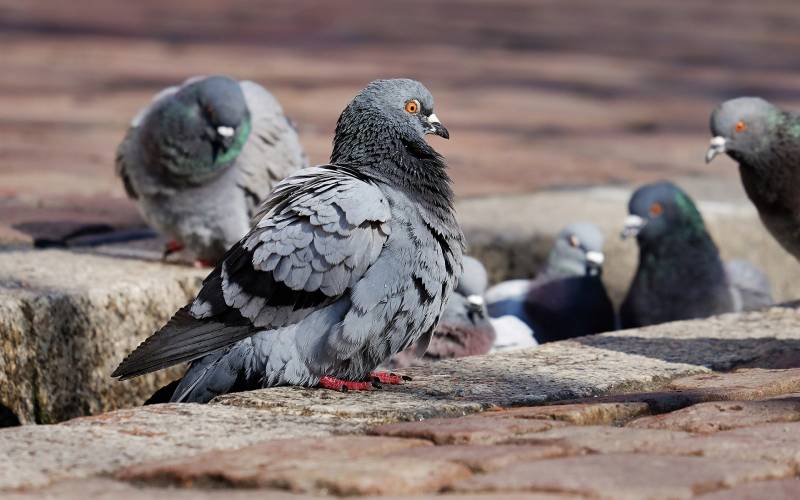
The ledge and parapet bird, and the one in the photograph above. Pigeons are excluded from treaty coverage as a human-introduced species rather than because their family was left out. See our pigeon profile.
European starling
A cavity nester, which is why starlings end up in soffits, gable vents and the gaps behind fascia boards. They are also the bird most likely to be standing in a feed bucket in an Aiken barn. Our European starling profile covers the cavity habit.
House sparrow
Small, tolerant of people, content to nest inside signage, light fittings and awning frames. Sparrows and starlings fall outside the treaties because their families were never covered — a different legal route, the same outcome. See the house sparrow profile.
Nearly everything else
American and fish crow, common and boat-tailed grackle, red-winged blackbird, brown-headed cowbird, the gulls, the egrets, Canada goose and the native swallows are all on the current list. Being handsome and familiar, several are the ones owners assume nobody cares about. That assumption is backwards.
Three federal provisions decide most of what happens next on a real job.
- 50 CFR 21.100. No permit is required merely to scare or herd depredating migratory birds. Anyone selling you a permit to shoo birds has the rule the wrong way round.
- 50 CFR 21.14. Any person may remove migratory birds from a building interior without a permit where they prevent normal use or create a health or safety risk. Handling must be humane, adhesive traps are prohibited, and the rule requires you to prevent reentry by patching holes or fitting exclusion devices. The federal government wrote exclusion into its own exemption.
- 50 CFR 21.150. A depredation order for blackbirds, cowbirds, crows, grackles and magpies allows control without a federal permit where serious damage is occurring, non-lethal methods first each year. It does not extend to gulls, vultures, geese, herons, egrets or doves.
SCDNR issues depredation permits free of charge, valid thirty days and renewable, and notes that additional permits may be required for federally protected birds. Two layers, not one.
Why does exclusion outlast every deterrent you can buy?
Because a bird is not frightened by a thing. It is frightened by a consequence, and it stops being frightened when the consequence never arrives. Tape, plastic owls, sonic units and gels depend on a threat the property never carries out, and a flock works that out within weeks. Exclusion needs the bird to believe nothing. The ledge is occupiable or it is not.
The difference shows clearest on a cornice. A strip of repellent gel is fifteen minutes of labour, and pigeons learn to stand on its dried skin, or on the debris collecting over it, inside a season. A 45-degree ledge conversion is a fabricated slope in aluminium, stainless or polycarbonate that deletes the flat plane. One is a consumable; the other is permanent.
| Approach | What it does | Service life |
|---|---|---|
| Stainless spikes | Denies landing on ledges, sills and sign tops; fails if debris builds a platform | Long, if specified and cleaned |
| Post-and-wire | Unstable perch on narrow ledges and railings; least intrusive on a historic facade | Long, with tension checks |
| 45-degree ledge conversion | Removes the horizontal surface, so the perch stops existing | Permanent |
| Netting | Encloses courtyards, canopies, barn bays and equipment wells | Long, tensioned and inspected |
| Sealing soffits and vents | Ends starling and sparrow cavity nesting at source, which no perch deterrent touches | Permanent |
| Gels and pastes | Surface discouragement; degrades, collects debris, gets learned around | Months |
| Sonic and visual scares | Brief displacement; habituation is documented across every deterrent class | Days to weeks |
| Falconry patrol | Breaks an entrenched flock’s habit of using the site | Holds while flown |
What does Aiken’s building stock offer a bird?
The Laurens Street commercial blocks
Downtown sits on the original 1834 plan, wide streets divided by boulevards, the medians original to the plat. What matters for birds is above eye level: parapet copings, cornices, recessed sign bands and awning frame tops. Pigeons roost on parapets and loaf on awnings; sparrows nest inside the frames. Because the blocks are continuous, a displaced flock moves along the row, so we scope the run rather than the one address that called.
The Alley and outdoor dining
The Alley is a pedestrian lane of restaurants, rocking-chair seating and a taproom pouring forty-eight taps. Outdoor dining is a food source with a roof over it, and sparrows learn a patio faster than any other bird. Half the fix is exclusion above the seating, half is bin lids. See our restaurant and food service program.
Brick storefronts, churches and civic buildings
Masonry parapets, bell openings, louvred towers and deep window reveals. Appearance constrains the fix, so post-and-wire or a discreet slope beats a bank of spikes. Downtown holds South Carolina’s twelfth designated Cultural District, and Schofield and Parkway District anchors such as Friendship Baptist Church are where a visible install is the wrong answer.
Winter Colony houses and their outbuildings
Winter Colony Historic District I was National Register listed on 27 November 1984 and holds around thirty-five properties built between roughly 1882 and 1948, with large houses, outbuildings and stables on the tree-lined streets and unpaved roads of Highland Park Drive, Lancaster Street and Grace Avenue. Deep eaves, open porches, cupolas. The main house is rarely the problem. The carriage house and the stable are.
Warehouse and light industrial
Sage Mill industrial park, the Bridgestone plant at Graniteville and the Kimberly-Clark operation at Beech Island anchor a corridor of large-footprint buildings: high open bays, exposed purlins that read to a pigeon as a nesting shelf, dock doors open through the shift. Netting the bay and sealing the roofline is the job. See our warehouse and distribution program and, where product is exposed, our food processing program.
Campus and heavy industrial
USC Aiken passed 4,200 students in fall 2025 with residence halls full: covered walkways, breezeways, light structures, rooftop plant and food service. Twelve miles south, the Savannah River Site spreads across 310 square miles, and its pipe racks and transfer buildings pose the same problem as any steel estate. Campus work runs through our schools and student housing program.
Why does horse country change the problem?
A barn is, from a bird’s point of view, an unusually generous building. Warm, dry, open at both ends, structural ledges at every height, food on the floor. The 2022 Census of Agriculture counted 5,610 horses and ponies in Aiken County across 1,132 farms, alongside 4,057 acres of corn for grain. The equestrian half is concentrated tightly — the Aiken Training Track, the Steeplechase Racecourse, Whitney Field, Stable View, the Horse District and the 2,400-acre Three Runs Plantation.
- Spilled grain. Sweet feed on an aisle floor is the most reliable starling and sparrow magnet on a horse property. Birds do not colonise barns because they are barns. They colonise them because feeding time is predictable.
- Open structure. Bays open at the gable, unsealed soffits, hay lofts with no closure and exposed purlin runs give cavity nesters unlimited choice. Netting a run of bays beats any amount of work on individual perches.
- Standing water. Troughs, wash racks and automatic waterers supply drinking and bathing water year-round, and bathing birds foul what the horses drink. Trough covers shift the picture faster than owners expect.
- Competition at feed. Starlings work buckets, tubs and hay in flocks, take a share of the ration and foul the rest. Since starlings carry no federal protection, the constraints are physical rather than legal.
What about the barn swallows?
Barn swallows are native migratory birds. They sit on the protected list at 50 CFR 10.13, and that protection covers the nest and the eggs. The mud cup on the beam over your wash rack is not something you may simply scrape off in the breeding season, and no depredation order changes that — the order at 50 CFR 21.150 covers blackbirds, cowbirds, crows, grackles and magpies. Swallows are not on it.
That makes timing the plan rather than a convenience. Exclusion aimed at swallow-occupied structures belongs outside the nesting window, when nests are inactive. Once eggs or young are present, you wait. Preventing new nests from being started is a different act from destroying an active one, which is why we push barn clients toward the cool months instead of June.
We will not publish state nesting-window dates here, because we could not verify a South Carolina document that sets them and we are not going to invent dates carrying legal weight. At the site visit we confirm the position with the relevant federal and state wildlife offices for the species present. If a contractor quotes barn exclusion in nesting season without raising any of this, that is your answer about the contractor.
What do accumulated droppings actually do?
You will see claims that birds carry sixty or more diseases transmissible to humans. We could find no agency source for that figure, so we do not use it. Here is what is documented.
- Histoplasmosis. Histoplasma lives in the environment, mainly across central and eastern states, and spreads in bird and bat droppings that mix into soil. The fungus grows in the droppings; the CDC does not describe birds as carriers. The risk is disturbing large accumulations in enclosed or poorly ventilated spaces — an attic, a disused loft, an old tower.
- Cryptococcus neoformans. Present worldwide, with soil, bird droppings and decaying wood among its sources, and infections occurring overwhelmingly in people with weakened immune systems. Worth stating accurately at a healthcare site.
- Uric acid corrosion. Droppings are acidic and attack what buildings are made of — painted metal, galvanised flashing, roofing membranes, HVAC casings, stone and mortar joints. On a historic facade that is a conservation problem, not a cleaning problem.
- Blocked gutters, drains and scuppers. Nesting material and droppings block them, water backs up, and the water finds the structure. Aiken County averages 50.77 inches of precipitation a year on the 1991 to 2020 normals — a lot of water looking for the path a bird built.
- Ectoparasites left behind. Bird mites and other nest arthropods do not leave with the bird. Pull a nest out of a soffit and do nothing else, and they disperse into the space looking for a host. Nest removal without treating and sealing the void is half a job.
Where does falconry fit, and where does it not?
Falconry abatement flies trained raptors on a planned patrol to break a flock’s habit of using a property. It changes a site’s risk profile. It does not eliminate a population.
Two controlled landfill study programmes in the UK are the best comparative evidence that exists. One flew trained falcons and hawks against gulls and corvids and found neither group eliminated all scavenging birds, though falcons reduced numbers more consistently. The wider programme ran forty trials over two years across six landfills against nine techniques and concluded that birds could not be eliminated, with habituation varying significantly by method.
Two more points for a quote comparison. There is no FAA approval scheme for falconry abatement or any other wildlife deterrent method, so a claim of federal approval describes something that does not exist. And no published study covers falconry at retail centres, campuses or equestrian venues. For an Aiken property, falconry is most defensible as a knockdown phase on an entrenched roost while exclusion goes in behind it. Our falconry bird abatement page sets out the permitting and the evidence in full. Geese are a separate discipline with their own federal control orders, handled through our Aiken goose control service.
When in the year should this work happen?
The calendar is a legal question before a convenience one. The AIKEN 4 NE station records a last spring freeze on 22 March and a first fall freeze on 12 October, giving 232 freeze-free days against a county mean annual temperature of 64.1 degrees F. A long mild season means a long breeding season, so the window for unrestricted work on buildings hosting protected species is narrow.
- Late autumn through winter — the build window. October to February is when protected nests are inactive, barns are quieter, and netting, ledge conversion and soffit sealing proceed without a timing constraint. This is when exclusion goes in.
- February and early March — before the season fills. The Aiken Triple Crown runs three consecutive March weekends. More than ten thousand spectators turn out for the Trials at the Historic Aiken Training Track, then come the Spring Steeplechase and Pacers & Polo at Whitney Polo Field. Work at a venue or an inn wants to be finished before it.
- Spring — identification season. New nesting starts and the wrong decision is easiest to make. If a nest appears, the first action is to identify and photograph the species, not to remove it.
- Summer — constrained. Protected nests are active and options narrow. Work on unprotected species and unoccupied structures continues, with deterrent maintenance and sanitation.
How does an exclusion job run?
Identify the species and photograph the evidence
Before anything is priced. Which birds, how many, where they roost as against where they feed and nest, and whether any nest is active. The species sets the legal envelope and the envelope sets the scope. This is also where we say if the answer is sanitation rather than hardware.
Survey the structure, not the complaint
Roof plane, parapet, cornice, sign band, soffit line, gable and ridge vents, exhausts, canopy frames and open bays. Birds use buildings as systems. Treating one ledge and leaving the soffit open moves the problem twenty feet and lets you believe you fixed it.
Confirm the permitting position in writing
Whether anything on site needs a federal permit or falls under a depredation order, whether an SCDNR permit is appropriate, and whether the calendar constrains the work. Where a protected species is involved we set out what is lawful, with the citation, so the position is on the record.
Clean and remediate before installing
Droppings and nest material come out first, with respiratory protection where accumulation is heavy and the space enclosed, and voids treated for the mites left behind. Netting over fouled surfaces traps the problem underneath, a common cause of a job that looks finished and is not.
Install the physical work
Netting, post-and-wire, spikes, ledge conversion, vent and soffit closure, and repair of the defects that let birds in. Fixings are chosen against the substrate: historic masonry, standing seam metal, EPDM and painted timber each want different treatment, and getting it wrong damages the building you were hired to protect. See our repairs and exclusion page.
Fix the reason they came, then re-inspect
Spilled feed, open bins, unlidded troughs, dock spillage, patio waste, standing water. This is the part most often declined and most often regretted. Then photographs, a written scope, and a scheduled return.
What is included?
- Species identification and active-nest assessment before any pricing
- Written statement of the permitting position, with citations
- Dropping and nest removal, with treatment of ectoparasites in the void
- Netting to courtyards, canopies, barn bays, parking structures and equipment wells
- Spike, post-and-wire and 45-degree ledge conversion to ledges, sills and signage
- Soffit, gable, ridge and exhaust vent sealing with correct hardware rather than expanding foam
- Interior bird removal under the federal building-interior rule, entry sealed
- Photographed before-and-after documentation for an inspector or insurer
- Scheduled re-inspection of tension, fixings and debris
What will we not sell you?
- Plastic owls, hawk silhouettes and reflective tape. They work briefly and then stop, because nothing follows the threat. The clearest example of habituation in the whole trade.
- A nest knock-down without an identification. The species decides whether that is routine maintenance or a federal offence, and you cannot settle it with a squint from the ground.
- An effectiveness percentage for falconry. No study supports one for any commercial setting, and the landfill work states plainly that birds could not be eliminated.
Who licenses this work in South Carolina?
Structural pest work in this state runs through the Clemson University Department of Pesticide Regulation — the licensing body is the land-grant university, not a state agriculture department. The category is 7A, Industrial, Institutional, Structural and Health-Related Pest Control. A commercial firm needs a DPR business licence, a Designated Certified Applicator at every location, and general liability cover of at least $100,000 combined single limit.
Above that sits the federal wildlife layer, which pesticide licensing does not touch. Anything involving a species on the 50 CFR 10.13 list, including nest and eggs, is governed by the Migratory Bird Treaty Act and, where lethal action is contemplated, by a depredation permit or order.
Falconry adds a third layer, requiring a state falconry permit at the appropriate level plus the federal Special Purpose Abatement permit. South Carolina regulation is explicit that a Master Falconer may conduct abatement holding that federal permit, while a General Falconer may do so only as a sub-permittee, and SCDNR inspects facilities before a permit issues. If a vendor cannot say which layer each part of their proposal sits under, that is worth knowing before the scaffold goes up.
Which Aiken properties call us most?
Downtown retail and food service along Laurens Street and in The Alley, where the fix has to be invisible from the pavement. Lodging, from The Willcox, operating since 1898, through to the chain hotels on the highway corridors, where a fouled entrance canopy is a review problem before it is a maintenance one. Warehouse and light industrial along the Sage Mill corridor. Institutional buildings at USC Aiken and Aiken Technical College. Healthcare, where Aiken Regional Medical Centers runs 273 licensed acute-care beds and an immunocompromised population makes fouling a genuine concern. Multi-site scoping goes through our commercial programmes.
Residential calls cluster on starlings and sparrows in soffits and gable vents, and pigeons on a chimney or rear elevation. The city holds 15,345 housing units, much of the older stock carrying the open eaves and unscreened vents cavity nesters need. If you hear scratching above a ceiling rather than seeing birds outside, that may not be birds at all, and our Aiken K-9 rodent detection service settles it faster.
Where do we cover?
Our base is 320 Wendy Lane in Windsor, a short drive from the city. Regular coverage runs through downtown and the Laurens Street corridor, the Winter Colony districts and the Horse District, the Parkway District and Schofield, Virginia Acres, Crosland Park and Forest Heights, Woodside Plantation, Cedar Creek, Houndslake, the Kalmia developments and Three Runs Plantation, out to Montmorenci, Beech Island, New Ellenton and Jackson, and west into Horse Creek Valley at Graniteville, Vaucluse, Warrenville, Langley and Bath. Beyond the county we work North Augusta, Columbia and Lexington, and across the river into Augusta. The full list sits on our service areas page; if the question is bed bugs rather than birds, that is our Aiken K-9 bed bug detection page.
Frequently asked questions
Is it legal to remove a bird nest from my building in Aiken?
It depends entirely on the species. Rock pigeon, European starling and house sparrow nests carry no federal protection. Nests of species on the list at 50 CFR 10.13 are protected along with their eggs, and that list runs to 1,106 species. Several are hard to tell apart from the ground, so identification comes first. Photograph the nest and the adult bird and let us confirm.
Are barn swallows protected in South Carolina?
Yes. Barn swallows are native migratory birds on the federal protected list, and the protection covers the nest and eggs, not just the adult. No depredation order applies to them; the order at 50 CFR 21.150 covers blackbirds, cowbirds, crows, grackles and magpies only. So exclusion aimed at swallow structures belongs outside the nesting window, and preventing a nest is a different matter from destroying one.
Do bird spikes work, or do birds just nest between them?
They work on the surfaces they are designed for — ledges, sills, sign tops, pipe runs — and they fail when specified for the wrong surface, or when debris builds between the rows until it forms a platform. That is a specification and maintenance issue, not a defect in the method. On a wide parapet a ledge conversion is usually better, because it removes the flat plane instead of defending it.
Will falconry get rid of the pigeons on my building?
It will move them, and while it is flown it will keep them moving. It will not eliminate them. The two controlled landfill study programmes that form the best available evidence both concluded that birds could not be eliminated. For a single structure with a defined roost, exclusion is cheaper and permanent. Falconry earns its place on large, entrenched sites while the physical work goes in.
Does the FAA approve falconry for airfields?
No. It approves no wildlife deterrent method, because no such scheme exists. Any vendor claiming federal approval or certification is describing something that is not real. At an airfield, falconry operates as one contracted tool inside a biologist-led wildlife hazard management programme run under the airport’s own plan.
How dangerous are pigeon droppings in an old Aiken building?
The real risk is disturbing a large, long-standing accumulation in an enclosed, poorly ventilated space such as an attic, loft or tower. Histoplasma grows in droppings that mix into soil and is present across central and eastern states, which warrants respiratory protection and proper remediation. Droppings on an open car park do not carry the same exposure.
Birds keep getting into my warehouse. How fast can they come out?
The way in is usually dock doors held open, damaged personnel doors or gaps at the roofline. Rule 50 CFR 21.14 lets anyone remove migratory birds from a building interior without a permit where they prevent normal use or create a health or safety risk, with humane handling and no adhesive traps, and it requires the entry point to be closed afterwards. Sealing stops the repeat.
Starlings are eating my horses’ feed. What actually stops them?
Three things together. Feed discipline first: sweep spillage, lid the bins, shorten the window loose feed sits available. Then exclusion of the structure they nest in, meaning gable ends, soffits and open bays rather than individual perches. Then netting where a bay can be closed. Starlings carry no federal protection, so the constraint is structural.
Can exclusion go on a historic facade without damaging it?
Yes, but the fixing method matters more than the product. On historic masonry the aim is to fix into mortar joints rather than face brick or stone, to use non-staining stainless components, and to favour low-visibility systems such as post-and-wire over banks of spikes. Downtown Aiken and the Winter Colony districts both need that approach.
How soon can you look at a bird problem in Aiken?
Site visits are normally within the week from Windsor, and an interior bird in a plant or warehouse is urgent, because the regulation and the disruption point the same way. Installation is scheduled around species and season, which is why we steer barn owners toward the autumn and winter window.
Related services
Birds on a roof you cannot keep clean?
Send us the building, a photograph of the birds if you have one, and what has already been tried. We will identify the species, tell you what the law allows for that species, and price the physical work that ends it — and if sanitation alone would fix it, we will say that instead. Bird exclusion across Aiken, the Horse District, Graniteville and Horse Creek Valley from Windsor, South Carolina.