
Bird Control in Lexington, SC
Lexington is unusual. The town declared itself a bird sanctuary in its own code, in language broader than federal law, and that shapes how bird work should be approached inside the town limits. Coastal K-9 & Pest Solutions leads with exclusion here — netting, spikes, ledge geometry, sealed cavities — so birds never settle at all.
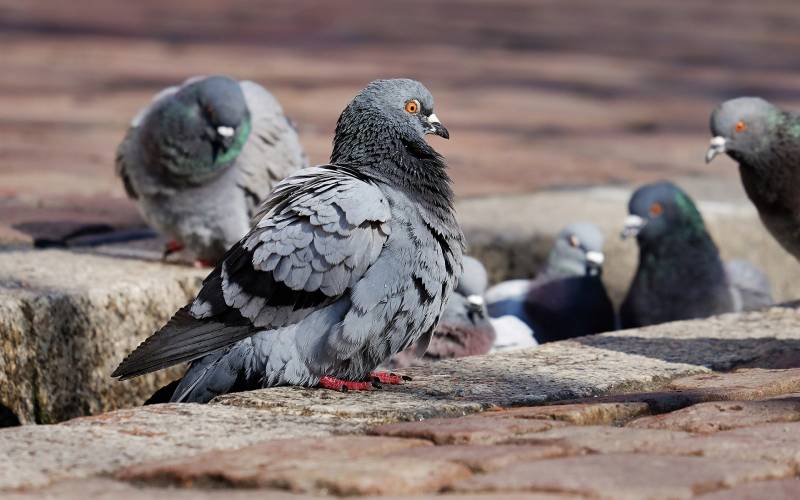
Two facts set this town apart from anywhere else we take bird calls. One is a sentence in Title IX of the municipal code that protects birds more broadly than the Migratory Bird Treaty Act does, and names nest removal specifically. The other is that Lexington is young: the median housing unit in town dates from 2002, so the troublesome perches are canopy steel, sign boxes, rooftop screening and light standards, not weathered cornices.
Around it sits a county raising poultry at industrial scale, where starlings in a grow-out house are a feed bill and a biosecurity file rather than a stained wall. One discipline covers all three: name the species, read the rules for that address, then change the structure. That is our bird control and exclusion service.
Why does a bird job here begin with the town’s own code?
Because Lexington wrote a rule most municipalities never bothered with. Title IX, Chapter 91, section 91.06 is headed BIRD SANCTUARY; HUNTING BIRDS OR WILD FOWL PROHIBITED. The operative sentence reads: “It is unlawful to trap, hunt, shoot or attempt to shoot or molest in any manner any bird or wild fowl or to rob bird nests or wild fowl nests.” It arrived as Ordinance 285, passed on 1 April 1996.
- No species list. The phrase is “any bird or wild fowl”. Federal law reaches a defined roster and leaves three introduced birds outside it; the town’s text prints no such carve-out.
- Nests named directly. Robbing a nest is its own prohibited act, separate from anything done to a living bird — and nest clearance is our most common request.
- A wide verb. “Molest in any manner” is not confined to killing or capture.
- A real penalty. Section 91.99 sets up to $500 or thirty days, each day a separate offence.
Section 91.21 then adopts the Lexington County animal control ordinance by reference and provides that the county ordinance controls where the two conflict, most recently by Ordinance 2024-13, passed 7 October 2024.
Now the honest part. We are not offering a legal opinion on how the town interprets or enforces section 91.06, and nobody should take one from a contractor’s website. Anyone planning bird work inside the corporate limits should pull the current code and speak to the town first. Outside those limits the chapter does not apply.
What we will say is why this pushes our recommendation. Exclusion acts on the building, not on the bird. A slope fitted to a coping, mesh behind a sign, a gable louvre closed with hardware cloth — each prevents a bird establishing rather than doing anything to one already present. That is the durable answer anywhere, and here it also keeps the work furthest from the question the ordinance raises.
What does federal law protect, and where does the town’s line sit differently?
The Migratory Bird Treaty Act covers the species named at 50 CFR 10.13, revised at 88 FR 49310, effective 30 August 2023, now 1,106 birds. Protection travels to the nest and the eggs, which is why an active nest changes a project overnight. Five familiar birds sit outside it: rock pigeon, European starling, house sparrow, Eurasian collared-dove and mute swan. Almost everything else on a local roofline is in — gulls, crows, grackles, red-winged blackbird, brown-headed cowbird, Canada goose, cattle egret, great egret.
- 50 CFR 21.100. The rule states that “no permit is required merely to scare or herd depredating migratory birds.” Federally, hazing is not a licensed activity.
- 50 CFR 21.14. No permit is needed for anyone to remove a migratory bird trapped inside a building, where its presence stops the room being used as intended or puts health and safety in question. The bird must be handled humanely, glue boards are forbidden, and the same rule requires the entry to be patched or an exclusion device fitted so it cannot happen again.
- 50 CFR 21.150. A depredation order for blackbirds, cowbirds, crows, grackles and magpies permits control without a federal permit where serious damage is under way, non-lethal methods first each year. Gulls, vultures, geese, herons and egrets fall outside it.
Here is the comparison that matters locally. Federal law gives an exit ramp on pigeons, starlings and house sparrows. The ordinance, on its face, does not, and it adds nest removal as a named act — a narrower envelope than a contractor working purely from the CFR would assume.
Which bird is actually up there?
Rock pigeon
The ledge specialist, and the bird photographed above. It wants a level surface about the width of its feet, a wall at its back and a short flight to food. More in our pigeon profile.
European starling
Starlings seek holes, not shelves, which is why spikes never solve a starling problem. They take gable louvres, lifted flashing, the void behind a fascia, an open sign box, the ventilation runs of a poultry house. Detail in our European starling profile.
House sparrow
Small, unbothered by people, content to raise a brood inside a light fitting, a canopy tube or a menu board frame. Sparrows sit outside the treaties by a different route than the pigeon: their family was never brought under them. See the house sparrow profile.
The natives that end the conversation
Barn swallows on a run-in shed, chimney swifts in a flue, killdeer on a flat gravel roof, crows and grackles in a parking lot. All federally listed, nest and eggs included.
Why does exclusion last when deterrence wears off?
A bird is not afraid of an object. It is afraid of an outcome, and it stops being afraid the moment the outcome stops arriving. Reflective tape, plastic raptors, sonic units and gels borrow credibility from a threat the property never delivers, and a flock audits that threat daily.
Exclusion asks the bird to believe nothing. A surface can be occupied or it cannot, and learning does not change geometry. Put the two on a parapet coping. A bead of gel takes fifteen minutes to lay and stops working once its skin cures or the birds stand on the crust. A fabricated 45-degree conversion in aluminium, stainless or polycarbonate deletes the flat plane instead. Gel is a line item you reorder; the slope is a change to the property.
| Method | Where it earns its place in Lexington | How long it holds |
|---|---|---|
| Cavity closure at soffits, louvres and vents | Starling and sparrow nesting, untouched by any perch product | Permanent, in hardware rather than foam |
| 45-degree ledge conversion | Copings, sign band tops, wide sills, canopy fascia returns | As long as the fabrication lasts |
| Tensioned netting | Loading canopies, covered entries, plant screens, barn and poultry bays | Years, with scheduled tension checks |
| Stainless spike | Narrow ledges, pipe runs, light standard heads, lintels | Long, unless debris bridges the rows |
| Post-and-wire | Slim ledges and railings where the fix must stay invisible | Years, with retensioning |
None of it survives an unmanaged food source. Hardware buys the structure; housekeeping buys the result.
What does a building put up after 2000 offer a bird?
More than owners expect, and this is the section most bird marketing omits, because it assumes every problem building is old. Of 10,348 housing units inside the corporate limits, 80.3 percent were built in 1990 or later and only 9.5 percent predate 1980. Town population reached 25,729 in the July 2025 estimate, up 8.9 percent since 2020 after 31.9 percent the previous decade. New structure has its own vocabulary of opportunities.
Covered entries and canopy steelwork
A drive-through canopy is a roof with no walls: ideal shelter for a pigeon, an ideal nest frame for a sparrow. Open-ended tube steel, C-channel with the web turned upward and the fascia return ledge foul first. Netting the underside beats defending every member.
Sign boxes and illuminated letters
An internally lit cabinet is warm, dry, dark and almost never inspected. Sparrows enter through the service gap or a failed gasket, and by the time anyone notices, the nest sits against a ballast.
Rooftop mechanical screening
Screening built to hide condensers from the street creates a sheltered corridor with a solid floor: one of the most productive pigeon roosts on a modern building, and one of the least visited.
Parking-lot light standards and walkway canopies
The head casting on a pole light and the run above a shopfront canopy foul onto surfaces customers use. Spike the standard, net the canopy, then deal with the trash corral drawing them back.
Loading canopies and dock roofs
A roosting line above a dock lands on pallets. Distribution work runs through our warehouse and distribution program, kitchens and dock lines through our restaurant and food service program.
Open venue structure
The Icehouse Amphitheater at 107 West Main Street is the clearest local example of a building offering birds everything and defending nothing. Ground was broken in 2015, the 900-seat venue opened in October 2016, a pavilion followed in 2021. Trusses, lighting bars and speaker mounts are perch, above seated people.
The residential side is a steady stream of subdivisions: the town’s status layer carries Barr Lake at 182 lots, River Ridge at 150, West of Main at 76 and Nightingale Hills at 66, plus phases of Sterling Bridge and Brookstone. Multifamily is 23.8 percent of the stock, where our multifamily and property management program gets called: breezeways, stair towers and dryer vents repeated across a property.
Institutional buildings drive the rest. Lexington County School District One operates 32 schools with 27,074 students on federal Common Core of Data figures, concentrating covered walkway structure above children; that runs through our schools and student housing program. Prysmian is expanding its plant at 700 Industrial Drive by $80 million, roughly 135 jobs, online around May 2028.
What are starlings doing inside a poultry house, and why is it not cosmetic?
Because the numbers are not cosmetic. The 2022 Census of Agriculture recorded 7,065,868 broilers and other meat-type chickens in Lexington COUNTY, across 822 farms and 79,450 acres, with $331,830,000 in products sold, 77 percent of it from livestock and poultry. The county ranks second in South Carolina for agricultural sales.
- Feed removal. Starlings feed selectively and take the high-value fraction of a ration. A flock working pan lines through a winter is a shrink line, not an annoyance.
- Biosecurity. A wild bird moving between houses, farms and a manure stack is a vector pathway every audit checklist asks about, and inspectors expect physical measures.
- Structure and airflow. Nesting in ceiling voids and ventilation runs pulls insulation apart, blocks inlets and undermines the airflow the house was designed around.
- The physical answer. Inlet and fan screening, closure at eave and gable, netting across open ends, door discipline, spillage cleared. Outside the town limits the constraint is engineering, not permitting.
Where product is processed rather than grown, documentation becomes part of the deliverable: that sits with our food processing and manufacturing program, and multi-site scoping with our commercial programs.
The small-scale version sits in back gardens all over town. Section 91.02 permits backyard chickens under limits: four birds maximum regardless of lot size, no roosters, a $20 permit from the Office of Planning, Building and Technology, rear yard only, structures 25 feet from any property line and reducible to 10 with a neighbour’s letter plus screening. It also requires the resident to provide sanitary waste disposal and pest control. That clause does real work, because an open feeder is a reliable starling magnet and the birds it draws do not stay in that yard.
What do years of droppings actually do?
A number gets passed around this industry putting the count of human diseases spread by birds above sixty. No agency publishes it, and we could not trace it to one, so it appears in nothing we write. What is documented is narrower.
- Histoplasmosis. The fungus behind it lives in soil that droppings have enriched, most heavily through the central and eastern states. It is an environmental organism; the CDC does not describe birds as carrying it around. Exposure comes from stirring a deep old deposit into the air in a closed, unventilated room.
- Uric acid attack. Droppings are acidic and work on materials continuously: painted and galvanised metal, single-ply membranes, HVAC casings, canopy panels. On a five-year-old building that becomes a warranty argument.
- Blocked gutters and scuppers. Nest material dams a drainage path, water backs up over an upstand and finds the structure. The nearest published rainfall normals are Richland County’s next door, 47.75 to 48.11 inches a year on the 1991 to 2020 set.
- Ectoparasites left behind. Mites and other nest arthropods do not depart with the birds. Pull a nest from a soffit and do nothing else, and they move inward through the ceiling seeking a new host.
Which popular fixes do we decline to sell?
- Plastic owls, hawk silhouettes and holographic ribbon. A fortnight of displacement, then decoration. Habituation to a consequence-free deterrent is the best-demonstrated effect in the field.
- A nest knocked down before anyone identified the builder. Federally the species is the difference between maintenance and a violation, and inside the town limits a second question sits on top of it.
- An effectiveness percentage for falconry. No study produces one for a commercial site, and the best available research points the other way.
- Federal approval of a deterrent method. No such scheme exists at the FAA, for raptor patrols or anything else, so a badge claiming one points at a certification that was never created.
Where does falconry fit in a town that calls itself a bird sanctuary?
Falconry abatement flies a trained raptor on a planned patrol until a flock stops reading a property as safe ground. It changes a site’s risk profile. It does not eliminate a population.
The evidence base is small and worth knowing before a patrol contract is signed. Two controlled programmes on United Kingdom landfills are the comparative work that exists. Falcons and hawks were put up against gulls and corvids; in neither case did the scavenging birds all leave. The wider programme tested nine techniques in forty trials at six sites over two seasons and reported that eliminating the birds proved impossible. Nothing published examines a shopping centre or a poultry farm.
Applied here, the recommendation is narrow. For one building with one roost, falconry is rarely the right purchase, because exclusion costs less and keeps working after the last visit. Its use is on a big site with a long-settled flock, breaking the habit while hardware goes in. There is also a local question: a patrol flown inside the corporate limits raises the same reading of section 91.06 as any other active method. Permitting sits on our falconry bird abatement page. Waterfowl are a separate discipline under their own federal control orders and belong with our Lexington goose control service.
When in the year should the hardware go up?
Season is a legal question before a scheduling one. There is no climate station inside the town, but the State Climatology Office publishes two in Lexington County that bracket it. LITTLE MOUNTAIN records a last spring freeze on 31 March and a first fall freeze on 20 October, 246 freeze-free days; PELION 4 NW records 21 March and 10 October, 226 days. A long warm season means a long breeding season, and a narrow window for unrestricted work where protected species are present.
- Late autumn to late winter is the install window. Protected nests inactive, no timing argument against netting, ledge conversion or cavity closure, and the right season for a poultry house.
- Late February and March is the last clean run. Preventive work on unoccupied structure finished before the season starts is ordinary maintenance; the same work three weeks later may not be.
- Spring is identification season. New nesting begins and expensive decisions get made fastest. Photograph first, act second.
- Summer is constrained. Where a protected species is nesting, options narrow. Survey and sanitation continue; installs wait.
How does the work run from the first phone call?
Name the species and the status of any nest
Pictures of the birds, the mess and any nest, taken before we talk money. What they are, how many, which surfaces they sleep on versus feed on, and whether a nest is currently occupied.
Establish which rules apply at that address
Inside the town limits or outside, which federal provisions are engaged, whether an SCDNR permit fits, what the calendar allows. Where section 91.06 is in play we quote it in writing and point you to the town, not to our reading of it.
Survey the envelope, not the complaint
Roof plane and plant screen, coping, canopy steel, sign cabinets, soffit line, gable venting, dock roofs, light standards. A flock reads the whole property, not the one ledge that generated the call, so a partial fix shifts the roost down the elevation.
Clean and remediate first
Droppings and nest material out before anything is fixed to the structure, with respiratory protection where the deposit is deep, and the void treated for mites.
Specify fixings against the substrate
Standing-seam metal, EIFS, precast panel, EPDM and masonry each want a different anchor, and a roof warranty is easy to void with the wrong screw. Failed components go to our repairs and exclusion work.
Install, remove the attraction, then come back
The hardware goes up, then the part clients skip: lids that close, corrals that get swept, feed not left in the open. Photographs, a written scope, and a return date already in the diary.
What is in the scope?
- Species identification and active-nest assessment ahead of pricing
- A written federal position with citations, plus the town code text where the address is in town
- Removal of droppings and nest material, with the void treated for ectoparasites
- Tensioned netting to canopies, covered entries, plant screens and poultry-house bays
- Spike, post-and-wire and 45-degree slope conversion to copings, sills, sign bands and light standards
- Cavity closure at soffits, louvres, ridge vents and exhausts, using screened hardware and never foam
- Birds taken out of an occupied interior under the federal rule, with the way in shut before we leave
- A scheduled re-inspection rather than an open-ended promise
Who licenses this work, and who answers the ordinance question?
In this state the licensing authority is a university. Clemson’s Department of Pesticide Regulation runs structural pest control, under category 7A: industrial, institutional, structural and health-related work. Firms operating commercially hold a DPR business licence, post a Designated Certified Applicator to each location, and carry general liability of $100,000 combined single limit or better.
Pesticide licensing says nothing about birds, and that gap is where most confusion in this trade lives. The wildlife layer is federal. Anything named at 50 CFR 10.13 falls under the Migratory Bird Treaty Act, nest and eggs included, and killing one needs either a depredation permit or an order that covers it. Falconry forms a third layer: a state falconry permit at the right grade plus the federal Special Purpose – Abatement permit, which under South Carolina regulation a Master Falconer may work from while a General Falconer may act only as a sub-permittee.
The town layer is a fourth, and not ours to interpret. For section 91.06, for the chicken permit under section 91.02, and for anything else in Chapter 91, the Town of Lexington is the authority. In unincorporated Lexington County, county ordinances are enforced by the Sheriff’s Department code enforcement officers. If a contractor cannot say which layer each line of a proposal answers to, ask before the lift is booked.
Which properties around Lexington generate the most of this work?
Retail and food service first, because covered entries, drive-through canopies, illuminated signage and trash corrals cluster tightly on almost every site. Then schools, then multifamily, then industrial buildings with high open bays and dock doors held open through a shift. Agricultural buildings are their own category, and the county’s poultry sector means we see more of them here than in most places we work: barns, run-in sheds, feed rooms and grow-out houses each need a different closure strategy. Golden Hills Golf and Country Club at 100 Scotland Drive is the one verified golf property with a town address.
Residential calls concentrate on starlings and sparrows in gable vents, soffit returns and dryer vents, and pigeons on a chimney. If what you hear is scratching inside a ceiling void rather than birds visible outside, it may not be birds at all, and our Lexington K-9 rodent detection service settles that faster than a torch and a guess.
Where do we cover around Lexington?
We are based at 320 Wendy Lane in Windsor and work the Midlands from there. Around the town, regular coverage runs through the subdivisions on the town’s own map: Barr Lake, Bent Creek Plantation, Brookstone, Carriage Hills Lake, Cherokee Village, Coventry Lake, Creekside Farms, Gibson Forest, Golden Hills, Heritage Hills, Hope Ferry Plantation, Hunters Ridge, Laurel Falls, Madison Park, Mallard Lakes, Middlebrook, Nightingale Hills, Pilgrim Point, River Ridge, Shoal Creek, Sterling Bridge, Summerfield, Twelve Mile Ridge, Woodcreek and Woodside Farms.
We also work downtown along West Main Street, out toward Gibson Pond Park and Virginia Hylton Park, along the Fourteen Mile Creek corridor off North Lake Drive, and into the unincorporated county. Further afield we cover Irmo, Chapin, Cayce, West Columbia, Columbia, Aiken County and North Augusta; the full list is on our service areas page. Where the trouble is in bedrooms rather than on a roof, start with our Lexington K-9 bed bug detection page.
Frequently asked questions
Does the bird sanctuary ordinance mean nobody can do bird control in Lexington?
We will not give you a legal conclusion, because it is not ours to give. What we can do is show the text. Section 91.06 makes it unlawful to trap, hunt, shoot or molest in any manner any bird or wild fowl, or to rob bird nests, with a penalty of up to $500 or thirty days. Confirm the current code and the town’s position with the town. Meanwhile, exclusion changes your building rather than acting on a bird.
Federal law says pigeons are not protected. Does that settle it inside the town limits?
Not on its own. Rock pigeon, European starling and house sparrow are absent from the federal list at 50 CFR 10.13, so the Migratory Bird Treaty Act does not reach them. The town’s ordinance says “any bird or wild fowl” and prints no equivalent exception. Put that to the town before work is scheduled.
Can I take a nest off my own house?
Start by finding out what built it. If the species is on the federal list, nest and eggs are protected along with the adult, and 1,106 species are on it. Inside the corporate limits, section 91.06 separately names robbing bird nests as a prohibited act. Answer both questions before a ladder comes out.
Starlings are cleaning out the feeder in our chicken run. What helps?
Feed discipline first, because it is free: a treadle or covered feeder, feed lifted overnight, spillage swept, the bin sealed. Then close the coop with hardware cloth over vents and gaps. Section 91.02 already requires a permitted flock owner to provide pest control, alongside the four-bird cap.
Will flying a hawk clear the birds off our property for good?
No, and anyone promising that is selling past the evidence. Falconry moves birds while it is flown and shifts a site’s risk profile; it does not eliminate a population. The largest controlled programme, nine techniques across forty trials at six landfill sites, reported that eliminating the birds proved impossible. Nor has the FAA ever created an approval scheme for raptor patrols.
How dangerous is clearing out an attic full of droppings?
The exposure worth taking seriously is stirring a deep, long-settled deposit into the air in a closed space with no ventilation. The fungus behind histoplasmosis lives in soil that droppings have enriched, most heavily through the central and eastern states, so a loft clear-out calls for proper respiratory protection. An open car park is a different situation.
Our building is barely ten years old. Why do we have a bird problem?
Because age is not what birds respond to. They respond to geometry and shelter, and modern construction supplies both: rooftop screening, open-ended canopy tube steel, sign cabinets, walkway canopies, light standard heads. A building finished in 2016 can hold a settled roost within two seasons.
Do we need a permit just to scare birds off a roof?
Federally, no. The rule at 50 CFR 21.100 states that “no permit is required merely to scare or herd depredating migratory birds.” What needs permitting is killing a bird and keeping a raptor. Inside the town limits there is a separate question about how section 91.06 reads on active methods, and that one belongs to the town.
There are geese on the pond behind our building. Same job?
Same company, different discipline. Canada geese are federally protected and sit under their own control orders covering agricultural facilities, public health situations, airfields, and nests and eggs, so the permitting path looks nothing like a pigeon job. SCDNR puts the statewide resident population above 50,000.
Related services
Birds on a canopy you keep pressure washing?
Give us the address, a picture of the birds where you have one, and a line on what has already been attempted. Back comes the species, the federal position written down, the wording of the town chapter where your address falls inside it, and a figure for closing the roost. If a swept dock and a proper lid would do it, that is what you will be told. Bird exclusion across Lexington and the Midlands, from Windsor, South Carolina.