
Bird Control in Columbia, SC
Downtown Columbia is a masonry city, and masonry produces ledges by the thousand. Coastal K-9 & Pest Solutions puts a name to the bird first, because federal law splits three introduced species from every native one, and then shuts the roost down with netting, wire and slope conversion rather than a product that wears off.
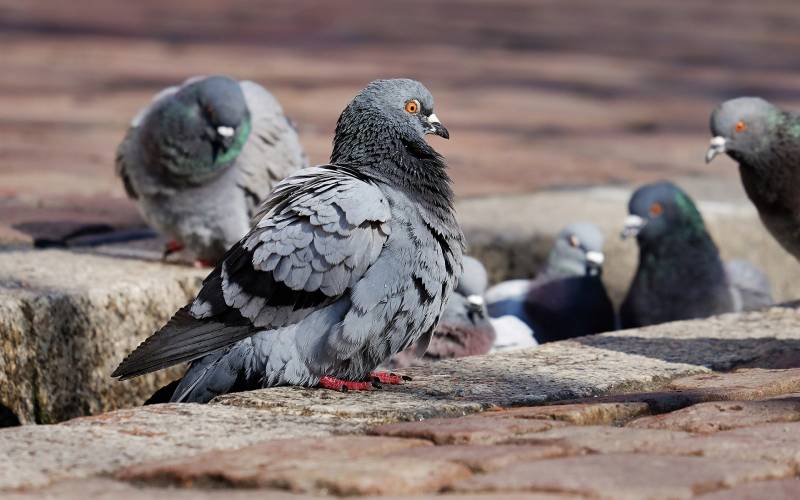
Ask a pigeon what it wants and the answer is dull: a flat surface wide enough to stand on, high enough to feel safe, with something edible within a short flight. Columbia supplies all three at a scale smaller Midlands towns do not. Stone cornices and string courses, parapeted flat roofs, deep porticos around the capitol complex, parking-deck beams, covered walkways, and a hospitality quarter where food waste leaves a building nightly.
Two questions govern every job here, and neither is which product to fit. Which bird do you have, because that decides what is lawful. And what part of the structure created the opportunity, because that is what has to change. Both sit at the centre of our bird control and exclusion service, worked out here for a capital city carrying seventeen National Register historic districts.
Which bird is standing on the ledge, and what does that decide?
Everything downstream. The Migratory Bird Treaty Act protects the species carried at 50 CFR 10.13, revised at 88 FR 49310 and effective 30 August 2023, now 1,106 birds, and protection extends to the nest and the eggs in it. Three of the birds fouling most Columbia buildings are absent from that list; a fourth group that looks just as ordinary is squarely on it.
Rock pigeon
The cornice bird, and the one photographed above. Its wider family sits inside the treaties, but the feral bird is excluded as a human import. More in our pigeon profile.
European starling
Starlings want a hole, not a shelf: louvred gable vents, lifted flashing, the void behind a fascia. Ledge spikes do nothing about any of that. Detail in the European starling profile.
House sparrow
Content to raise a brood inside an illuminated sign or a light housing. Sparrows sit outside the treaties for a reason unlike the pigeon’s: their family was never brought under them. See the house sparrow profile.
The birds people assume are fair game
Chimney swifts, swallows, purple martins, crows, grackles, blackbirds, cowbirds, herons, egrets, gulls and Canada geese are all listed, and several nest on exactly the old brick this city is full of.
Three federal provisions carry most of the weight.
- 50 CFR 21.100. The text reads that “no permit is required merely to scare or herd depredating migratory birds.” Hazing is not a licensed act, and a pitch built on holding permission to frighten birds has the rule upside down.
- 50 CFR 21.14. Anyone may take a migratory bird out of a building interior, unpermitted, when the bird stops the space being used normally or puts health and safety in question. Humane handling is required, glue traps are ruled out, and sealing the way in afterwards forms part of the exemption.
- 50 CFR 21.150. A standing depredation order reaching blackbirds, cowbirds, crows, grackles and magpies where serious damage occurs, non-lethal measures attempted first in each calendar year. Its reach stops short of gulls, vultures, geese, herons and egrets.
SCDNR issues depredation permits free, valid thirty days and renewable, and warns that protected birds may require further authority.
What counts as a ledge in a city built out of masonry?
A pigeon needs a surface about as wide as its feet with a wall at its back; a starling needs a cavity the width of a fist. This is the downtown inventory.
Cornices, string courses and ornament
The projecting bands that give a masonry elevation its shadow lines are the most productive pigeon surface in the city, and statuary, clock surrounds and sign tops add small platforms that foul onto what the owner values most. Nothing announces it until the wall below stains.
Parapets and copings
A parapeted flat roof hands a flock a wind-sheltered perimeter with sightlines everywhere, and copings run wide and continuous, so treating one bay relocates the birds along the run.
Porticos, entablatures and columns
The capitol complex and the buildings around it are the classical end of the problem: columned porticos create sheltered runs at capital height, under an entablature no hose reaches.
Decks, walkways and the service side
Open-sided parking decks are the most under-treated bird structure downtown: beam flanges, ledger angles and light housings make excellent roosts, and the cars beneath take the result. Dock canopies, bay lintels, corral walls and rooftop condenser frames do the same over the point where waste leaves the building.
Why does exclusion outlive everything sold as an alternative?
Because deterrence is an argument with the bird and exclusion is not. Every repellent asks a flock to accept a threat the property never carries out, and pigeons test it daily. Exclusion makes no claim. The surface can be stood on, or it cannot.
Put the two side by side on a limestone string course. A bead of gel is finished once its skin hardens and grit settles into it, and on porous stone it leaves a residue long after the birds return. A fabricated 45-degree slope deletes the horizontal plane instead. One is a consumable; the other alters the building once.
| Measure | Where it belongs downtown | Honest service life |
|---|---|---|
| 45-degree slope conversion | Wide cornices, copings, string courses, sign tops | As long as the fabrication survives |
| Sealing soffits, gables and exhausts | Starling and sparrow cavities, which no perch product touches | Permanent, with hardware not foam |
| Tensioned netting | Parking decks, light wells, plant enclosures, canopies | Years, given tension checks |
| Post-and-wire | Narrow ledges, railings and ornament, where visibility is the constraint | Years, if retensioned |
| Stainless spike | Sills, pipe runs and lintels; fails when debris bridges the rows | Long, if cleaned |
| Falconry patrol | Large entrenched sites, as a knockdown phase alongside installation | Only while it is flown |
None of it survives an unmanaged food source.
How is a contributing building different to work on?
A great deal, and it starts before anyone opens a toolbox. Seventeen National Register historic districts sit inside the city, and the contributing counts are not trivial. Melrose Heights–Oak Lawn–Fairview, a streetcar suburb with a concentration of “airplane” bungalow cottages, holds 607 contributing buildings. Elmwood Park, established by public auction in 1905 and filled out with brick bungalows in the 1920s and 1930s, holds 219 contributing of 279 homes. Forest Hills, mostly built after 1927, holds 215 contributing buildings, nine sites and one structure.
Waverly, Columbia’s first suburban development, built from about 1898 to 1925 and recognised by the National Park Service African American Civil Rights Network in February 2021, holds 132. Granby Mill Village, grouped around a Romanesque Revival mill of 1896 to 1897 with saltbox operatives’ houses, holds 97. Columbia Historic District I on Arsenal Hill holds nine, every one antebellum — few enough that an error on any of them is a permanent loss.
- Attachment becomes a design question. Netting rides on a tensioned cable perimeter, and that perimeter has to land somewhere. On a contributing facade that means mortar joints and existing fixing points, never dressed stone or a moulded profile.
- Adhesion is rarely the right tool. Glued spike bases and gel beads look non-invasive and behave otherwise, because the adhesive eventually has to come off. On soft brick and lime mortar the removal is the damage.
- Reversibility is the test. If taking the system off in twenty years means grinding or solvent across an ornamental profile, it was the wrong specification.
The city maintains conservation districts and protection areas of its own, among them Cottontown/Bellevue, Elmwood Park, Granby, Melrose Heights/Oak Lawn, Oakwood Court and Wales Garden. We will not tell you what Columbia’s code requires of your elevation: we could not read that code from a desk, and we do not publish guesses about anything carrying legal weight. We confirm the review position with the city and the owner’s architect in writing first. A failed component is usually part of the story, which is where our repairs and exclusion work takes over.
Where do droppings stop being a nuisance and become a compliance problem?
At the point where they land on the path food travels. The Congaree Vista turned from warehousing into a restaurant, retail and hotel district in the late 1990s and early 2000s, and the Columbia Metropolitan Convention Center opened alongside it in September 2004 at 142,500 square feet, taking over 8,000 events and 3.9 million visitors since. Accommodation and food services accounts for 21,045 Richland County jobs, and all of it runs on loading docks, dumpster corrals and covered entries.
Those three surfaces turn birds into an inspection finding rather than an eyesore. A dock canopy with a roosting line above drops onto the pallets below, a corral wall perches a flock over open waste, and a covered entry turns a fouled soffit into a slick threshold. One correction is worth making, because plenty of competitor pages still have it wrong: since 1 July 2024 retail food establishments in South Carolina have been inspected by the South Carolina Department of Agriculture, not DHEC, which was split into the Department of Public Health and the Department of Environmental Services. SCDA covers roughly 24,000 establishments under SC Regulation 61-25.
Kitchen and dock work runs through our restaurant and food service program, guest-facing elevations through our hotel program, portfolios through our commercial programs.
What does a settled roost cost the building?
A figure circulates in this trade putting the number of human diseases spread by birds above sixty. We looked for an agency source behind it and there is not one, so it appears nowhere in our material. The documented harms are narrower and quite bad enough.
- Histoplasmosis. Histoplasma grows in soil enriched by bird and bat droppings and is concentrated in the central and eastern United States. The CDC frames it as an organism of the environment rather than something a bird carries about with it. The exposure that matters is aerosolising an old deposit inside an enclosed, poorly ventilated space.
- Cryptococcus neoformans. Distributed worldwide in soil, bird droppings and decaying wood, and causing disease almost entirely in people whose immune systems are already compromised. Real weight on a hospital campus, very little on a warehouse roof.
- Uric acid attack on the fabric. Droppings are acidic: they etch painted and galvanised metal, degrade membranes, corrode HVAC casings and open mortar joints. On a contributing building that is irreversible loss of original material.
- Blocked gutters, scuppers and drains. Nest material dams a scupper, water backs up over the upstand and goes into the structure. Richland County averages 47.75 to 48.11 inches of rain a year on the 1991 to 2020 normals.
- Slip risk on a wet entry. Fresh droppings on smooth stone or polished concrete under a covered entrance are genuinely slippery, and that is where nobody looks down. This one turns up in an incident report rather than a laboratory.
- The parasites left behind. Mites and the other arthropods living in nest material stay put once the birds have gone. Pull the material out of a soffit without treating the void, and they work inward looking for a new host.
What does a hospital campus need that a strip mall does not?
A different standard of evidence. Prisma Health Richland runs 641 beds plus 124 at the affiliated Heart Hospital, a Level I Trauma Center and a freestanding children’s hospital, and is the sole regional referral centre for the Midlands; health care is Richland County’s largest employment sector at 33,974 people. Work over an ambulance bay is sequenced around clinical access, remediation near air intakes needs containment agreed with facilities first, and the documentation has to be filable. Senior living carries the same profile and runs through our healthcare and senior living program.
What about chimney swifts and swallows on old brick?
They are the constraint owners discover too late. Chimney swifts and the native swallows are on the 50 CFR 10.13 list, and the protection covers the nest and the eggs, not only the adult. The depredation order at 50 CFR 21.150 does not reach them; it stops at blackbirds, cowbirds, crows, grackles and magpies. A disused masonry flue with swifts in it is not a chimney you may cap this week.
The distinction that keeps you lawful is between preventing a nest and destroying one. Capping, screening and netting an unoccupied structure ahead of the season is ordinary maintenance; over an active nest it is not. Columbia’s older districts and mill village stock offer the open flues and sheltered ornament these species have used for generations.
We do not print South Carolina nesting-window dates, because no state document fixing them could be verified and a date carrying federal consequences is not something to guess at. At survey we check with the office holding jurisdiction and write down what we are told.
Which products do we refuse to sell?
- Plastic owls, rotating reflectors and holographic ribbon. A fortnight of displacement, then scenery. Habituation to deterrents carrying no consequence is the best-demonstrated effect in the field.
- A nest knocked down before anyone identified the builder. The species is the whole difference between maintenance and a federal violation.
- A percentage figure for falconry, or federal approval of it. No study produces a success rate for a commercial setting. No FAA approval scheme exists for falconry abatement, or for any wildlife deterrent method at all, so a vendor advertising one is describing a certification nobody issues.
Where does falconry honestly fit in a downtown program?
A falconry program flies a trained raptor over the site on a planned patrol until the flock no longer reads the place as safe ground. It shifts a site’s risk profile; it does not remove a population, and we will not describe it as though it does.
The evidence base is small and worth knowing. Baxter and Allan, in the Wildlife Society Bulletin in 2006, flew trained hybrid falcons and hawks at gulls and corvids on UK landfills; neither raptor group cleared every scavenging bird. The larger dataset from that programme ran forty trials over two years at six landfills against nine techniques, and its conclusion was blunt: “Birds could not be eliminated but numbers were reduced to different extents by different techniques.” Cook, Rushton, Allan and Baxter, in Environmental Management in 2008, found that methods carrying a genuine consequence lasted longest.
Translated to a Columbia block, falconry is rarely the right first purchase for one building with one roost, where exclusion costs less and does not stop the day the patrol ends. It earns its keep on a large entrenched site, as a knockdown phase while the physical work is built behind it. Permitting sits on our falconry bird abatement page.
Do the rivers change where birds go?
They organise the movement. The Congaree is formed in Columbia by the confluence of the Saluda and the Broad near the Piedmont fall line; the Columbia Canal, cut between 1820 and 1824 and rebuilt to reopen in 1891, runs alongside them, breached in the October 2015 flooding and still awaiting repair as of February 2024. The Three Rivers Greenway links riverfront parks on both banks. A corridor of water and cover through a city is a highway for anything with wings, so a riverside building rarely stays clear on work at that address alone, and we scope the elevation facing the corridor first. Waterfowl sit under their own federal control orders rather than ledge hardware, and go to our Columbia goose control service.
How does the calendar constrain the work?
Season is a legal question before a scheduling one. The state climatology office records a last spring freeze of 1 April and a first fall freeze of 13 October at Columbia Metropolitan Airport, 236 freeze-free days, while the Columbia University of SC station downtown records 26 February and 26 October for 261. That 25-day gap between two stations a few miles apart is the most defensible measure of Columbia’s urban warmth available. Longer warm season, longer breeding season, narrower window for unrestricted work.
- Late autumn to late winter is when hardware goes up. With protected nests inactive, netting, slope conversion and cavity closure carry no timing argument.
- Spring is identification season. New nesting begins and the costliest mistakes get made. Photograph the nest and the adult before touching anything.
- August needs planning around. USC’s 2026 move-in runs early arrivals on 7 August and the full Move-In Day on 15 August, across 28 residence halls.
- Summer is constrained wherever a protected species is present. Sanitation, survey and specification continue; the install waits for autumn.
What happens between the first call and the re-inspection?
Confirm the species and the status of any nest
Photographs of the birds, the fouling and any nest material, before a price exists. Which species, roughly how many, where they roost as distinct from where they feed, and whether anything is in use. The species fixes the legal envelope; the envelope fixes the scope.
Map the envelope from the roof down
Roof plane and plant deck, parapet and coping, cornice and string course, sign band, soffit line, ridge venting, canopy frames and deck beams. A bird treats a building as linked opportunities, so closing one and ignoring the rest redistributes the flock.
Put the law and the calendar in writing
Whether a federal permit is engaged, whether a depredation order reaches the species, whether SCDNR permitting applies, and what the season allows. Citations included.
Remediate before anything is fixed to the building
Material comes out first, with respiratory protection wherever the deposit is deep and the space poorly ventilated, and the void treated for mites.
Specify fixings against the substrate
Historic mortar, dressed stone, standing-seam metal, EPDM and precast concrete each want a different anchor, and the wrong one damages what we were hired to protect.
Install, then remove the reason they came
Netting, post-and-wire, spike, slope conversion and cavity closure, then bin lids, corral housekeeping and dock spillage. The second half is the recommendation most often declined and most regretted, and netting laid over unremediated fouling is how a job fails quietly.
What does the scope cover?
- Identification of the species, and assessment of any active nest, ahead of pricing
- A written statement of the federal and state position, citations attached
- Tensioned netting to parking decks, light wells, plant enclosures and canopies
- Slope conversion, post-and-wire and spike to cornices, copings, sills and signage
- Cavity closure at soffits, gable louvres and exhausts, in hardware and not foam
- Reversible mortar-joint fixings on contributing buildings, specified in advance
- Removal of birds from a building interior under the federal rule, entry closed same visit
- Before-and-after photography for an inspector, an insurer or a review board
- A scheduled return to check tension, fixings and debris
Which institutional sites generate the most bird work here?
The ones with the most covered outdoor structure. The University of South Carolina enrolled 38,504 students on its Columbia campus in fall 2024 and operates 28 residence halls with 9,243 assignable beds, so roughly three quarters of the student body lives off campus. Breezeways, stair towers, covered walkways and rooftop plant are the recurring campus surfaces, handled through our schools and student housing program. The off-campus half is a landlord matter for our multifamily program — Columbia is a majority-renter city, 45.5 percent owner-occupied against 53,076 households.
Fort Jackson, annexed into the City of Columbia in October 1968, covers more than 52,000 acres with over 1,000 buildings and trains roughly 43,000 service members a year, an estate carrying every surface in this article several hundred times over. Public administration accounts for another 24,376 Richland County jobs, in the oldest and most ornamented buildings downtown.
Who regulates this work in South Carolina?
Structural pest control here is licensed through the Clemson University Department of Pesticide Regulation, not the state agriculture department most people assume. The relevant licence category, 7A, covers industrial, institutional, structural and health-related work. Any firm doing it holds a DPR business licence, keeps a Designated Certified Applicator at every location, and carries general liability cover with a combined single limit of $100,000 or more.
Pesticide licensing does not touch the bird question, which is where most of the confusion in this trade lives. Every species named at 50 CFR 10.13 sits under the Migratory Bird Treaty Act, together with its nest and eggs, and lethal action requires a depredation permit or an applicable order. Falconry occupies a third layer again: a state falconry permit at the right level alongside the federal Special Purpose Abatement permit, with South Carolina regulation letting a Master Falconer run abatement under it and a General Falconer act only as a sub-permittee. Where a proposal cannot place each line item on the correct layer, settle that before the lift is booked.
Where do we work around Columbia?
The base is 320 Wendy Lane in Windsor, and coverage runs across the city and the Midlands around it. Commercial calls concentrate downtown and in The Vista, along the Main Street blocks, around Arsenal Hill and out along the hospital corridors. Residential and small-commercial work runs through Shandon and Old Shandon, Rosewood, Heathwood, Forest Hills, Earlewood, Elmwood Park, Cottontown and Bellevue, Eau Claire, Hyatt Park, Historic Waverly, Wales Garden, Melrose, Druid Hills, Lake Katherine, Granby Hill and Olympia, University Hill, Seminary Ridge, Celia Saxon and Greenview, and across the rivers into Cayce and West Columbia. Beyond the city we take work in Lexington, Irmo, Aiken County and North Augusta, and our service areas page lists the rest.
Where the sound is scratching inside a ceiling void rather than birds on the parapet, it may not be birds at all, and our Columbia K-9 rodent detection service settles it faster than a torch and a hunch. Where the trouble is in bedrooms, start with our Columbia K-9 bed bug detection page.
Frequently asked questions
Do I need a permit to chase pigeons off my building in Columbia?
No. Feral rock pigeons carry no protection under the Migratory Bird Treaty Act, so no federal permit governs moving them or their nests. Even for protected species, 50 CFR 21.100 states that “no permit is required merely to scare or herd depredating migratory birds.” Permits attach to lethal take and raptor possession.
Our building is a contributing structure in a National Register district. Can it be netted?
Usually, but the specification changes. Netting rides on a tensioned cable perimeter, and on a contributing elevation those anchors belong in mortar joints and existing fixing points rather than dressed stone. Ask what the facade looks like when the system comes off in twenty years; that answer tells you whether it was specified well.
There are chimney swifts in a disused flue. What are our options?
Wait, then cap. Chimney swifts are native migratory birds on the 50 CFR 10.13 list, and the protection covers the nest and eggs. No depredation order reaches them, so clearing an active nest is unlawful. Preventing a nest is a different act from destroying one, which is why capping belongs outside the season.
Does Columbia have an ordinance about feeding birds downtown?
We do not know, and we will not invent an answer. The city’s code of ordinances sits on a platform we could not read reliably, and an unverified claim that no rule exists is as unhelpful as one saying a rule does. Ask the City of Columbia, or have your attorney check the code.
Who inspects restaurants in South Carolina now?
The South Carolina Department of Agriculture. Retail food inspection moved there on 1 July 2024, when DHEC was split into the Department of Public Health and the Department of Environmental Services. SCDA inspects roughly 24,000 establishments under SC Regulation 61-25, Grade A above 87. Copy still naming DHEC is out of date.
Will flying a hawk clear the birds off our parking deck?
It moves them while it is flown and does not eliminate them. The best comparative research available, forty trials over two years across six landfill sites, concluded that the birds could not be eliminated. On an open deck the durable answer is netting the beam bays and closing the light housings.
Starlings are nesting in the soffit of a rental house. Whose responsibility is that?
South Carolina statute is quieter here than people expect. The Residential Landlord and Tenant Act at section 27-40-440 requires a landlord to keep the premises fit and habitable and to comply with codes materially affecting health and safety, but it never mentions pests, vermin or extermination, and section 27-40-510 is silent too. The lease decides.
How soon can somebody look at it?
Site visits from Windsor are normally inside the week, and a bird loose in a kitchen, food plant or clinical area gets priority, since the compliance exposure and the operational cost push in the same direction. Installation dates follow the species and the season, not our diary.
Related services
Stained stone and a ledge you keep washing?
Give us the building, a photograph of the birds where you have one, and a short history of what has been tried. You will get the species named, the legal position in writing, and a price for the work that ends the roost. Where the real answer is a bin lid and a pressure wash, that is what we will tell you. Bird exclusion for Columbia, the Vista and the Midlands, run out of Windsor, South Carolina.