What's Actually Dangerous — and What's Just Doing Its Job
Aiken County's warm, humid climate is exactly what spiders look for — which is why homeowners here see plenty of them, especially from late spring through fall. The good news: the overwhelming majority of the spiders you'll run into are harmless, and many are actively helping you by eating the insects you'd rather not have around. A small handful are worth knowing how to identify, and the rest are just neighbors.
The Ones Actually Worth Knowing
South Carolina has four venomous spiders that matter: three members of the widow family, and the brown recluse. Everything else you're likely to find in or around an Aiken County home — including spiders that look intimidating — falls into the harmless category.
Southern & Northern Black Widow
Southern and northern black widows are venomous, but bites are uncommon and rarely happen unless the spider is startled or trapped against skin. (Clemson HGIC)
Shiny black body, and on females, the classic red or orange hourglass marking on the underside of the abdomen. Males are smaller, don't carry the hourglass marking the same way, and rarely bite. Widows build irregular, messy webs low to the ground and prefer dark, undisturbed spots — woodpiles, water meter boxes, crawl spaces, sheds, and garages. They're not aggressive and won't chase you down; bites happen when a widow gets pressed against skin, usually because a hand or foot found its hiding spot without warning.
Brown Widow
Brown widows are venomous cousins of the black widow, but their bites are generally considered milder and less medically significant. (Clemson HGIC)
A lighter, tan-to-gray cousin of the black widow, with a similar hourglass marking that runs more orange or yellow. Same general habits and habitat preferences as the black widow, and the same reason to give woodpiles and storage boxes a shake before reaching in.
Brown Recluse
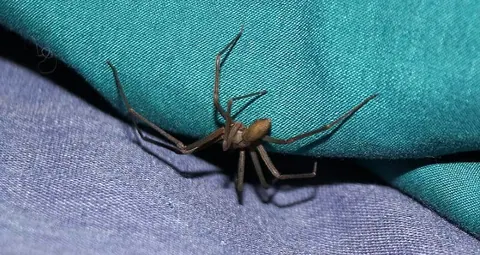
Brown recluse spiders are genuinely rare in South Carolina — decades of specimen collection have never verified an established population anywhere in the state, Aiken County included. (JABFM)
This is the one with the biggest reputation and the smallest actual presence here. A peer-reviewed survey of museum and state records found only a small handful of verified brown recluse specimens collected in South Carolina over decades of records, scattered across a few counties with no evidence of a breeding population — while doctors statewide reported hundreds of suspected bites in the same years. (JABFM) That gap matters: almost every "brown recluse" spotted in an Aiken County home turns out, on closer look, to be the harmless southern house spider. The reliable way to tell them apart is eye count: a brown recluse has six eyes arranged in three pairs, where the southern house spider and most other spiders have eight. The violin-shaped marking people look for is real but inconsistent enough that it shouldn't be the only thing you rely on.
Frequently Mistaken for Dangerous (But Aren't)
Most of the spiders homeowners in Aiken County worry about are completely harmless.
- Southern house spider — large, dark, and often confused for a brown recluse at a glance. Common in garages, basements, and sheds. Harmless. (Clemson HGIC)
- Wolf spiders — big, fast, and unnerving to meet in a doorway, but they don't build webs to catch prey and pose no real threat to people. (Clemson HGIC)
- Orb-weavers — the ones responsible for the elaborate wheel-shaped webs across porches and garden edges in late summer and fall. Beneficial insect control, nothing more. (Clemson HGIC)
Keeping Them Out
- Move woodpiles and debris away from the foundation, and wear gloves when handling stacked wood.
- Shake out shoes, gloves, and clothing that have been sitting in a garage, shed, or storage box.
- Clear clutter in basements, closets, and attics — spiders (and the insects they're hunting) both prefer places that don't get disturbed.
- Seal obvious gaps and cracks around the foundation and utility entry points.
- Keep storage boxes off the floor and sealed, especially anything that's been in a shed or outbuilding.
If a Bite Happens
Wash the bite with soap and water and apply ice — then watch for warning signs that mean it's time to see a doctor.
For a widow bite, watch for spreading pain, cramping, or difficulty breathing — those warrant emergency care, not a wait-and-see approach. For a suspected recluse bite, a wound that spreads, blisters, or doesn't start improving should be seen by a physician. When in doubt, treat it like a medical question, because it is one.
Our Approach
We don't walk into a spider call assuming the worst species is the one you've got — most calls turn out to be harmless spiders doing exactly what they're supposed to do outdoors. What we do is confirm what's actually present, identify where it's coming from, and treat that — not blanket-spray a house because something with eight legs showed up in a bathroom.
Common Questions
How many venomous spiders are in South Carolina?
South Carolina has four spiders considered medically significant: the southern black widow, northern black widow, brown widow, and brown recluse. (Clemson HGIC)
How do you tell a brown recluse from a southern house spider?
The most reliable method is eye count. A brown recluse has six eyes arranged in three pairs, while most spiders, including the southern house spider, have eight. (Clemson HGIC)
Are brown recluse spiders common in Aiken County?
No. Verified brown recluse specimens in South Carolina are extremely rare statewide, with no confirmed established population anywhere in the state, Aiken County included — most spiders identified as brown recluses turn out to be the harmless southern house spider. (JABFM)
What should you do if bitten by a black widow?
Wash the area with soap and water and apply ice. Seek emergency care if you notice spreading pain, cramping, or difficulty breathing.
Sources
- Clemson HGIC — Brown Widow Spiders (covers southern/northern black widow and brown widow identification & control)
- Clemson HGIC — What Is It Wednesday: brown recluse vs. southern house spider (eye-count identification)
- Frithsen, Vetter & Stocks (2007), J. Am. Board Fam. Med. — verified brown recluse specimen survey for South Carolina
- Clemson HGIC — Big Yellow Spiders in South Carolina (orb-weaver behavior and bite risk context)
Detection Before Treatment. Every Time.
Coastal K9 and Pest Solutions • 320 Wendy Lane, Windsor, SC 29856 • 803-226-3155