Falconry Bird Abatement for Casinos, Stadiums & Large Sites
Falconry bird abatement uses trained raptors under a USFWS Special Purpose – Abatement permit to move gulls, pigeons, starlings, grackles and vultures off a property. It is silent, chemical-free and permitted for dispersal, not killing. Coastal K-9 & Pest Solutions runs abatement programs across South Carolina, Georgia and nationwide, paired with exclusion and food-source work.
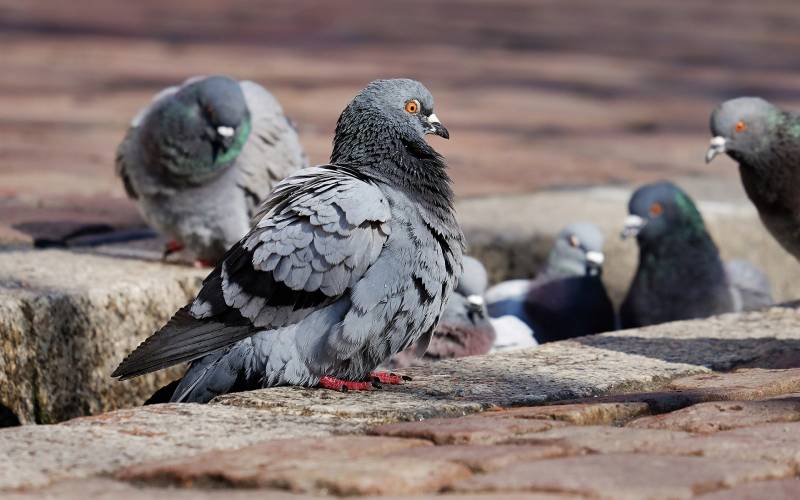
Most bird deterrents fail for the same reason: the bird works out that nothing actually happens. Cannons, distress calls, kites, reflective tape and pyrotechnics all rely on a threat that is never carried out, and a gull that has ignored a noise cannon for two weeks will ignore it for the rest of the season. A live raptor is different because the threat is real and occasionally reinforced, which is why it holds up far longer than acoustic and visual deterrents do.
We are going to be unusually direct on this page about what the evidence does and does not show, because this is an industry with a lot of invented statistics in it. There are only a handful of controlled falconry studies worldwide, mostly UK landfills and New Zealand vineyards, and every one of them reports reduction rather than elimination. If someone quotes you a 95 or 99 percent success rate for a casino or a stadium, they made it up. What falconry does well is break an entrenched flock's habit of using your property. What keeps them off afterward is exclusion and removing whatever brought them there.
What is falconry bird abatement?
It is the use of trained, captive-bred raptors, flown by a licensed falconer on a planned patrol, to flush and haze nuisance bird flocks off a property. The birds you want gone are not caught or killed; they are made to feel that your rooftop, pool deck, loading dock or parking structure is a place where a predator hunts. Flocks relocate.
It is silent. It uses no pesticides, no pyrotechnics and no propane cannons, which is why it fits venues where noise and chemicals are not options — guest-facing resorts, hospitals, outdoor dining, stadium concourses and food plants. Handlers work in uniform, on agreed flight lanes, in patrol windows coordinated with your security and operations teams.
Because we also run an exclusion crew and a full commercial pest program, we can do the part that most falconry vendors cannot: fix the reason the birds were there. See our bird control and exclusion service and our repairs and exclusion work.
What permits does this actually require?
This section is worth reading closely, because almost every competitor page in this industry gets at least one of these points wrong, and a regulator can check every one of them.
- The federal permit is USFWS Form 3-200-79, Special Purpose – Abatement, issued under 50 CFR 21.95. There is no CFR section called “the abatement regulations” — a 2015 proposed rule that would have created one was never finalized, and the word “abatement” is not even defined in the definitions section at 50 CFR 21.6. Abatement permits are special purpose permits. Anyone citing “abatement regulations” as their authority is describing something that does not exist.
- Falconry itself is now at 50 CFR 21.82, not 21.29. Part 21 was reorganized effective 2022. You will still find 21.29 cited on competitor sites — and, remarkably, on some government pages that have not been updated. It is the single fastest way to tell whether a vendor's compliance material has been reviewed since 2022.
- The permit is issued to individuals, not companies. A business name can be listed as a DBA, but no corporation holds an abatement permit. “Federally licensed company” is not a thing. Ours is held by our Master Falconer.
- Eligibility is narrow. The holder must have a current, active state falconry permit at the Master Falconer level — which in South Carolina requires at least five years of practicing falconry with your own raptors at the General level. The raptors must be captive-bred and marked on the metatarsus with a seamless numbered USFWS band. And critically, the only raptors that may be used are those belonging to the permittee — you cannot fly borrowed or leased birds under a federal abatement permit.
- Payment is expressly allowed, and only here. 50 CFR 21.82(f)(11)(ii) states that you may receive payment for providing abatement services if you have a Special Purpose Abatement permit. Falconry is otherwise a non-commercial activity — even conservation education programs are limited to cost recovery. Abatement is the one falconry-adjacent activity where a fee is permitted.
- South Carolina authorizes it explicitly. SC Regulation 123-170 states that a Master Falconer may conduct abatement activities with a bird possessed for falconry if the falconer has a Special Purpose Abatement permit, that General Falconers may conduct abatement only as a sub-permittee, and that falconers may receive payment for abatement services with that permit. Facilities must pass an SCDNR inspection before a permit is granted.
- Georgia works by incorporation. Georgia Rule 391-4-9-.07 requires falconry permittees to comply with the federal falconry standards as now or hereafter amended. Georgia has no rule text addressing abatement directly. We treat Georgia engagements as requiring their own confirmation with GA DNR's Special Permit Unit rather than assuming reciprocity, and we will tell a Georgia client exactly where that stands before we quote.
- Nationwide means nationwide subject to state law. USFWS conditions the permit plainly: you may not conduct the authorized activities if doing so would violate the laws of the applicable state. Falconry permits are state-issued. Any vendor telling you a federal permit lets them operate in all fifty states is misreading their own permit. We deploy nationwide, and each engagement includes confirming authorization in that state.
Do the hawks kill the birds?
No, and the permit is explicit about it. The Form 3-200-79 language is worth quoting verbatim: “An abatement permit does not authorize killing or injuring of birds or other wildlife.” Programs are flown to move flocks off the property, not to catch them. Lethal take of a bird protected under the Migratory Bird Treaty Act requires a separate depredation permit or a depredation order — a different application, a different legal basis, and not what this service is.
There is a related point most vendors invert, and it is worth understanding because it tells you what you are actually buying. 50 CFR 21.100 states that no permit is required merely to scare or herd depredating migratory birds. Hazing protected birds is not itself a licensed activity. The abatement permit is required because we possess and commercially deploy MBTA-protected raptors — not because chasing gulls needs federal permission. When a competitor tells you “you need a permit to scare protected birds and we have it,” they have the regulation backwards.
Raptors are predators, and a bird flown at a live flock will occasionally catch something. When that happens to a protected species it is incidental take, and it must be reported to the Regional Migratory Bird Permit Office within two business days. We do that, every time, and we log it. Every acquisition and disposition of a raptor is filed on Form 3-186A, activity records are kept per bird, and records are retained for at least five years past permit expiration. If a vendor has never mentioned incidental take reporting to you, ask why.
Which birds are protected, and which are not?
This determines what is legally possible at your site, and the distinctions are finer than most people expect.
Not protected under the MBTA
Rock pigeon, European starling, house sparrow — plus Eurasian collared-dove and mute swan. A precision point worth knowing: pigeons and starlings are unprotected for different legal reasons. Pigeons belong to a family the treaties cover but are excluded as a human-introduced species. Starlings and house sparrows belong to families the treaties never covered at all. Competitors get this wrong constantly. Pigeon, starling and house sparrow profiles.
Protected — gulls
Laughing gull, ring-billed gull and herring gull are all on the current 50 CFR 10.13 list. Laughing gulls are the dominant Southeastern nuisance gull, breeding in South Carolina and Georgia salt marsh colonies and heavy at waterfront, marina, retail and stadium sites in spring and summer. Ring-billed gulls are the parking-lot gull and are a winter problem inland, driving most gull complaints from autumn through early spring.
Protected — corvids and blackbirds
American crow, fish crow, common grackle, boat-tailed grackle, red-winged blackbird and brown-headed cowbird are protected, but all fall under the depredation order now at 50 CFR 21.150, which allows control without a federal permit where they cause serious agricultural, health or structural damage — with non-lethal methods attempted first each year. Boat-tailed grackles are a coastal Carolina and Georgia specialty and are aggressive around outdoor dining and marinas.
Protected — vultures
Black and turkey vultures are protected and no depredation order covers them, so lethal take requires a full depredation permit. They are also a distinctive commercial problem: they roost on rooftops, cell towers, light stanchions and communications gear, and they damage EPDM roofing, pool covers, vehicle rubber trim and wiper blades, with heavy fecal loads. Non-lethal dispersal is the legally clean path, which is exactly why abatement suits them. Be aware that a vulture is a large soaring bird and flying at a vulture roost is a materially different operation from flying at gulls — we will tell you honestly what we would deploy and what to expect.
Protected — waterfowl and waders
Canada goose is protected, with a set of dedicated control orders covering airports and military airfields, agricultural facilities, public health situations, and nests and eggs. Resident geese on retail ponds, corporate campuses and golf courses are usually better handled through our dedicated Canada goose management program, with falconry as an escalation option. Cattle egret and great egret are protected and turn up at aquaculture, pasture-adjacent and retention-pond sites.
Birds already inside a building
A separate and very useful rule: 50 CFR 21.14 allows any person to remove migratory birds from a building interior without a permit where their presence prevents normal use or creates a health or safety risk. Humane handling is required, adhesive traps are prohibited, birds must be released immediately, and — importantly for warehouses and food plants — the rule itself requires you to prevent reentry by patching holes or installing bird exclusion devices. A sparrow in a distribution center is an exclusion job, not a falconry job.
What does the evidence actually show?
We would rather publish the real literature than a made-up number, so here is all of it.
Falcons outperform hawks on open-airspace flocking birds. Baxter and Allan, writing in the Wildlife Society Bulletin in 2006, flew trained hybrid falcons and hawks against gulls and corvids at UK landfills throughout daylight hours, seven days a week, for periods of seven to twelve weeks. Their conclusion: neither group eliminated all scavenging birds, but numbers were reduced more consistently by falcons than by hawks, and they recommended falcons as the more appropriate choice within an integrated bird management strategy.
The best comparative dataset that exists says nothing eliminates birds. The same researchers ran forty separate trials over two years across six UK landfills, comparing pyrotechnic rockets, helium kites, hawks, falcons, automated distress calls, hand-held distress calls, sound generators, blank-firing pistols and live rounds. Each trial ran twelve weeks or until birds stopped responding. Their conclusion, verbatim: “Birds could not be eliminated but numbers were reduced to different extents by different techniques. The success of various techniques also varied significantly in terms of habituation.” They hypothesized that combining techniques would improve results — which is precisely how we build programs.
Habituation is the real mechanism, and the honest version is more interesting than the marketing version. Cook, Rushton, Allan and Baxter, in Environmental Management in 2008, tested nine methods against three gull species across six landfills. Distress calls, falconry, and combinations of lethal and non-lethal ammunition produced the strongest initial deterrent effect — but the durable ones were the methods carrying real consequence. Non-consequential methods declined as birds habituated to repeated exposure without an actual threat. Note what that means: falconry's durability advantage comes from the raptor being a genuine, occasionally successful predator, not from merely looking like one. We are not going to tell you birds never habituate to a live raptor. We will tell you they habituate far more slowly, because the threat is real and gets reinforced.
The agricultural number, with its caveats attached. Kross, Tylianakis and Nelson, in Conservation Biology, studied New Zealand falcons introduced into vineyards and found a significant decrease in passerines and a 95 percent reduction in grapes removed relative to vineyards without falcons, with a 55 percent reduction in pecked grapes for one species, and modelled savings of US$234 per hectare for Sauvignon Blanc and $326 for Pinot Noir. Those are real published figures — and they come from New Zealand, from wild falcons establishing territory rather than a falconer flying trained birds on patrol, against a pest complex that is not ours. Quoting “falconry reduces bird damage 95 percent” without that framing would be misleading, so we do not.
What does not exist. There is no peer-reviewed US airport study quantifying strike reduction attributable to falconry. The FAA's own Wildlife Hazard Management at Airports manual mentions trained falcons in a single line, with no effectiveness data and no cost analysis, while habitat modification and exclusion get full chapters. There is no published study on falconry at casinos, resorts, stadiums, hospitals, retail centers, distribution centers, marinas or solar farms — none. There is no published dose-response on patrol frequency or program duration. Falconry is not FAA-approved, FAA-certified or USDA-certified, and no such designation exists. Any percentage you see attached to those settings on any company's website, including numbers that sound modest, is unsourced.
What falconry does not solve
Publishing this costs us some jobs. We would rather lose the ones we would have failed.
It does not eliminate birds
Two independent controlled studies say so explicitly. The deliverable is reduction and displacement, not eradication. If your requirement is zero birds, falconry is not the tool and no honest vendor will tell you otherwise.
It does not work while the food stays
Every study site was a landfill — the attractant remained, so the effect was suppression requiring continuous input. Open dumpsters, loading-dock spillage, outdoor dining, standing water, retention ponds and landscape fruit all have to be addressed, or you are paying us to fight your own site conditions indefinitely.
It does not replace exclusion
Netting, bird wire, ledge modification and sealed entry points are permanent. Falconry is a recurring service. Even the federal rule for interior birds requires patching holes and installing exclusion devices. The right sequence is usually knockdown by falconry while exclusion is installed, then a reduced maintenance patrol.
It is the wrong tool for several situations
Birds already on active nests — protected nests attract federal protection and entrenched nesters do not disperse well. Interior infestations. A single-structure pigeon problem that exclusion would solve permanently and more cheaply. Sites where the attractant cannot be reduced and the budget cannot sustain continuous patrols. And any situation where what the client actually needs is lethal control, which this permit does not authorize.
It is weather-limited
High winds, heavy rain, fog and extreme heat ground raptors. Coverage is not 24/7 and we will not pretend otherwise in a contract.
Cost scales with patrol frequency
And patrol frequency is the one variable the evidence says matters most. Both landfill studies flew birds daily, through all daylight hours, for seven to twelve weeks. Intermittent service is not what was tested. Event-day-only coverage manages the symptom during those hours and rarely relocates a resident flock.
Which raptors, and why?
Harris's hawk is the one species choice with genuine peer-reviewed backing behind it. Bednarz's 1988 paper in Science documented Harris's hawks in New Mexico forming hunting parties of two to six individuals in the non-breeding season, a behavior that improved capture success and let them take prey larger than themselves. They are the only North American raptor with documented cooperative group hunting, which is why they tolerate handling well, work in casts, and are the standard choice for structured, lower-airspace, guest-facing environments. That study documents wild social hunting, not abatement — we are not going to imply it tested our service.
Falcons — peregrine, gyr and saker hybrids, saker, lanner, barbary — are the open-airspace group, flown at gulls and pigeons over rooftops, landfills and large open sites. This is the one species-selection claim with head-to-head data behind it: falcons reduced gull and corvid numbers more consistently than hawks at UK landfills.
Smaller falcons such as aplomado and merlin are flown at small passerines — starlings, sparrows and small blackbird flocks — in tighter airspace. That mapping is real operational practice rather than published science, and we will describe it as our experience rather than dress it up as a study.
Eagles are not an abatement tool. Bald eagles are prohibited outright and golden eagles are excluded from the abatement permit. Eagles fall under an entirely separate permitting regime. If a vendor offers eagles for large sites, that is a compliance red flag.
How a program runs
Site assessment
We identify the species, count and map the flock, find where they roost versus where they feed, identify the attractants, and photograph the damage and the fouling. We tell you at this stage if we think exclusion or sanitation alone would solve it more cheaply, because a program built on the wrong diagnosis fails no matter how well it is flown.
Scope, permits and coordination
Written scope with a defined knockdown phase and a maintenance rate. Flight lanes and no-fly zones agreed with your venue. Patrol windows matched to target-species activity — dawn and dusk pressure for roosts, midday for feeding sites. Radio coordination with security and operations before each flight. Confirmation of state authorization for the site's jurisdiction. On airports, we operate as one contracted tool inside a biologist-led wildlife hazard management program, never as the program.
Knockdown phase
Consistent, frequent patrols — this is the phase where frequency does the work, and where thin coverage produces thin results. Telemetry on every bird, documented weather stand-down criteria, guest-corridor separation, and a documented response if a raptor is lost or a non-target animal is taken.
Exclusion and source removal in parallel
Netting, wire, ledge modification, sealed entry points, dumpster and spillage management, standing water. This is the part that makes the result durable, and it is why we prefer to run abatement inside a broader program rather than as a standalone patrol.
Maintenance phase
Reduced patrol frequency once the flock has relocated and the exclusion is in place, scaled to your season. For most Southeastern sites that means heavier coverage in the gull and vulture seasons and lighter coverage in between.
Documentation
Patrol logs, species counts against baseline, photographs, and USFWS-compliant records — every raptor, every acquisition and disposition, every activity, and every incidental take reported within two business days. If you are audited, inspected or challenged, the record is the deliverable.
Where falconry abatement makes sense
- Casinos and resorts — pool decks, outdoor dining, valet and porte-cochère, where noise cannons and chemicals are unusable and guest optics matter
- Stadiums and arenas — gulls and grackles working concourses and outdoor food service
- Airports — as one contracted tool inside a 14 CFR 139.337 wildlife hazard management plan, never as the plan itself
- Landfills and transfer stations — the one setting with real published data, and the one where daily flying was what was actually tested
- Food processing and distribution — where FDA's Preventive Controls rule is the driver (see below)
- Agriculture — vineyards, blueberry and pecan operations, with the New Zealand vineyard study as the only real evidence base
- Marinas and waterfront — laughing gulls, boat-tailed grackles and herons
- Hospitals and healthcare campuses — where an immunocompromised population makes fouling a genuine concern
- Corporate campuses, retail centers and golf — resident geese, gull roosts and vulture perching on rooftop equipment
- Warehouses and distribution centers — usually a combined interior-removal, exclusion and exterior-pressure job
What is the actual cost of a bird problem?
Aviation. The FAA reports about 19,700 wildlife strikes at 780 US airports in 2023, and roughly 292,000 reported strikes with civil aircraft between 1990 and 2023. Reported costs totalled $1.48 billion over that 34-year period, and adjusted for strikes where costs were not provided, losses could run as high as $300 million per year. Birds account for 97 percent of reported strikes. Waterfowl are only 4 percent of strikes but cause 27 percent of the damaging ones. We cite those figures because they are the FAA's own. We will not attach a falconry-attributable percentage to them, because no US study supports one.
Food facilities. This is the cleanest compliance hook there is, and it does not require inventing audit statistics. Under FDA's Preventive Controls rule, 21 CFR 117.3 defines “pest” to include birds — birds are legally pests in a food plant. And 21 CFR 117.35(c) states that pests must not be allowed in any area of a food plant, and that effective measures must be taken to exclude pests from manufacturing, processing, packing and holding areas. That is the regulation. We are not going to quote you AIB, SQF or BRCGS point deductions, because we have not verified them against the current standards and a wrong clause number in front of a QA manager is worse than saying nothing. See our food processing and manufacturing program and our warehouse and distribution program.
Health. Here too we are going to be more careful than the industry norm. You will see claims that birds carry 60 or more diseases transmissible to humans; we could find no agency source for that number or anything like it, so we do not use it. What the CDC actually says is narrower and worth stating correctly: Histoplasma lives in the environment, mainly in central and eastern states, and spreads in bird and bat droppings that mix in soil — the fungus grows in the droppings, and the CDC does not describe birds as carriers. Cryptococcus neoformans lives in the environment worldwide, with soil, bird dung and decaying wood among its sources, and infections occur overwhelmingly in people with weakened immune systems. Accumulated droppings are a legitimate reason to remediate. They are not a reason to frighten your staff.
The costs we see most often are more mundane and easier to price: sanitation labor and pressure-washing, slip hazards on fouled walkways and the liability that comes with them, product and packaging contamination, uric acid corrosion of roofing membranes and HVAC and painted metal, drains and gutters clogged with nesting material, fire risk from nests in signage and lighting, and guest complaints and review scores at hospitality and retail sites.
When should you start?
Before nesting, and the reason is legal as much as behavioral. MBTA protection extends to the nests and eggs of protected species. Once a protected bird has an active nest on your property, your options narrow considerably — the clean regulatory exception is 50 CFR 21.14 for birds inside a building, and everything outside a building interior becomes a different and more constrained analysis. Unprotected species — pigeon, starling, house sparrow — have no federal nest protection, which is one more reason species identification is the first step.
Behaviorally, a flock that is feeding at your site is far easier to move than a flock that has established a roost, and both are easier than birds that are nesting. We will not publish specific nesting-window dates for South Carolina and Georgia, because we could not verify a state-specific document and we are not going to guess at dates that carry legal weight. What we will do on your assessment is check the current guidance with USFWS Ecological Services and the relevant state nongame program for the species on your property, and tell you what window you are actually working in.
What we will not claim
We are putting this on the page deliberately, because you are going to compare vendors and it is easier to compare them against a list.
| Common industry claim | Why it does not hold up |
|---|---|
| “Permitted under 50 CFR 21.29” | Obsolete since the 2022 reorganization. Falconry is 21.82; the abatement permit is 21.95. |
| “Federally licensed company” | Abatement permits are issued to individuals only. No company holds one. |
| “Our federal permit covers all 50 states” | USFWS conditions the permit on compliance with applicable state law, and falconry permits are state-issued. |
| “FAA-approved” or “USDA-certified” | No such designation exists. The FAA manual gives falconry one line with no effectiveness data. |
| “95% effective” / “eliminates nuisance birds” | The two controlled landfill studies state that birds could not be eliminated. |
| “Birds never habituate to a live predator” | Overstated. The research supports slower habituation because the threat is real and reinforced — not zero habituation. |
| “Permanent solution, one and done” | Every study measured suppression under continuous daily flying at sites where the attractant remained. |
| “Birds carry 60+ diseases” | No agency source exists for that figure or anything like it. |
| “Eagles available for large sites” | Bald eagles are prohibited and golden eagles are excluded from the abatement permit. |
Frequently asked questions
Is falconry bird abatement safe around guests, staff and pets?
Yes. Raptors are flown under a handler's direct control on planned lanes and are focused on the target flock, with agreed no-fly zones and guest-corridor separation, and patrol windows coordinated with your security team. Handlers work guest-facing venues in uniform. Falconry is silent and chemical-free, which is precisely why it suits properties where noise cannons, pyrotechnics and pesticides are not options.
Do the hawks kill the pest birds?
The goal is dispersal, not take. The federal permit states directly that an abatement permit does not authorize killing or injuring of birds or other wildlife. Programs are flown to move flocks off the property. Raptors are predators, so incidental captures do happen — and when a protected species is taken, we report it to the USFWS Regional Migratory Bird Permit Office within two business days and log it in the records we retain for five years.
How fast will we see results?
The only defensible timeline comes from the published landfill trials, which ran seven to twelve weeks of daily, all-daylight flying and measured reduction against a four-week pre-treatment baseline. How fast your site moves depends on whether it is a feeding site or an established roost, whether the food source is still there, flock size and species, the season relative to nesting, site openness, and above all patrol consistency. There is no published dose-response literature, so anyone guaranteeing results in a specific number of days is inventing it.
Can you provide abatement on event days only?
We can, but you should know what you are buying. Event-day-only coverage manages the symptom during those hours and rarely relocates a resident flock — the studies that produced measurable reduction flew birds daily for weeks. Venues that want birds gone rather than briefly displaced should fund a continuous knockdown phase first, then step down to event-day maintenance.
How is falconry priced?
By patrol hours and program length, driven by property size, number of zones, the species involved and how entrenched the flock is. Patrol frequency is the variable the evidence says matters most, so it is also the main cost driver. Pricing follows a site assessment and is issued as a written scope with a defined knockdown phase and a separate maintenance rate. We do not quote from a photograph.
Will this work on vultures?
Often, and it is frequently the only legally clean option, because no depredation order covers black or turkey vultures — lethal take requires a full depredation permit. Vultures roosting on rooftops, cell towers and light stanchions damage EPDM membranes, pool covers and vehicle rubber trim. Be aware that flying at a large soaring bird is a different operation from flying at gulls; we will tell you at assessment what we would deploy and what to expect.
Do we still need netting and spikes if we hire you?
Almost certainly, and we would rather say so before you sign. Falconry breaks a flock's habit of using your property; exclusion is what makes the change permanent. The federal rule for birds inside buildings actually requires patching holes and installing exclusion devices. The strongest programs run knockdown by falconry while exclusion is installed, then drop to maintenance patrols. We can do both parts — see our bird control and exclusion service.
Is falconry FAA-approved for airports?
No, and neither is anything else — there is no FAA approval scheme for wildlife deterrent methods. The FAA's Wildlife Hazard Management at Airports manual mentions trained falcons in a single line with no effectiveness data or cost analysis, while habitat modification and exclusion receive full chapters. At an airport we operate as one contracted tool inside a biologist-led wildlife hazard management program under the airport's own plan. Any vendor claiming FAA approval or certification is describing something that does not exist.
What about Canada geese?
Geese are protected but sit under a specific set of federal control orders covering airports and military airfields, agricultural facilities, public health situations, and nests and eggs. For retail ponds, corporate campuses and golf courses we usually lead with our dedicated Canada goose management program, which combines habitat modification, egg and nest work under the appropriate authorization, and dispersal — with falconry as an escalation option where the flock is entrenched.
Can you work outside South Carolina and Georgia?
Yes, and here is the honest framing. The federal abatement permit is federal, but USFWS conditions it on compliance with applicable state law, and falconry permits are issued by states. So we deploy nationwide subject to confirming the required authorization in each state, and that confirmation is part of the engagement rather than an assumption. For Georgia specifically, the state rule incorporates the federal falconry standards by reference and does not address abatement directly, so we confirm the position with GA DNR's Special Permit Unit for each engagement rather than assuming reciprocity.
Related services
Have a flock you cannot move?
Tell us the property, the species if you know it, and what has already been tried. We will assess the site, tell you whether falconry is the right tool — and if exclusion or sanitation would fix it more cheaply, we will say so. Permitted programs across South Carolina, Georgia and nationwide from Windsor, South Carolina.