
K-9 Rodent Detection in Lexington, SC
Lexington sits inside a poultry county with a brand-new town wrapped around it, and rodent pressure follows the feed. Coastal K-9 & Pest Solutions runs a certified detection dog through barns, feed rooms, lakeshore outbuildings and post-2000 subdivision houses to mark where live activity actually sits, then hands over the map.
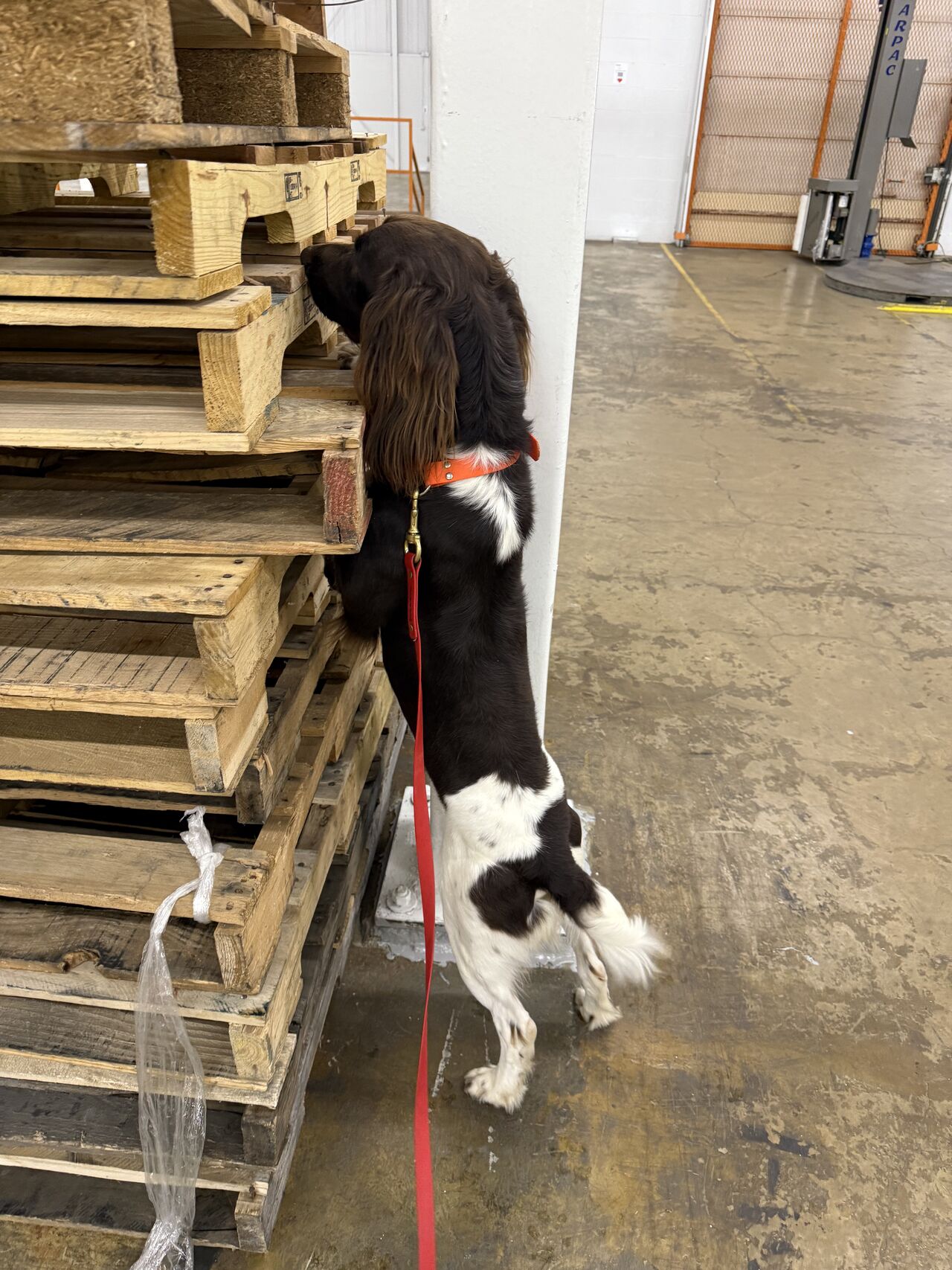
Two very different buildings generate most of the rodent calls we take around Lexington. One is a feed and equipment building on a farm, where the thing being protected is the thing the rodents came for. The other is a house finished after 2000, whose owner was told new construction does not get rodents, and who is now in a garage listening to something move above the ceiling.
Neither is solved by guessing which cavity to open. This page is detection; trapping, baiting and structural repair live on rat and mouse control under the wider rodent control service.
Why does a poultry county change what a rodent inspection has to cover?
Because the largest concentration of rodent food here is not in anybody’s kitchen. It is in feed bins, delivery augers, litter packs and the ground beneath a feed line.
The 2022 Census of Agriculture puts 822 farms and 79,450 acres of farmland in Lexington County, selling $331,830,000 of product that year, second in South Carolina for total agricultural sales. Seventy-seven percent of that money came from livestock, poultry and their products, and the number explaining the rest is 7,065,868 broilers and other meat-type chickens. Row crops are there too, at 9,189 acres of forage and 4,457 of cotton.
So the productive surfaces are rarely the ones a homeowner would name: bin skirts and boot pits, the underside of auger runs, the seam where a sidewall curtain meets the foundation, the cool room, the generator shed, the pallet of bagged feed nobody has moved since spring. A dog reads all of that at walking pace. For growers and elevators under customer audit, the same methodology runs through agriculture and grain handling.
What can a nose do here that a bait station cannot?
Stations and traps answer one narrow question: did an animal cross this exact spot since the last service. Everything between the devices goes unmeasured, and on a farm that is most of the volume.
Detection inverts that. Handler and dog move along wall bases, slab edges, machine plinths, chases and stacked goods, and the dog responds to odor leaving cavities nobody has opened. Nothing is applied and no exploratory hole gets cut on a hunch.
Here is the part we insist on printing. An indication gives a place, not a headcount. Odor pools at the bottom of a chase, so an alert can sit several feet from the animal producing it. Scent will not name the species either. That call is made later, from physical sign.
One more limit, published rather than buried. Scent-dog field trials are numerous for bed bugs and sparse for commensal rodents in structures, so you will find no hit rate quoted here. We hunted for a study that would hold up to hostile questioning and came away without one. The argument is on our canine scent detection accuracy page. This company was founded by Kimberly Camera, twenty-eight years into scent detection work and formerly with FEMA Urban Search & Rescue.
Does keeping four hens in a back yard make this your problem?
The Town of Lexington has answered that in its own code, and the answer is yes.
Section 91.02 permits backyard chickens with conditions: four birds maximum however large the lot, no roosters, a $20 permit from the Office of Planning, Building and Technology, rear yard only, and any structure at least 25 feet from a property line, reducible to 10 feet with a neighbor letter and screening. In the same passage, the resident is required to provide proper disposal of sanitary waste and pest control.
That clause is not decoration. A sack of layer feed in a garage, an open bin beside a coop and scratch grain on bare soil amount to a small feed operation dropped into a subdivision. The same ordinance keeps horses, hogs and cows 250 feet from a residence and barns 500 feet; chickens got the pest-control clause.
Note also that section 91.21 adopts the Lexington County animal control ordinance by reference, and where the two conflict the county ordinance governs. The latest amendment is Ordinance 2024-13, adopted 7 October 2024.
A flock is easy enough to make rodent-hostile: feed in a hard-sided bin with a latching lid, feeders up at dusk, run floor and coop skirt closed with quarter-inch hardware cloth. Chicken wire keeps a hawk out. It does not slow a rat.
If the houses are this new, why are rodents getting in?
Label the geography before the number, because the two Lexingtons are not the same place. The TOWN’s median year of construction is 2002; the COUNTY’s is 1993. Of the town’s 10,348 housing units, 80.3 percent were built in 1990 or later, 57.5 percent in 2000 or later, only 9.5 percent before 1980. Town population went from 17,870 in 2010 to an estimated 25,729 in 2025.
People assume young stock means tight stock. It does not. New construction fails in a short, predictable set of places, and because the housing is uniform the same defect repeats down a street.
- Garage door corner seals. The bottom seal compresses across the middle and lifts at both ends, leaving a triangle at each jamb. It is the opening we photograph most in post-2000 houses here.
- Utility penetrations at the slab edge. Water, waste, gas, service entrance and the refrigerant line set all cross one band, each drilled by a different trade.
- Weep holes in brick veneer. Required for drainage, so filling them is not an option. Stainless or copper inserts keep the drainage path and close the doorway.
- Soffit returns. Where a gable meets the main box, the soffit dead-ends into a void that often opens into the attic behind the fascia.
- Builder-grade exterior doors. More than a quarter inch of clearance underneath is an entrance, and new-house sweeps are usually adequate at the middle and open at the corners.
- Trench backfill and stoop edges. Loose fill along a service trench is the easiest digging on the lot, and Sandhills quartz sand neither waterlogs nor collapses around a burrow.
None of it is a builder scandal, and all of it is fixable in an afternoon once somebody marks the openings. Our repair crew closes to specification.
What happens when the next phase breaks ground behind you?
You inherit the neighbors, through nothing you did.
The town’s own GIS subdivision status layer shows how much ground is moving. Barr Lake phases 3D and 3E carry 182 lots between them. River Ridge is recorded at 150 lots, West of Main at 76, Nightingale Hills at 66. Sterling Bridge is working through phases six to ten at 26, 16, 25, 25 and 65. Brookstone one and two add 51 and 53, and Riverside runs through phases one, 2A and 2B. Countywide, 2,006 residential building permits were issued in 2025.
When a grader strips forty acres, everything living in that cover relocates within a day or two. Burrow systems along a fence line or a drainage swale get opened or buried, and the animals do not disperse evenly. They move to the nearest structure with food and harborage: the finished phase next door.
The signature is unmistakable: a street of five-year-old houses with no history of trouble starts generating calls, clustered on the side facing the work. It is also the cheapest moment to seal.
Which of the three species is it, and what does each one leave?
The animal itself stays out of view, so the call gets made from what it leaves behind. Three commensal species share these buildings, each on its own vertical plane, and naming the wrong one costs you a fortnight.
| Species | Field marks | Where the sign turns up here | What it dictates |
|---|---|---|---|
| Norway rat | Heavy build, blunt nose, small ears, a tail that falls short of head plus body; droppings up to three-quarters of an inch, ends squared off | At grade — burrow mouths at slab edges and stoops, under feed bins and sheds | Grade-level sealing and burrow work lead. It drinks daily and shies from new objects, so a device must sit unused for days |
| Roof rat | Slender, sharp nose, prominent eyes, an ear that folds forward past it; droppings around half an inch, both ends drawn to a point | Overhead — loft floors, top plates, duct runs, batt insulation, and the limbs and cables leading up to them | The whole job moves up: gable and soffit vents, chase caps, canopy cut off the roof |
| House mouse | Half an ounce, ears large for the head; droppings near a quarter inch, rice-shaped, scattered not piled | Small amounts in many places — drawer backs, toe kicks, appliance cavities, tack trunks, dry attics | Trap density decides it. Needs no free water; home range of ten to thirty feet, so two traps under a sink do nothing |
Detail sits in the Norway rat, roof rat and house mouse profiles. Rule out the impostors first. A southern flying squirrel nests in cavities and moves after dark, so it lands on the phone as a rat almost every time, and the eastern gray squirrel is game in this state with separate rules. Our pest library has the rest.
The shortcut on a farm: sign on a feed room floor points at Norway, sign along a truss chord at roof rat, a light scatter everywhere at mice. Height settles more arguments than size does.
Does a lakeshore address change the job?
It changes the inventory. A house on the water is rarely one building, and the outbuildings are where the work is.
Lake Murray covers 48,579 acres with 620 miles of shoreline across Lexington, Newberry, Richland and Saluda counties, averaging 41.5 feet deep, and its 1.6-mile dam feeds the 205 MW Saluda hydroelectric station. Along much of that shore the normal maximum pool sits at the 360-foot contour, frequently the boundary between Dominion Energy and the upland owner, under FERC Project No. 516 and a Shoreline Management Plan first developed in 1975. What you may build on the water is not a town decision.
A lakeside property therefore accumulates structures a house inspection never touches: a boathouse loft, a dockbox holding rope and dog food, a pump house, a detached garage with a boat in it. Each has a low floor system, an unfinished ceiling and nobody looking inside for months. Frontage also guarantees permanent drinking water, which matters for the Norway rat, and shoreline canopy supplies the routes a roof rat prefers.
Inland, the creek corridors do the same work. Twelve Mile Creek runs through Lexington with USGS gauging station 02168810 on it, in hydrologic unit 03050109, and the Twelve Mile Ridge subdivision takes its name from it. Fourteen Mile Creek carries a 3,500-foot town trail off North Lake Drive and Old Cherokee Road. A riparian strip is unbroken cover, water and food running through developed ground, and burrowers travel it the way climbers travel branches.
How small does a gap have to be before it counts?
Smaller than instinct suggests. The coin version is worth memorizing: a house mouse passes an opening about the width of a dime, a rat one about the width of a quarter. As a specification, seal anything over a quarter inch for mice and over half an inch for rats. UC IPM puts it bluntly — a half-inch gap beneath a door is a rat door.
The building code lands on that same quarter inch by a different route. Under IRC R408.2, whatever covers an under-floor ventilation opening may not exceed a quarter inch in its least dimension, and the acceptable materials are listed out: 0.070-inch perforated sheet metal, 0.047 expanded metal, cast-iron grating, extruded brick vents, or hardware cloth woven from 0.035-inch wire upward. A compliant vent excludes rodents for free. A rusted one is simultaneously a defect and a door.
- Against rats: half-inch hardware cloth, 19 gauge, woven. Welded mesh opens at the joints under repeated gnawing.
- Against mice: quarter-inch hardware cloth, 24 gauge, again woven.
- Sheet metal: 24 gauge for pipe and wall barriers, 22 gauge where a surface takes abuse.
- Doors: a quarter inch maximum at the threshold, and a sweep that still shuts to an eighth of an inch out at the jambs, since the jamb end is what gives way.
- Copper mesh: stuffing to sit behind a hard cap, not the cap itself. It has one advantage over steel wool, which rusts loose inside a season.
- Sill plate and band joist: the highest-yield hour on any building here, because every service crossed that line.
- Expanding foam: an air seal and nothing more. Teeth pass through it without slowing.
Digging gets stopped structurally by one of three published details: a below-grade curtain wall taken down three feet, a footing with a twelve-inch outward return, or a two-foot band of gravel at the perimeter.
Why is bait the wrong opening move around poultry and feed?
Two reasons, and the first is everything on the property that is not a rat.
Secondary poisoning has been measured, not merely argued. A 2022 Ecotoxicology paper out of Cornell reported anticoagulant residue in 68 percent of the 72 red-tailed hawks it screened in New York. Separate USGS sampling of 40 barred owls returned at least one anticoagulant compound in 48 percent. Neither study is from this region, and our search for Southeastern raptor monitoring turned up nothing, so read those numbers as proof the pathway is real, not as a rate for this county. On farmland the pathway is what counts: an anticoagulant kills over days, and a rodent dying slowly is the slowest thing on the property. A hawk takes it. So does a barn cat.
The second reason is that bait destroys your own evidence. A poisoned rat does not oblige you by dying in the aisle. It dies inside a wall, under a litter pack or six bales into a stack, and you get a fortnight of odor and no confirmation.
None of that makes rodenticide illegitimate. Used by a licensed applicator after the envelope is understood, it sits outside in tamper-resistant housings that are numbered on a drawing and serviced on a record. Worth knowing on the consumer side: the EPA rodenticide risk mitigation decision pulled the second-generation anticoagulants — brodifacoum, bromadiolone, difenacoum, difethialone — out of homeowner products, and pellet formulations are off the consumer shelf as well.
Which rodent remedies are worth nothing?
- Ultrasonic and electronic repellers. Between 1985 and 1997 the Federal Trade Commission took enforcement action against six companies over these products; in May 2001 it sent warning letters to over sixty firms making or selling them. UC IPM says the same thing without the litigation: almost nothing in the evidence base shows noise, magnets or vibration emptying a building of established mice.
- Peppermint oil and botanical repellents. We searched for an extension service or regulator endorsing peppermint oil in structural rodent work and came up empty, so we neither sell nor recommend it. We are not asserting it has been disproven, which is a separate statement. We are saying nothing citable backs it.
- Glue boards left down and forgotten. Grown animals often sense the board and walk around the edge of it, per UC IPM, which leaves you a tray of juveniles and an untouched breeding population. Lizards, snakes and small birds end up stuck on them too.
- One round of bait and nothing after. A Norway rat runs four to six litters annually at six to twelve young each and is breeding by three months old; a house mouse runs five to ten litters and is breeding between six and ten weeks. Leave one pair alive, or one hole open, and the season replaces everything you killed.
- Chicken wire on a coop or a crawl vent. Poultry netting was designed to contain birds, not exclude rodents, and the mesh is far too coarse for either target. Woven hardware cloth is the cheapest upgrade on a residential lot.
The gnawing fact worth citing is anatomical: incisors grow roughly five inches a year and must be worn down continuously, which is why chewed wiring and stripped insulation are routine findings.
When does rodent pressure arrive in Lexington County?
Two SC State Climatology Office freeze stations sit inside the county and they disagree by twenty days. Little Mountain records a last spring freeze around 31 March, a first fall freeze around 20 October, 246 freeze-free days. Pelion 4 NW records 21 March and 10 October, for 226. The town lies between them, with no station of its own. The nearest published temperature and rainfall normals are the Columbia and Midlands set, roughly 47.75 to 48.11 inches a year on a mean of 66.5 degrees F, and they are cited here as Midlands figures rather than Lexington ones.
A long frost-free season means outdoor food and cover persist most of the year. It does not mean breeding never stops. Published work puts the Norway rat reproductive peaks in spring and again in fall, with a summer lull and frequently a winter halt.
Late February into April
The spring reproductive peak, landing as fields are worked and feed movement picks up. Burrow entrances along foundations and bin skirts become visible before ground cover thickens over them.
May through August
Summer heat slows reproduction just as outdoor food peaks, so the pressure moves outside onto gardens, spilled feed and refuse. Calls about indoor noise dry up, and owners decide the problem went away by itself. It changed address.
September through November
The yearly peak. The autumn breeding surge arrives alongside colder nights and disappearing food outdoors, somewhere between the two county freeze dates, and roof rats start moving into lofts and attics as leaf cover drops away.
December through February
Whatever got in is obvious — overhead noise, droppings behind a pantry, shredded insulation, chewed cable. Poultry houses are heated by design, so they never get a quiet season.
The sealing window here runs from August into early October. Screen, then close, while the timing is still yours.
How does a canine screen run here, from the first call?
Scope settled on the phone
Which structures and levels, whether birds are in the houses, whether a feed room can be quiet for an hour, and who gets the report.
The outside, on foot, first
Grade line, slab edge, stoops, garage door corners, weep holes, utility trenches, bin pads, and every limb and service drop reaching a roof. Sign gets photographed before the dog leaves the vehicle.
The dog works the structure
One consistent search pattern over wall bases, floor lines, machine bases, pipe chases, plant rooms and product on pallets. A tired dog gets pulled off the job, and we will not run one in heat that is unsafe for it.
Every indication verified by hand
Targeted inspection at each alert — droppings, urine staining, grease marks, gnawing, nest material, and a borescope through an existing opening.
Species called from physical evidence
Dropping dimensions and end profile, the height sign appears at, gnaw pattern. That fixes trap layout and the order openings close in.
Map, clear, seal, re-screen
You get an annotated photo set: each opening to be closed, and the material and gauge that closes it. Trapping indoors precedes sealing the envelope, so nothing alive gets shut into a cavity. The dog then covers the building a second time.
What does a Lexington canine rodent screen include?
- A certified handler and dog on one repeatable search pattern, inside and out
- Photographed exterior survey of grade line, slab edge, roofline, weep holes and utility penetrations
- Indoor coverage of stud cavities, ceiling planes, pipe chases, machine bases and palletized goods
- Barns, feed rooms, bins, coops, boathouses and detached garages within the agreed scope
- Hand confirmation of every canine indication before a single recommendation is made
- An entry-point map keyed to mesh size, gauge and door-sweep specification
- Harborage and sanitation findings: spilled feed, storage practice, vegetation contact, refuse
- Written, dated, photographed findings for an owner, an insurer or an auditor
- A re-screen after the work is finished, regardless of who carried it out
Which Lexington operations need this documented rather than merely done?
Poultry, grain and feed handling. Anyone facing a customer audit needs the written program, the drawing with uniquely numbered device positions, dated service records and corrective actions closed out on paper. A canine screen feeds that file the thing auditors press hardest on: a specific location, photographed, with the evidence beside it. The same program runs nationally through nationwide K-9 rodent detection. We will not recite an SQF, BRCGS or AIB clause number, since citing the wrong one does more damage than citing none.
Industrial and distribution space. Prysmian is putting $80 million into its facility at 700 Industrial Drive in Lexington for FlexRibbon fiber-optic cable, roughly 135 new jobs, online in May 2028. At county level the economic development office lists Amazon, Dominion Energy South Carolina, House of Raeford, Lexington Medical Center, Michelin, Nephron Pharmaceuticals, Shaw Industries and Southeastern Freight Lines among its largest employers. Deep racking is the point at which looking with your eyes stops telling you anything — see our warehouse and distribution program.
Schools. Lexington County School District One enrolls 27,074 students across 32 schools, with 2,083.80 full-time-equivalent teachers and a ratio of 12.99, in a locale NCES calls large suburban. Cafeterias, receiving docks, kitchen line voids and portable classrooms have to be inspected without applying anything around children. See our schools and student housing program.
Food service. Know who scores you, because a lot of advice online is out of date. Since 1 July 2024 the retail food program in this state belongs to the South Carolina Department of Agriculture, not DHEC. Roughly 24,000 establishments fall under it, inspected against SC Regulation 61-25 on a hundred-point scale, with an A awarded above 87. See restaurant and food service.
Apartments and managed communities. Nearly a quarter of the town’s housing sits in buildings of five units or more, where a shared cavity is a corridor rather than a boundary — our multifamily program covers that, and some owners want an inspector who is not pricing the repair, which is the argument on our independent canine detection page.
Who is actually allowed to do this work here?
Not where most people look for it. Licensing of applicators and pest control businesses in South Carolina runs through Clemson University, specifically its Department of Pesticide Regulation, rather than through any state agriculture department.
The credential is Category 7A, covering industrial, institutional, structural and health-related pest control. A commercial firm also needs a DPR business license, a Designated Certified Applicator named for every location it works out of, and general liability insurance at a combined single limit of $100,000 or better with the deductible held under $1,000. Ask to see both. A legitimate firm produces them in a minute.
Where in and around Lexington do we work?
Coastal K-9 & Pest Solutions · 320 Wendy Lane, Windsor, SC 29856 · 803-226-3155 · Kim@ck9ps.com
Inside the town we cover the Main Street blocks around the Icehouse Amphitheater at 107 West Main, plus Virginia Hylton Park, Gibson Pond and the subdivisions named in the town’s own GIS: Barr Lake, Bent Creek, Brookstone, Cherokee Village, Coventry Lake, Gibson Forest, Golden Hills, Heritage Hills, Hope Ferry Plantation, Hunters Ridge, Lakeside at Woodcreek, Laurel Falls, Mallard Lakes, Middlebrook, Nightingale Hills, Pilgrim Point, River Ridge, Riverside, Shoal Creek, Sterling Bridge, Twelve Mile Ridge, Whiteford Lakes and Woodside Farms. Golden Hills Golf & Country Club on Scotland Drive sits in the middle of it.
Beyond the town limits we work the Lake Murray shoreline and the Dominion access areas, Dreher Island, the Lower Saluda at Saluda Shoals Park, and out toward Irmo, Chapin, Cayce, West Columbia and Pelion. See every area we serve.
Properties here seldom need one service only. K-9 bed bug detection in Lexington covers lodging and rental turnover; bird control in Lexington handles roosting on ledges and signage; goose control in Lexington addresses pond and shoreline pressure.
Frequently asked questions
Can the dog tell me how many rats I have?
No, and any company saying otherwise is selling something it cannot deliver. A detection dog reports location and live activity. Odor drifts and settles low in a cavity, so an alert marks a concentration of scent, not an animal at that address.
Can you work a poultry house with birds in it?
Usually the surrounding structures rather than the occupied house itself, planned with you beforehand. Feed rooms, bin pads, cool rooms, generator sheds and building perimeters are where the useful findings sit. Nothing is applied on a detection visit, so no exclusion period applies and no product goes near feed or birds.
My house was built in 2006. Should it really have rodents?
Age predicts far less than people assume. New construction fails in a short, repeatable list of places: garage door seal corners, utility penetrations at the slab edge, open weep holes, soffit returns, and the clearance under a builder-grade door. Because the stock is uniform, one defect repeats down a street.
They started clearing land behind my subdivision. Is that connected?
Very likely. Grading strips cover and opens burrow systems within a day, and displaced animals head for the nearest structure offering food and harborage. The tell is several neighbors on one side of the street reporting activity within weeks of each other. Sealing first costs far less.
Do I have to unstack the feed room first?
Please leave it alone. A cluttered room is the argument for hiring a dog, not something to fix before one arrives. Breaking the stack down spreads odor around, wipes out runways and takes away the physical evidence we need to verify an alert. An aisle wide enough to walk is the only preparation required.
Does the town chicken ordinance really require me to do pest control?
Section 91.02 of the Town of Lexington code permits up to four hens, no roosters, on a $20 permit in a rear yard with a 25-foot setback, and states that the resident must provide proper disposal of sanitary waste and pest control. Section 91.21 also adopts the county animal control ordinance by reference, and the county version governs where the two conflict.
Will the dog work a boathouse or a dock?
Yes, and those structures are frequently where the finding is. A boathouse loft, a dockbox holding rope and food and a pump house all combine a low floor system, an open ceiling and months with nobody looking inside. Shoreline structures fall under FERC Project No. 516 rather than the town, so repairs need the permitting path checked.
Why does this page carry no accuracy percentage?
Because no study we would stand behind supports one. There is real published validation for detection dogs in bed bug work and in conservation fieldwork. For commensal rodents inside buildings there is far less, and lifting a percentage from an unrelated target odor and a different environment is marketing dressed up as evidence.
Do you carry out the repairs, or only find the problem?
Both, and deliberately kept apart. Detection produces the map and the species call. Trapping and clearance belong to rat and mouse control, and the exclusion crew builds to the figures above, then re-screens. Some clients want one contractor end to end; others want the inspection independent of whoever prices it.
Related services
Find the activity before you buy another bucket of bait
Describe the buildings, what has been heard and where sign has appeared. We bring a certified team through, verify every alert by hand, identify the species from the evidence and list the openings that need closing. Working Lexington, Lake Murray and the Midlands out of Windsor, South Carolina.