
K-9 Rodent Detection in Columbia, SC
Coastal K-9 & Pest Solutions runs certified detection dogs through Columbia kitchens, hospital service corridors, converted rental houses and downtown storerooms to show you exactly where live rodent activity sits. A nose reads sealed voids and stacked product from the aisle. You leave with mapped, photographed locations rather than a fresh guess.
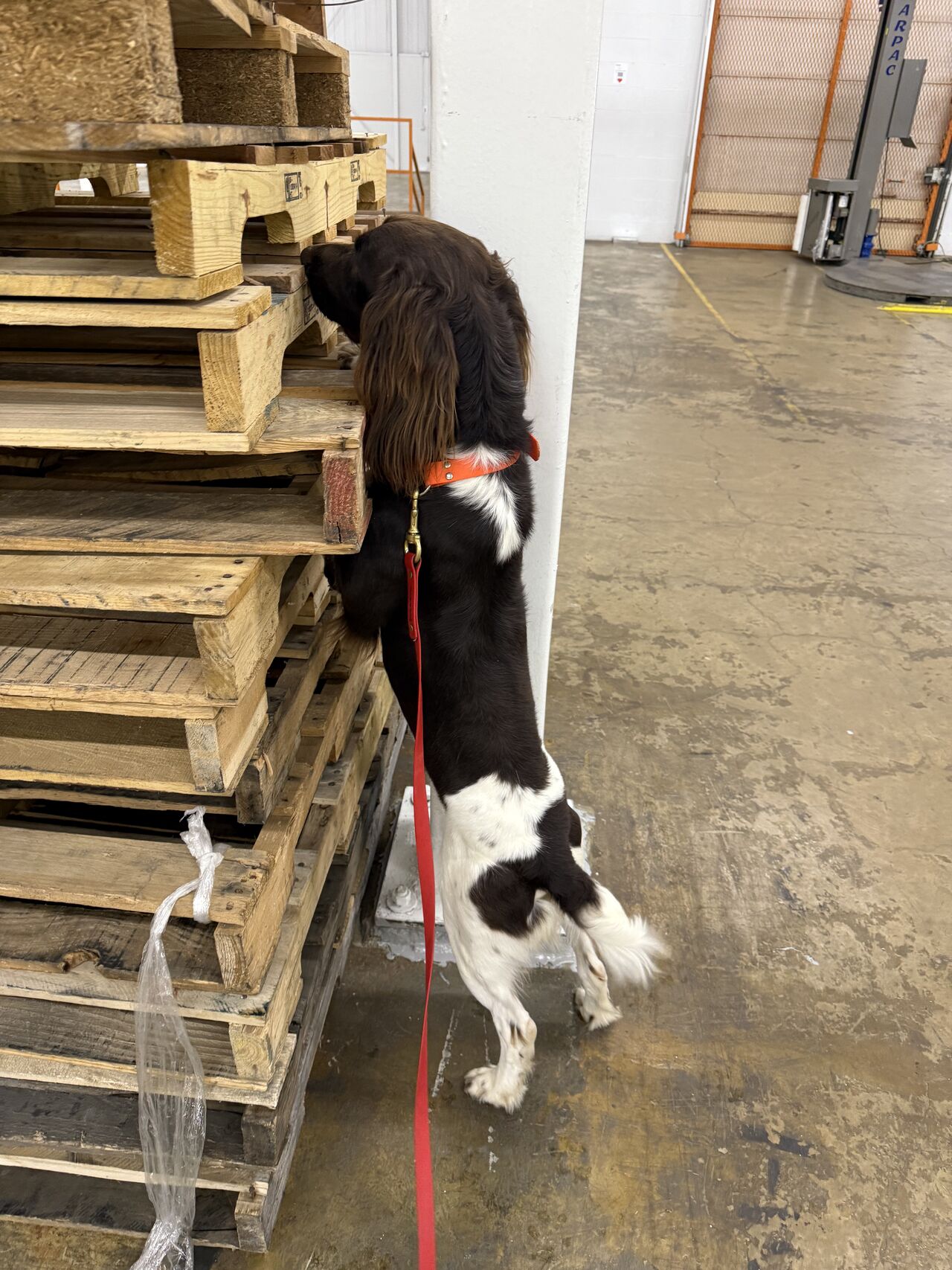
Columbia does not have one rodent problem. It has four or five, layered on each other, and they do not answer to the same fix. A Main Street kitchen, a hospital dock, a bungalow from 1905 cut into four units and a student rental off campus each fail in a different place.
Which is the argument for finding before treating. A trap set in the wrong cavity catches nothing, and for three weeks nothing looks like progress. Trapping, baiting and structural repair belong to rat and mouse control. This page is the other half of the job, K-9 rodent detection.
Why does Columbia’s commercial core drive most of this work?
Health Care and Social Assistance is Richland County’s largest employment sector at 33,974 jobs, 15.3 percent of everyone employed here; Accommodation and Food Services follows at 21,045, or 9.5 percent. The two overlap physically in a compact downtown, and both run buildings that never fully shut.
One hospital runs a production kitchen, a receiving dock, linen handling, soiled-utility rooms and a waste compactor, all live at three in the morning. Prisma Health Richland carries 641 beds plus 124 at the affiliated Heart Hospital and is the Midlands’ Level I Trauma Center. There is no window in which somebody pulls equipment off a wall to look behind it, which shapes our healthcare and senior living program.
Food service is that problem shrunk down and repeated a few hundred times. Grease interceptors, dish pits, dry storage and shared refuse corrals behind buildings that back onto one another decide whether a whole block has rodents or one address does. In the Congaree Vista, much of it renovated warehouse space turned into shops and restaurants, party walls make a single-suite finding rare.
Volume arrives in bursts too: banquet catering at the 142,500-square-foot Columbia Metropolitan Convention Center, or Fort Jackson, 52,000-plus acres with about 3,500 civilian employees and 43,000 service members trained a year, annexed in 1968.
What does a detection dog give you, and what will it never give you?
One thing: location. Bait stations and traps sample, reporting only on animals that cross the twenty-odd points a person selected. A dog does not sample. Handler and dog move at walking pace along wall bases, floor junctions, equipment plinths, pipe chases and stacked goods, reading odor that escapes cavities no camera reaches, in occupied space, without cutting an exploratory opening in anybody’s drywall.
Now the part this industry leaves out. An indication marks where odor has collected, not where an animal is standing, and never how many there are. Odor drifts and settles at the bottom of a shaft, so three alerts on one wall may be one rodent or six. Nor can a dog name a species from scent; that comes from dropping shape and sign height.
A further limit, which we publish. Field validation for scent detection dogs is strongest in bed bug work and conservation biology; structural rodent detection has far thinner support. So no accuracy percentage appears anywhere on this page — we hunted for a study that would survive hostile questioning and found none. Reasoning on our canine scent detection accuracy page. Kimberly Camera, who founded this company, spent twenty-eight years in scent detection and came out of FEMA Urban Search & Rescue.
What happens to a 1905 house once it holds four tenants?
Seventeen National Register historic districts sit inside the city limits, and almost all the housing in them was built for one family per address. A large share now takes rent, by the unit or by the room, and that conversion is where the residential work lives.
Subdividing an old house means a second kitchen upstairs: supply lines, a drain, a gas run, a vent through the band joist, a mini-split line set through an exterior wall. Each job was done by a different trade in a different decade, and none were thinking about a mouse.
Foundations matter as much as plumbing. Pre-war Southern housing of this type characteristically rests on brick piers with a curtain wall between them over a vented crawl space — a regional pattern, not a Columbia statistic, since no source gives a slab-versus-crawl split for this county. A crawl space with a rusted vent covering and an original sill plate is where to start.
Granby Mill Village
Mill built in 1896 and 1897, with 97 contributing buildings and operatives’ housing on a New England saltbox model. Small footprints, low floor systems, porches enclosed and re-enclosed over a century. Shallow crawl spaces discourage inspection and reward harborage.
Melrose Heights–Oak Lawn–Fairview
At 607 contributing buildings, the largest district by count: a streetcar suburb with a concentration of airplane bungalow cottages. Deep eaves and mature street trees put the roofline within reach.
Elmwood Park, Waverly and Forest Hills
Elmwood Park counts 219 contributing homes of 279, platted by auction in 1905; Waverly holds 132 from about 1898 to 1925; Forest Hills has 215, most after 1927, with multi-gable roofs full of valleys. Shotgun and foursquare plans give long uninterrupted floor and ceiling runs.
Columbia Historic District I
Nine contributing buildings, all antebellum, on Arsenal Hill. In fabric of that age nothing gets cut or drilled speculatively, which is exactly where a non-destructive screen earns its fee.
Which of the three species is it, and how do you read the evidence?
The animal itself stays out of sight, so identification is forensic. Three commensal species live here, each on its own vertical plane, and calling the wrong one costs you two weeks.
| Species | Field marks | Where sign turns up | What it changes |
|---|---|---|---|
| Norway rat | Blunt muzzle, small ears, short tail; droppings to three-quarters of an inch, blunt ended | Ground plane — burrow mouths at slab edges, under stoops and dumpster pads | Burrow work and sealing at grade lead. Needs water daily, and is wary enough of new objects to make pre-baiting mandatory |
| Roof rat | Pointed muzzle, big eyes, an ear long enough to fold over the eye; droppings near half an inch, tapered | Overhead — attic insulation, top plates, ductwork, and the limbs and cables leading there | Everything moves to the roofline: soffit and gable vents, roof junctions, tree clearance |
| House mouse | About half an ounce, oversized ears; droppings near a quarter inch, rice-shaped, scattered | Everywhere in small amounts — drawer backs, toe kicks, appliance cavities, dry attics | Trap density decides it. Home range is ten to thirty feet across, so two traps under a sink accomplish nothing |
Species detail sits in our Norway rat, roof rat and house mouse profiles. Impostors come first, though. Flying squirrels nest in cavities and move after dark, which is why they get reported as rats, and the eastern gray squirrel is a game animal in this state. More in the pest library.
Why does the roof rat deserve extra attention in the older neighborhoods?
Because the streetcar suburbs were planted, and a century on the planting has grown into a road network. Honesty marker first: nobody publishes a roof rat survey for Columbia, so what follows describes habitat and behavior, not a population claim.
The behavior is well established. Roof rats climb by preference and nest above ground, travelling limbs, fence tops, cables and any continuous horizontal surface, with a documented US range across the lower East Coast and Gulf states. Canopy touching a roof is a bridge, and so is an overhead service drop. A porch roof tied in at a lower pitch is a staircase.
So a roof rat job barely resembles a Norway rat job, and nothing is solved at ground level. The productive work is at height: guarding gable and soffit vents, closing the junction where an addition meets the original box, capping chases at the top plate, cutting limbs off the roof. Sign is overhead too.
Do the rivers and the sewer network actually move rodents around?
They do, and the way to say so is carefully. Columbia sits where the Saluda and the Broad join to form the Congaree near the Fall Line, and the Congaree runs about 53 miles on to the Wateree. The Columbia Canal, dug between 1820 and 1824 and rebuilt by 1891, was breached in the catastrophic flooding of early October 2015; as of February 2024 the repair was still in planning.
What matters is not the water but the edge. A riparian corridor is a continuous strip of cover, food and moisture running through a built-up area, and Norway rats use it the way roof rats use branches. Flooding pushes burrowers off low ground onto whatever sits above it.
Buried infrastructure is the other half. The city entered a federal Clean Water Act consent decree on 10 September 2013, committing to rehabilitate the sanitary sewer system over twelve years at an estimated $750 million to address overflows. Good for a river, a temporary complication for rodent work: open trench, relined mains and replaced laterals disturb established burrow systems and push animals elsewhere. A missing cleanout cap, an unplugged lateral or a floor drain with a dried trap connects a sewer directly to a kitchen. What we will not give you is a rat count for those sewers, because nobody has one.
How small does an opening have to be before it counts?
Smaller than the number in your head. Coins are the shorthand: an opening the width of a dime admits a house mouse, one the width of a quarter admits a rat. Written as a specification, that is a quarter inch where mice are the target and half an inch where rats are. A door with half an inch of clearance beneath it, UC IPM points out, is a rat door.
The residential code reaches the same threshold from another direction. Section R408.2 of the International Residential Code holds the covering over an under-floor ventilation opening to a least dimension of a quarter inch, then names what satisfies it: cast-iron grilles, extruded brick vents, hardware cloth woven from 0.035-inch wire upward, perforated sheet metal at 0.070 inches, expanded metal at 0.047. A vent meeting that standard is doing exclusion for free; a rusted one is a defect and a doorway at the same time, and in the historic districts they are usually original.
- Mesh: half-inch hardware cloth at 19 gauge against rats, quarter-inch at 24 gauge against mice, woven either way. Welded mesh separates at the joints under sustained gnawing.
- Sheet metal: 24 gauge minimum, 22 where a surface takes abuse. Masonry patches want two inches of reinforced concrete or properly mortared brick.
- Doors: threshold gap held to a quarter inch, with a sweep closing to an eighth at each corner, which is where sweeps fail and nobody checks.
- Copper mesh: packing behind a rigid cap, never the barrier alone. Unlike steel wool it does not rust into a soft plug in one wet season.
- The sill plate line: the highest-yield hour on any old Columbia house, because every water, waste, gas and refrigerant penetration ever installed crosses it.
- Expanding foam: fine for air sealing, useless against teeth.
To stop burrowing structurally: a curtain wall 36 inches below grade, an L-footing returning a foot outward, or a two-foot gravel band. Our exclusion and repair crew builds to those figures.
Why is rodenticide the wrong opening move in a dense neighborhood?
Two reasons, and the first concerns animals you never meant to harm. Secondary poisoning is documented, not speculative. Cornell researchers writing in Ecotoxicology in 2022 screened 72 red-tailed hawks in New York and reported anticoagulant residue in 68 percent of them. USGS work on 40 barred owls from Oregon and Washington turned up at least one anticoagulant compound in 48 percent. Neither dataset is Southeastern, and we looked for regional raptor monitoring without success, so take both as evidence of a mechanism rather than local prevalence. Anticoagulants kill slowly. They leave a rodent alive and conspicuous for several days, which makes it the easiest thing a hawk, an owl or a household pet will find that week.
The second reason is selfish, and it explains why bait and detection do not mix. Poisoned animals die inside cavities and behind stored goods, which buys a fortnight of odor complaints and confirms nothing at all. Bait also wipes out the fresh sign a canine screen gets verified against.
None of that makes rodenticide illegitimate. In licensed hands it belongs outdoors, in numbered tamper-resistant housings drawn on a plan, once the envelope is understood. One consumer-side change is worth knowing: the EPA’s rodenticide risk mitigation decision took brodifacoum, bromadiolone, difenacoum and difethialone off the shelf for homeowners.
Which remedies should you stop paying for?
- Ultrasonic and electronic repellers. The Federal Trade Commission took enforcement action against six companies from 1985 to 1997, and in May 2001 wrote to over sixty firms making or retailing ultrasonic pest devices. UC IPM puts it just as plainly: hardly any evidence supports sound, magnetism or vibration clearing an established mouse population.
- Peppermint oil and botanical repellents. Nothing from an extension service or a regulator endorses peppermint oil in structural rodent work, and we did check, so we neither sell nor advise it. That is not a claim of disproof. It means nothing we would cite endorses it.
- Unattended glue boards. Adults often sense a board and step around it, per UC IPM, so the tray collects juveniles while the breeding animals go untouched. Non-target lizards, snakes and songbirds end up stuck to them as well.
- A single round of bait. Norway rats raise four to six litters annually, each of six to twelve young, and start breeding at roughly three months; house mice raise five to ten litters and start at six to ten weeks. One pair that survives, or one gap nobody closed, rebuilds the whole population inside a season.
- The fire percentage in every rodent brochure. A number circulates in this trade assigning rodents some share of fires whose origin was never determined. We traced it to a state fact sheet that cites nobody, found nothing resembling it at the NFPA or the US Fire Administration, and therefore print no version of it. The defensible point needs no figure: incisors grow roughly five inches a year, and chewed wiring turns up constantly in an old infestation.
Does a longer warm season downtown change the rodent calendar?
It does, and the state climatologist’s own station data lets us show it rather than assert it. Columbia Metro Airport records a last spring freeze around 1 April, a first fall freeze around 13 October, 236 freeze-free days. Columbia University of SC, downtown, records 26 February and 26 October — 261 freeze-free days. That 25-day difference between two stations in one city is the closest thing to a measured urban warmth signal available without citing a heat-mapping study we could not verify exists. Rodents breed longer where it stays warmer.
Richland County averages a mean of 66.5 degrees F and about 76 days a year above 90. Heat cuts both ways: published work has Norway rat breeding peaking in spring and autumn, slowing through high summer, often halting in winter.
Late February into April
Downtown, freeze risk is over by the end of February, weeks ahead of the airport date, and the spring breeding peak arrives with it. Burrow entrances show along foundations before ground cover thickens.
May through August
Heat suppresses breeding while food outdoors is everywhere, so the pressure shifts outside: patio dining, refuse corrals, fruit trees. Interior calls fall away and people decide it fixed itself. It moved.
September through November
The annual spike. Cool nights and vanishing food outside coincide with autumn breeding, somewhere between the two first-freeze dates, and climbing rodents head for attics once the canopy opens up.
December through February
Whatever got in is obvious by now: noise overhead, droppings in a pantry, torn insulation, chewed cable. An occupied heated building is habitat all year, and winter does not pause breeding in one.
The sealing window is therefore August into early October: screen, then close, before the weather decides for you.
What can a Columbia renter actually do about it?
More than most tenants think, provided the documentation is right. In a majority-renter city this is a communication problem as much as a technical one. Columbia is 45.5 percent owner-occupied, so 54.5 percent of its 53,076 households rent, at a median gross rent of $1,204. Countywide, 80 percent of residents lived in the same house a year earlier, so roughly one household in five moves each year — and every turnover is a chance to inspect an empty unit that nobody takes.
The legal position, stated exactly: section 27-40-440 of South Carolina’s Residential Landlord and Tenant Act requires a landlord to meet housing codes materially affecting health and safety and to keep the premises fit and habitable. It never mentions pests, vermin or extermination, and section 27-40-510 on tenant obligations is silent too. No statutory deadline, no allocation of cost.
City requirements we will not summarize, because we could not read them. Columbia’s code sits on a platform that returned no usable text by any route we tried, and asserting that an ordinance exists, or that none does, would be invention.
Evidence fills that gap. A dated, photographed report naming where live activity is, identifying species from physical sign and listing the openings that must close turns an argument about noise into a document. It also settles the commonest dispute in a multi-unit building: shared cavities and plumbing chases connect units, so activity in your kitchen often starts two doors down. Hence our multifamily and property management program, and why some owners want an inspection from a firm that is not quoting the repair — see independent canine detection.
How does a screen run, from the phone call to the re-check?
Scope agreed in advance
Which structures and which floors, whether it is safe to enter an under-floor space, whether a kitchen has to be covered between services, and who gets the report.
Outside on foot, before anything else
Grade line, piers and curtain wall, stoops, crawl vents, weep holes, utility trenches, refuse enclosure, and every limb and cable reaching the roof, photographed first.
The dog covers the structure
A repeatable pattern across wall bases, floor junctions, cabinet kicks, chases, mechanical rooms and stored product. We stop before fatigue degrades the work, and decline conditions too hot for a dog.
Human confirmation at every indication
Targeted inspection wherever the dog alerted: rub marks, gnawing, urine staining, droppings, nest material, and where it helps a borescope pushed through a gap that is already there. Early activity leaves almost nothing visible, and that is the case a dog gets brought for.
Species named, then mapped
Dropping dimensions and end profile, sign height, grease marks and gnaw pattern fix the trap layout and the sealing order. You receive annotated photographs showing every opening that must close and the material that closes it.
Clear, seal, re-screen
Interior trapping runs first and envelope sealing follows, so nothing live is shut inside a wall. Then the dog works the building again.
What is included in a Columbia canine rodent inspection?
- A certified handler and dog working a repeatable pattern, outside and in
- Screening of wall voids, ceiling planes, chases, crawl spaces and stored product
- Hand verification of every indication before anything is recommended
- Species called from droppings and sign height, plus an entry-point map keyed to mesh, gauge and door-sweep specification
- Harborage and sanitation findings, dated and photographed for an owner, a tenant, an insurer or an auditor
- A re-screen once remediation is finished, no matter who carried the work out
Which Columbia operations need this on paper rather than just done?
Restaurants, bars and institutional kitchens. Get the regulator right, because much published advice has not caught up. Responsibility for inspecting retail food establishments in this state passed to the South Carolina Department of Agriculture on 1 July 2024, the day DHEC divided into the Department of Public Health and the Department of Environmental Services. SCDA covers roughly 24,000 establishments under SC Regulation 61-25, scoring out of 100, an A being anything above 87. Any competitor page still crediting DHEC tells you the year it was written. See restaurant and food service.
Hospitals, clinics and senior living. The county’s largest employment sector and the least forgiving place to work. Patient areas cannot be evacuated, product application is constrained, and the sensitive rooms cannot be disturbed: sterile processing, pharmacy, dietary, materials management. A canine screen applies nothing, which is why it fits.
Student housing and off-campus rentals. USC enrolled 38,504 students on the Columbia campus in fall 2024 against 9,243 assignable on-campus beds, putting roughly three quarters of the student body into private apartments and rented houses in the neighborhoods above. Add the late-night food economy serving them and kitchens, dumpsters and old buildings concentrate in a few blocks. See our schools and student housing program.
Hotels and banquet venues carry the same risk on one back-of-house spine of kitchen, store, dock and refuse handling, which is the shape our hotel and hospitality program is built around. Operators with several sites, or anyone answering to a customer audit, run on this identical methodology — see nationwide K-9 rodent detection — with a written program, a site drawing carrying uniquely numbered device locations, service reports and closed-out corrective actions. We quote no SQF, BRCGS or AIB clause numbers, because a wrong clause in front of a quality manager is worse than none.
Who is licensed to do rodent work in South Carolina?
Licensing sits where most people do not expect it. Applicators and pest control businesses answer to the Clemson University Department of Pesticide Regulation — a land-grant university rather than a state agriculture department. Structural work falls under Category 7A: industrial, institutional, structural and health-related pest control.
A commercial firm must hold a DPR business license, designate a Certified Applicator at every location it works from, and carry general liability cover of at least $100,000 combined single limit with no deductible above $1,000. Ask any company in your building for both.
Which parts of the Midlands do we cover?
Coastal K-9 & Pest Solutions · 320 Wendy Lane, Windsor, SC 29856 · 803-226-3155 · Kim@ck9ps.com
Within the city we cover downtown and the Main Street corridor, the Congaree Vista, Arsenal Hill, University Hill, Shandon and Old Shandon, Rosewood, Heathwood, Forest Hills, Wales Garden, Melrose, Elmwood Park, Cottontown and Bellevue, Earlewood, Eau Claire, Hyatt Park, Historic Waverly, Druid Hills, Kilbourne Park, Lake Katherine, Granby Hill, Olympia, Whaley Street, Celia Saxon, Lincoln Park and Greenview. Beyond the limits we work Cayce, West Columbia, Irmo, Lexington and the Fort Jackson side of town. See every area we serve.
Buildings here rarely need one thing only. K-9 bed bug detection in Columbia covers lodging, student turnover and senior living; bird control in Columbia handles roosting on roofs, ledges and signage; goose control in Columbia addresses pond and turf pressure.
Frequently asked questions
If the dog alerts three times, does that mean three rats?
No. An alert marks a concentration of odor, and odor travels. It moves on air currents, pools in low points and leaks from a cavity some distance from where the animal sits, so several alerts on one wall are often one animal. Numbers come later, from trap catch.
Can you screen a working kitchen without shutting it down?
Usually. Nothing is applied on a detection visit, so no exclusion period applies and no room has to be cleared of food or people. We work between services or after close, and settle in advance how a finding inside a production area gets passed to your manager.
DHEC does not exist any more. Who scores my restaurant now?
The South Carolina Department of Agriculture. Retail food inspection moved there on 1 July 2024, when DHEC was split into the Department of Public Health and the Department of Environmental Services. SCDA inspects around 24,000 establishments under SC Regulation 61-25, on a 100-point scale where above 87 earns an A.
I rent half of an old house. Is this the landlord’s problem or mine?
Legally it is less clear than it should be. The Residential Landlord and Tenant Act obliges a landlord to keep premises fit and habitable, but section 27-40-440 never mentions pests, and the tenant obligations section is silent. In practice what moves a landlord is a dated, photographed, independent report.
Will the dog work a crawl space under a pier foundation?
Often from outside first. A crawl space leaks odor continuously through its vents and hatch, so a dog can usually read it from the perimeter. If the space is dry, tall enough and safe, the team goes in. If it is not, a technician crawls it with a light and a camera and works only the points the dog marked.
Something runs across my ceiling after dark. Is that automatically a rat?
No, and identifying it first saves money. Southern flying squirrels are nocturnal cavity nesters and sound almost identical through a ceiling, and eastern gray squirrels are a game species with separate handling rules. Timing helps: squirrels are loudest at dawn and dusk. We confirm from droppings, never from noise.
Why does this page not carry an accuracy percentage?
Because we could not find a study behind one. Canine detection has genuine published validation in bed bug work and conservation research; rodent detection inside structures has far less. Borrowing a figure from a different application and target odor would be marketing dressed as science.
Do you do the repairs, or only tell me where the problem is?
Both, and deliberately separate. Detection yields the map; rat and mouse control covers trapping and clearance; the repair crew builds exclusion to the dimensions set out above. One contractor suits some clients. Others would rather the inspection stayed independent of whoever prices the repair.
Related services
Get the locations before you spend another month guessing
Tell us the building, what has been heard and where sign has appeared. A certified team works the structure, confirms each alert by hand, names the species and marks every opening that has to be shut. Serving Columbia and the Midlands from Windsor.