
Spider Control in Aiken, Augusta & the CSRA
Spider control works when you strip out webs and egg sacs, cut off the insects spiders feed on, seal the gaps they walk through, and treat harborage directly instead of spraying open surfaces. Coastal K-9 & Pest Solutions handles spiders across Aiken, North Augusta, Graniteville, Augusta and the Midlands — including widow work in barns, sheds and crawl spaces.
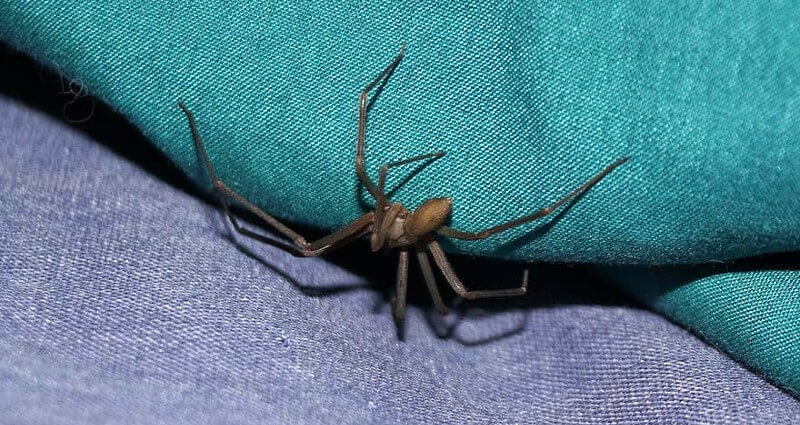
Spiders are the pest people ask us about with the most dread and the least accurate information. Almost every call starts the same way: someone found a fast brown spider in a laundry basket or a garage corner, searched the internet, and is now convinced it was a brown recluse. In the overwhelming majority of cases in Aiken, North Augusta, Graniteville, Columbia and the surrounding towns, it was not.
What is true is that this region grows spiders extremely well. The Sandhills give us deep, fast-draining sand and pine straw beds that hold enormous numbers of ground insects. Our frost-free window runs from roughly late March to mid-October, so prey insects are available for more than seven months a year. Add crawl spaces under century-old houses, barns and tack rooms across Aiken's horse country, boat houses on Lake Murray and the Savannah River, and you get a landscape built for web-builders and hunters alike. Our job is to reduce that pressure honestly — without pretending we can make a Southern property spider-free, and without selling you a fear that isn't supported by the evidence.
What actually works for spider control?
Four things, in this order: physical removal, harborage reduction, exclusion, and targeted treatment into the places spiders actually sit. Everything else is theater.
Physical removal comes first because it is the only step with an immediate effect. Purdue Extension is blunt about it — sanitation is the most practical method of spider control, and that means vacuuming webs with the egg sacs still in them. University of California IPM notes that a spider's soft body usually does not survive the tumbling trip through a vacuum hose. A single common house spider female can produce a dozen or more egg sacs in her life, each holding between 140 and 380 eggs, and she abandons webs and rebuilds nearby constantly. That is exactly why de-webbing has to be recurring rather than one-and-done, and it is why a property that gets de-webbed on a schedule looks and feels different from one that only gets sprayed.
Harborage reduction is the part homeowners control. UC IPM's guidance is to keep the band of ground next to the foundation free of trash, leaf litter, heavy vegetation and stacked material. Indoors, that means boxes up off the floor and away from walls in garages, sheds and storage rooms. In practice, in this region, it means the firewood stack against the back wall, the pile of flower pots beside the hose bib, the tarp folded on the ground behind the shed, and the stack of feed bags in the tack room. Those four things generate more widow calls in Aiken County than anything else we see.
Exclusion is what makes the result last. Caulking cracks in the foundation, sealing around window and door frames, repairing screens and trimming vegetation off the siding all reduce the number of spiders that get inside — and, just as importantly, reduce the number of insects that get inside for them to eat.
Targeted treatment goes last, and it goes into cracks and voids, not across open floors. University of Minnesota Extension states plainly that surface treatments and fogs are not effective and that material should instead be placed in cracks, gaps and the other places spiders hide. UC IPM goes further, cautioning that insecticides will not provide long-term control outdoors and that spraying is only temporary unless it is paired with housekeeping. We agree with both, and we build the service that way.
Which spiders do we actually have in Aiken, Augusta and the Midlands?
Knowing the species changes the work. A widow in a meter box is a removal-and-harborage job. An orbweaver on a porch column is a de-webbing job. A wolf spider in a hallway in November is an exclusion job. Treating all three the same way is how companies end up spraying baseboards for a spider that never touches a baseboard.
Southern black widow
Latrodectus mactans. The one genuinely medically significant spider in this service area. Shiny black female with a complete red hourglass underneath, roughly a half-inch body. Irregular, tangled cobweb close to the ground — woodpiles, rock piles, hollow stumps, meter boxes, crawl space piers, under the lip of a stacked flower pot. Egg sacs are smooth, beige, about a half-inch across, with roughly 220 eggs each. Indoors, in a garage or crawl space, activity can continue straight through winter uninterrupted by cold. More on black widows in our pest library.
Brown widow
Latrodectus geometricus. Gray to brown with an orange-to-yellow hourglass and dark bands on the legs. Clemson reports it as established in parts of South Carolina. The easiest field identification in all of spider work is the egg sac: brown widow sacs are covered in pointed projections, “much like the seed of a sandspur,” while black widow sacs are smooth. Venom is comparably toxic but the spider is far less inclined to bite or defend its web.
Wolf spiders
Family Lycosidae. No web at all — they hunt on the ground and react to vibration. Some species reach two inches in body length, which is why they generate a lot of phone calls. Their eyes reflect a flashlight beam at night, which is a genuinely useful way to survey a yard. Clemson notes that before winter, wolf spiders may wander into homes and simply stay for the duration of the cold weather. They do no harm to people or structures.
Common house spider
Parasteatoda tepidariorum. The species behind most of the cobwebs in corners, window frames, floor joists, basements and crawl spaces. Females abandon webs and rebuild nearby repeatedly, so a single spider can produce several derelict webs in a week. Bites are minor and short-lived. This is the primary reason de-webbing is a maintenance task and not a one-time fix.
Cellar spiders
Pholcus species. Long-legged, hanging upside down in loose, messy webs in damp crawl spaces, basements and garages. Clemson's control list for them is exactly the list we work from: vacuum the webs, reduce the insect food supply, lower the humidity, switch to yellow exterior lighting and seal entry points. Often confused with harvestmen, which are not spiders at all.
Orbweavers — including the Joro
Yellow garden spiders (Argiope aurantia) are adults from July through October, sitting at about knee height in a web with a zig-zag ribbon down the middle. The Joro spider (Trichonephila clavata), first found near Athens, Georgia in 2014, is now documented across Georgia, South Carolina, North Carolina and Tennessee. Females are bright yellow with bluish-green banding, webs reach roughly two feet across with anchor lines running several feet, and they build at eye level or higher on porches, eaves and power lines. Clemson is unambiguous: Joros are docile, far more likely to run and hide than to bite, and their venom is not medically relevant to people or pets.
Fishing spiders
Dolomedes species. Large, brownish-gray, banded legs. Despite the name, D. tenebrosus is more associated with wooded areas than water and commonly comes indoors. Active May through September, with egg sacs deposited in June and carried by the female. These are the spiders that turn up in dock boxes, boat houses and lake cabins on Lake Murray, the Congaree, the Saluda and the Savannah River.
Jumping spiders
Family Salticidae. Small, stout, active in daylight, with a front pair of enormous eyes and the best vision of any spider. They hunt houseflies, beetles and stink bugs indoors and out. Clemson's recommendation is a cup and a piece of paper, not a pesticide, and we agree — these are beneficial and harmless.
Do we have brown recluse spiders in South Carolina?
This is the single most important question on this page, and the honest answer is not the one most pest control websites give.
A peer-reviewed study published in the Journal of the American Board of Family Medicine in 2007 documented every verified brown recluse specimen collected in South Carolina from 1953 to 2004. The total was 44 spiders, from six of South Carolina's 46 counties, and every one of them was collected from a man-made structure rather than from natural habitat. Over the same period, South Carolina physicians reported 478 brown recluse bite diagnoses in 1990 and 738 in 2004. The authors concluded that South Carolina's recluse populations are the result of human introductions, are localized, and are unlikely to spread through natural habitat on their own.
Georgia has the same picture, mapped even more precisely. A 2009 study in the Journal of Medical Entomology collected roughly 100 verified specimens from 31 of Georgia's 159 counties over six years, against 963 poison-center bite reports from 103 counties in five years. Nearly every verified specimen came from north of the Fall Line. The authors wrote that brown recluse spiders “are not common in Georgia nor widespread,” and that in the southern half of the state, medical diagnoses of brown recluse bites “have virtually zero probability of being correct.”
Augusta sits on the Fall Line. The CSRA is at the extreme southern edge of even that sparse, patchy Georgia distribution. Aiken County sits on the South Carolina side of the same geological boundary, in the Sandhills. So when someone in North Augusta or Graniteville sends us a photo of a brown spider, the prior probability that it is a recluse is very low before we look at the picture at all.
The other half of the story is medical. A retrospective analysis of 422 emergency-department patients presenting with skin and soft-tissue infections found Staphylococcus aureus — predominantly community-acquired MRSA — responsible in roughly 320 of them, about 76 percent. Separately, work by arachnologist Rick Vetter published in JAMA Dermatology found that roughly 90 percent of genuine brown recluse bites heal on their own, about 10 percent produce tissue necrosis, and fewer than 1 percent cause a serious systemic reaction — and that about 40 different medical conditions are routinely mistaken for recluse bites.
What that means for you. If you have a spreading, painful lesion, the right call is a doctor, not a pest control company — and the most likely cause is a bacterial infection, not a spider. We do not diagnose or treat bites, and we will not sell you a recluse program for a spider that the published record says is almost certainly not in your house. What we will do is identify what you actually have, show you where it is living, and treat that. Our pest library profile on the brown recluse goes into the identification details, including the six eyes in three pairs that separate it from every look-alike.
When is spider season in the CSRA and the Midlands?
There are two service windows that matter here, and they are driven by real climate data. The South Carolina State Climatology Office puts Aiken's median last spring freeze around March 22 and its first fall freeze around October 12; Columbia's stations run from late February to late October depending on which one you use. That is a frost-free season in the range of 230 to 260 days — far longer than the markets most national pest-control advice is written for.
- January–February. Outdoor activity is at its lowest. Southern widows in garages, sheds and crawl spaces keep going regardless of the weather, and wolf spiders that came in before winter are still inside. This is the best time of year to do crawl space and garage work, because the population is concentrated and stationary.
- March–May. The frost window closes. Yellow garden spider spiderlings emerge from overwintered eggs in April and May; Joro spiderlings hatch around the same time and are far too small to notice. Widow mating and egg-sac production ramp up. This is the highest-value treatment window of the year — removing egg sacs in spring prevents the population you would otherwise be fighting in September.
- May–August. Peak prey-insect abundance drives every web-builder on the property. Fishing spiders are active May through September and deposit egg sacs in June. Widow and house spider egg production is at its maximum.
- August–October. The season everyone notices. Orbweavers reach full size, Joros become conspicuous — UGA describes them as most noticeable from August through October — and porches, eaves and shrub lines fill with large webs. Hunting spiders start moving toward structures.
- October–December. Joro egg sacs go up in dense white silk in mid-October and November, holding 400 to 500 eggs each, and the adults die after the first freeze. Wolf spiders make their move indoors. Any gap you have not sealed by now is going to be used.
How our spider service works
We run the same sequence on a 1920s Winter Colony house in Aiken, a slab-built subdivision home in Lexington, and a warehouse in Graniteville. The findings differ; the method does not.
Inspect and identify
We walk the exterior first — foundation line, meter boxes, hose bibs, soffits, porch ceilings, window wells, wood and material stacks — then the crawl space or basement, the garage, and finally the interior rooms where you have seen activity. We identify what you actually have, to species where it matters, and we tell you when a spider is harmless.
De-web and remove
Physical removal of webs, spiders and egg sacs from eaves, porch ceilings, corners, light fixtures, window frames, meter boxes, crawl space piers and outbuildings. This is the step that produces the visible change and the step most companies skip.
Reduce harborage
We identify and, where we can, correct the conditions producing the population: material stacked against the foundation, leaf litter in the bed line, pots and tarps on the ground, firewood against the wall, clutter in the garage. Where the fix is yours to make, you get a specific written list, not a generic pamphlet.
Address the prey and the light
Spiders follow insects, and insects follow light. UC IPM's strongest evidence-based recommendation is to move light fixtures off the structure and away from windows and doors where possible; Clemson recommends yellow lamps over white. We also address the insect pressure directly, because a house with fewer flies, moths and crickets is a house with fewer spiders — over time. It is a slow lever, not a fast one: Purdue notes most spiders can live for months without food.
Seal and exclude
Foundation cracks, gaps around window and door frames, failed screens, crawl space vents, utility penetrations and weather stripping. Where the work is structural, we can handle it through our repairs and exclusion service rather than handing you a list and walking away.
Targeted treatment and follow-up
Material goes into cracks, crevices, voids and harborage — not across open floors and not as a fog. Where non-chemical removal is enough, we use non-chemical removal. We schedule follow-up based on species and season, because a spring egg-sac visit and an October exclusion visit do different jobs.
What is included in a spider service visit
- Full exterior and interior inspection with species identification
- De-webbing of eaves, porches, entryways, light fixtures and window frames
- Removal of widow spiders and egg sacs from meter boxes, piers, stacked material and outbuildings
- Crawl space and garage inspection, including pier bases and vent screens
- Barn, tack room, shed and dock box service where present
- Targeted crack-and-crevice and harborage treatment where warranted
- Written findings with the specific harborage conditions we found, photographed
- Exterior lighting and moisture recommendations
- Exclusion scope for the gaps that are letting spiders and their prey inside
- Scheduled follow-up matched to species and season
Why do spiders come inside in the first place?
Three reasons, and none of them is that your house is dirty.
They followed food. UC IPM's framing is that the more insects there are inside a building, the more likely spiders are to live there. Exterior lighting concentrates flying insects against the wall of your house; those insects get in through the same gaps the spiders do; and web-builders set up exactly where the food is. This is why the porch light above the front door is the single most productive spider location on most properties.
They followed moisture. Cellar spiders and many hunting species want damp. A vented crawl space in the Midlands in July is a humid, dark, insect-rich environment with unlimited harborage under the joists. So is a garage with a leaking hose bib or a bathroom with a slow supply-line drip.
They wandered. Wolf spiders and other hunters do not build webs and are not looking for your house specifically. They are moving, and a quarter-inch gap under a garage door or a failed door sweep is simply the path they found. Clemson notes explicitly that hunting spiders may enter homes accidentally, particularly in the fall.
What does not work
We would rather tell you what to stop buying than sell you the same thing in a branded bottle.
- Total-release foggers and “bug bombs.” A North Carolina State study published in BMC Public Health tested four commercial fogger products across five apartment complexes and found them ineffective indoors. The mechanism is the important part: the aerosol fails to reach the undersides of surfaces and the interiors of cabinets and voids where the target pests actually live, while depositing residue exactly where people and pets spend their time. That study measured cockroaches rather than spiders — we are not going to claim otherwise — but the reason it failed applies directly to a spider sitting in a wall void or under a joist. University of Minnesota Extension reaches the same conclusion for spiders specifically: surface treatments and fogs are not effective.
- Blanket outdoor spraying. UGA advises directly against broad-spectrum insecticide applications over large areas for Joro spiders, because they kill pollinators and the beneficial predators that were suppressing your pest insects for free. UC IPM says outdoor insecticide use will not provide long-term spider control at all.
- Spraying without de-webbing. A treated web is still a web. If the visible result you want is a clean porch ceiling, the tool that produces it is a brush and a vacuum.
- Killing every spider you see. University of Minnesota puts it well: eliminating all spiders from a home is difficult and unnecessary. Jumping spiders and cellar spiders are actively removing your other pests. The goal is to control the species that matter in the places that matter.
Spiders in barns, sheds, crawl spaces and dock boxes
This is where the work in our service area diverges from generic advice, and it is where widow encounters actually happen.
Aiken's horse country. Barns, tack rooms, feed rooms and run-in sheds around the Horse District, the Aiken Training Track, Whitney Field and the Aiken Horse Park are textbook widow habitat: dark, undisturbed, full of stacked material at ground level, and rarely disturbed between seasons. The CDC's own guidance for outdoor workers lists woodpiles, eaves, debris accumulation and outbuildings as the black widow situations to watch. We service barns and outbuildings as part of the property, not as an upcharge afterthought.
Historic and mill-village housing. The Aiken Winter Colony historic districts hold homes built largely between about 1900 and 1930, on masonry piers, with outbuildings and stables. Graniteville's district preserves original mill workers' housing from the 1840s. Old Shandon in Columbia was established in 1893. This is pier-and-crawlspace construction with a century of utility penetrations, and it is where widow and cellar spider harborage concentrates. New subdivisions across the South Atlantic are now roughly 86 percent slab, which is exactly why the crawl space problem is an older-house problem here.
Wooded edges. Hitchcock Woods runs to 2,100 acres of sandy trails directly against residential Aiken; Harbison State Forest sits nine miles from downtown Columbia. Properties on a woodland edge get more wolf spiders, more fishing spiders and more orbweaver activity than properties in the middle of a subdivision, and they need the perimeter handled differently.
Water. Docks, boat houses, dock boxes and lake cabins on Lake Murray, the Congaree, the Saluda, the Broad and the Savannah River collect fishing spiders from May through September. Dock boxes in particular are closed, dark and undisturbed for weeks — a perfect harborage.
How is this different from a traditional exterminator?
| Typical spray-route service | Coastal K-9 & Pest Solutions | |
|---|---|---|
| Identification | “Spiders” as one category | Species-level ID, because a widow, an orbweaver and a wolf spider need three different responses |
| Webs | Sprayed and left in place | Physically removed along with egg sacs — the step that changes what you see |
| Where material goes | Baseboards and open perimeter surfaces | Cracks, crevices, voids and harborage, per UC IPM and Minnesota Extension guidance |
| Outbuildings | Usually out of scope | Barns, tack rooms, sheds and dock boxes included where they exist |
| Recluse claims | Often used to sell a program | We show you the published South Carolina and Georgia specimen data instead |
| Structural gaps | Noted on a form | Repaired through our own exclusion and repairs crew |
Where we work
We are based in Windsor, South Carolina, and we run spider service across Aiken, North Augusta, Graniteville, Vaucluse, Warrenville, Beech Island, Edgefield, Columbia, Lexington, West Columbia, Cayce and Irmo, plus Augusta, Evans and Martinez on the Georgia side. That covers the Horse District and the Winter Colony districts in Aiken, Hammond's Ferry and the Greeneway corridor in North Augusta, the Graniteville and Vaucluse mill villages, Shandon, Old Shandon, Rosewood, Earlewood and the Olympia and Granby mill villages in Columbia, the Riverwalk corridor through Cayce and West Columbia, and the Lake Murray shoreline through Lexington and Irmo. See the full list of areas we serve.
Who licenses spider control in South Carolina and Georgia?
It is worth knowing, because the answer surprises people and because it gives you a way to check any company you are considering.
In South Carolina, pesticide regulation is administered by the Clemson University Department of Pesticide Regulation — the land-grant university, not a state agriculture department. Structural and household pest control falls under Category 7A, Industrial, Institutional, Structural and Health-Related Pest Control. Clemson's own language is direct: if you apply any pesticide in Category 7A to another person's property for compensation, you are a Commercial Applicator and must be licensed. Commercial firms also need a business license from DPR and a Designated Certified Applicator at each location.
In Georgia, structural pest control is regulated by the Georgia Department of Agriculture through the Structural Pest Control Commission under the Georgia Structural Pest Control Act. Companies need a Structural Pest Control Company License, a Certified Operator License and Registered Employee credentials, with Household Pest Control as the relevant operator category.
These are two separate licensing regimes, and no single license covers both states. Ask any company working across the Savannah River to show you both. We are happy to provide ours.
Frequently asked questions
Is it a brown recluse?
Almost certainly not. Verified specimens number 44 in South Carolina across five decades, from six counties, all collected inside man-made structures — against 738 physician-diagnosed bites in a single year. In Georgia, nearly all verified specimens come from north of the Fall Line, and Augusta sits on the Fall Line. If you have the spider, keep it and we will identify it. If you have a lesion, see a doctor: roughly 76 percent of emergency-department cases presenting as spider bites turn out to be Staphylococcus aureus infections, mostly MRSA.
Are Joro spiders dangerous?
No. Clemson describes them as docile and much more likely to run and hide than to bite, with venom that is not medically relevant to people or pets. They build large golden webs at eye level or above on porches, eaves and power lines from August through October, then die after the first freeze. We remove the webs. We do not recommend blanket spraying for them, because UGA advises against broad-spectrum applications that kill pollinators and beneficial predators.
Can you make my house spider-free?
No, and any company that promises it is not being straight with you. University of Minnesota Extension states that eliminating all spiders from a home is difficult and unnecessary. What we can do is remove the webs and egg sacs, clear widows out of the places you reach into, cut the harborage and the prey pressure, seal the gaps, and keep the population at a level where you stop noticing it.
How long before I see a difference?
The de-webbing produces a visible change the same day. The population change takes longer, because spiders survive months without feeding — Purdue notes this specifically as the reason prey reduction is a slow control lever. Expect the first visit to fix appearance, and the follow-up schedule to fix pressure. Spring egg-sac removal is what makes the following September easier.
Do I need to leave the house during service?
Most spider work is inspection, physical removal and targeted crack-and-crevice placement, so in the majority of homes you do not. We will tell you before we start if any part of the visit calls for you or your pets to be out of a specific area, and for how long. We do not fog occupied living space.
Is the treatment safe around children and pets?
We build the visit so that the largest share of the result comes from physical removal, exclusion and harborage work, which involve no product at all. Where we do use product, it goes into cracks, voids and harborage rather than across open surfaces, which is both the more effective placement and the lower-exposure one. Tell us about pets, aquariums, pollinator gardens and anyone in the home with asthma or a chemical sensitivity, and we will plan around it.
What should I do with a spider I find?
If it is on a wall and you want it gone, a cup and a piece of paper works, which is what Clemson recommends for jumping spiders. If you think it may be a widow, do not handle it — photograph it, note where it was, and let us deal with the harborage it came from, because where there is one widow there is usually an egg sac nearby. If you have been bitten and have symptoms, that is a medical question, not a pest control question.
Do you treat barns, sheds and dock boxes?
Yes, and in this service area they matter more than the house. Barns and tack rooms around Aiken's horse country, garden sheds, pump houses, boat houses and dock boxes on Lake Murray and the Savannah River are where widow populations concentrate, because they are dark, undisturbed and full of ground-level stacked material. We include outbuildings in the property scope.
Will changing my outdoor lighting really help?
It helps, and it is the one free change with real evidence behind it. UC IPM's guidance is to move fixtures off the structure and away from doors and windows where possible, since outdoor lighting attracts insects and insects attract spiders. Clemson recommends yellow lamps over white for cellar spiders. Bulb colour is not a cure-all — different insects see different wavelengths — but moving the light source away from the door is consistently effective.
Do you offer ongoing service or one-time visits?
Both. A one-time visit is reasonable for a specific problem — a widow in the meter box, webs before an event, a pre-listing clean-up. Ongoing service is what actually holds a Southern property, because our frost-free season runs seven months or more and web-builders rebuild continuously. Most customers here land on a spring visit for egg sacs and a late-summer visit before orbweaver season, with exclusion work handled once.
Related services
Found a web you would rather not walk into?
Tell us what you are seeing and where. We will identify it, tell you honestly whether it matters, and give you a plan that starts with removing what is there — not with spraying around it. Serving Aiken, North Augusta, Graniteville, Augusta, Columbia and the Midlands from Windsor, South Carolina.